Let $n\ge2$ be an integer. Let $A_1,A_2,\ldots,A_{2^n}$ be all $2^n$ subsets of an $n$-element set, in some order. Prove that
$$|A_1\cap A_2|+|A_2\cap A_3|+\cdots+|A_{2^n-1}\cap A_{2^n}|+|A_{2^n}\cap A_1|\ge2^{n-2}.$$
Let $\mathbb R_+$ denote the positive real numbers. Determine all functions $f:\mathbb R_+\to\mathbb R$ such that for all $x,y,z\in\mathbb R_+$,
$$|x-y|\lt |y-z|\quad\text{if and only if}\quad|f(x)-f(y)|\lt |f(y)-f(z)|.$$
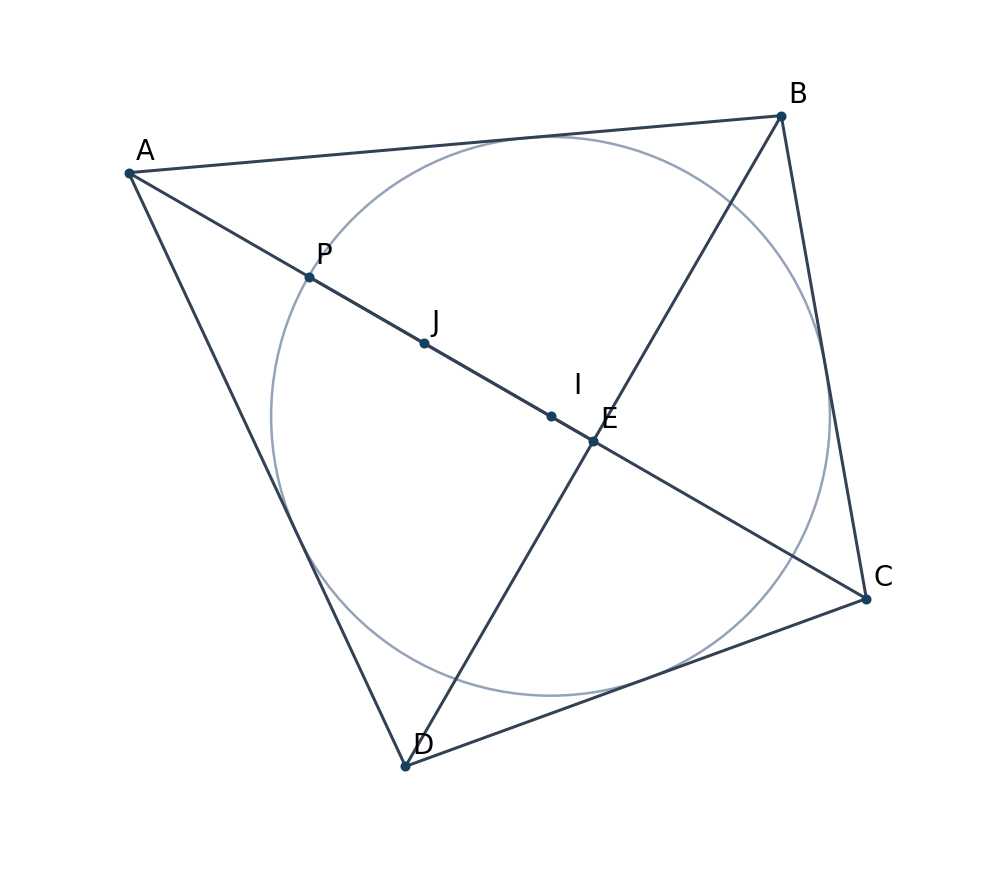
Let $ABCD$ be a quadrilateral with an incircle $\omega$ of center $I$. The diagonals $AC,BD$ intersect at $E$. Let $J$ be the incenter of triangle $ABD$. The extension of ray $EJ$ intersects $\omega$ at $P$. Prove that $PI\perp BD$.
AI-generated configuration using only the given points:
Let $n$ be a positive integer. There are $n(n+1)$ rooms arranged in an $(n+1)\times n$ grid. Every pair of adjacent rooms has a door between them. Find the number of ways to choose a subset of doors to lock such that there exist two rooms $S,G$ satisfying:
1. $S$ is in the first row and $G$ is in the $(n+1)$st row.
2. One can reach $G$ from $S$ using only unlocked doors.
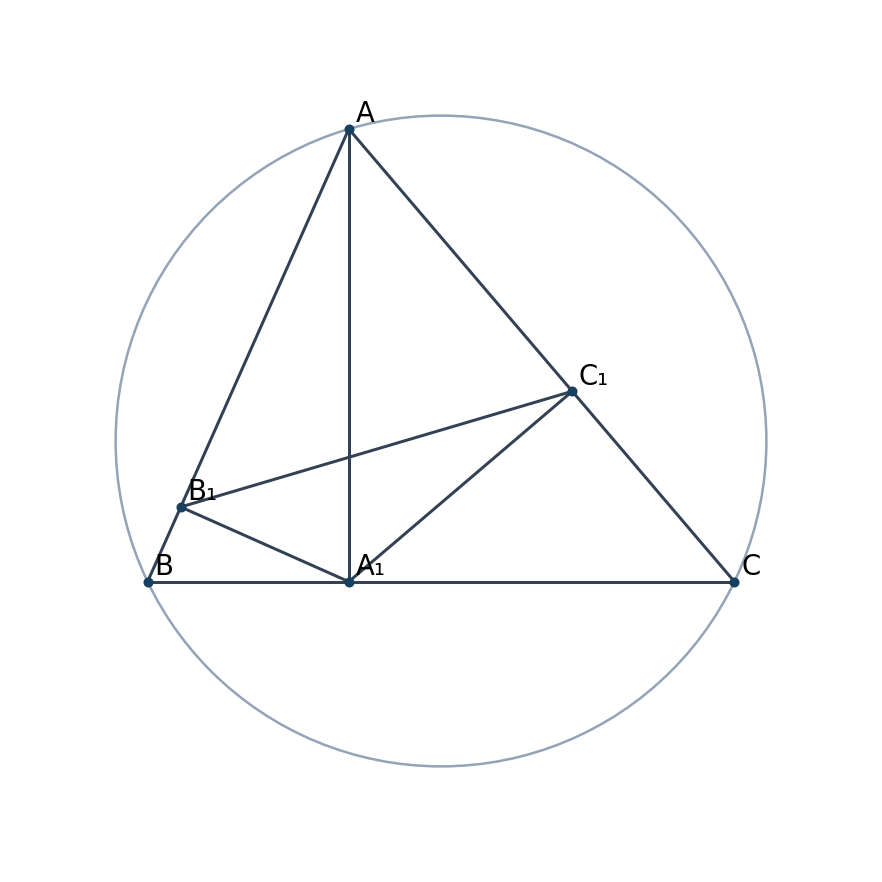
Let $ABC$ be an acute triangle inscribed in a circle $\Gamma$. Let $A_1$ be the orthogonal projection of $A$ onto $BC$, so $AA_1$ is an altitude. Let $B_1,C_1$ be the orthogonal projections of $A_1$ onto $AB,AC$, respectively. Point $P$ is such that quadrilateral $AB_1PC_1$ is convex and has the same area as triangle $ABC$. Is it possible that $P$ lies strictly inside $\Gamma$? Justify your answer.
AI-generated diagram of the given triangle and projections:
Let $\alpha,\beta$ be positive real numbers. Emerald makes a trip in the coordinate plane, starting at $(0,0)$. Each minute she moves one unit up or one unit right, always staying in the region $|x-y|\lt 2025$. Upon visiting $(x,y)$, she writes the integer $\lfloor x\alpha+y\beta\rfloor$ there. She writes each nonnegative integer exactly once. Find all pairs $(\alpha,\beta)$ for which such a trip is possible.
Let $P(x)$ be a nonconstant polynomial with integer coefficients such that $P(0)\ne0$. Let $a_1,a_2,a_3,\ldots$ be an infinite sequence of integers such that $P(i-j)$ divides $a_i-a_j$ for all distinct positive integers $i,j$. Prove that the sequence is constant.
Let $n\ge3$ be an integer. There are $n$ cells on a circle, each assigned $0$ or $1$. A rooster stands on one cell and repeatedly does the following:
- On a cell assigned $0$, it changes the number to $1$ and moves to the next cell counterclockwise.
- On a cell assigned $1$, it changes the number to $0$ and moves to the cell after the next cell counterclockwise.
Prove that after sufficiently many operations the following statement holds: if the rooster is on a cell $C$, it will go around the circle exactly three times and stop again at $C$, with every cell assigned the same number as immediately before these three laps.
Consider an infinite sequence $a_1,a_2,\ldots$ of positive integers such that
$$100!\,(a_m+a_{m+1}+\cdots+a_n)$$
is a multiple of $a_{n-m+1}a_{n+m}$ for all positive integers $m\le n$. Prove that the sequence is either bounded or linear.
A sequence is bounded if there is a constant $N$ with $a_n\lt N$ for every positive integer $n$. It is linear if $a_n=n\,a_1$ for every positive integer $n$.
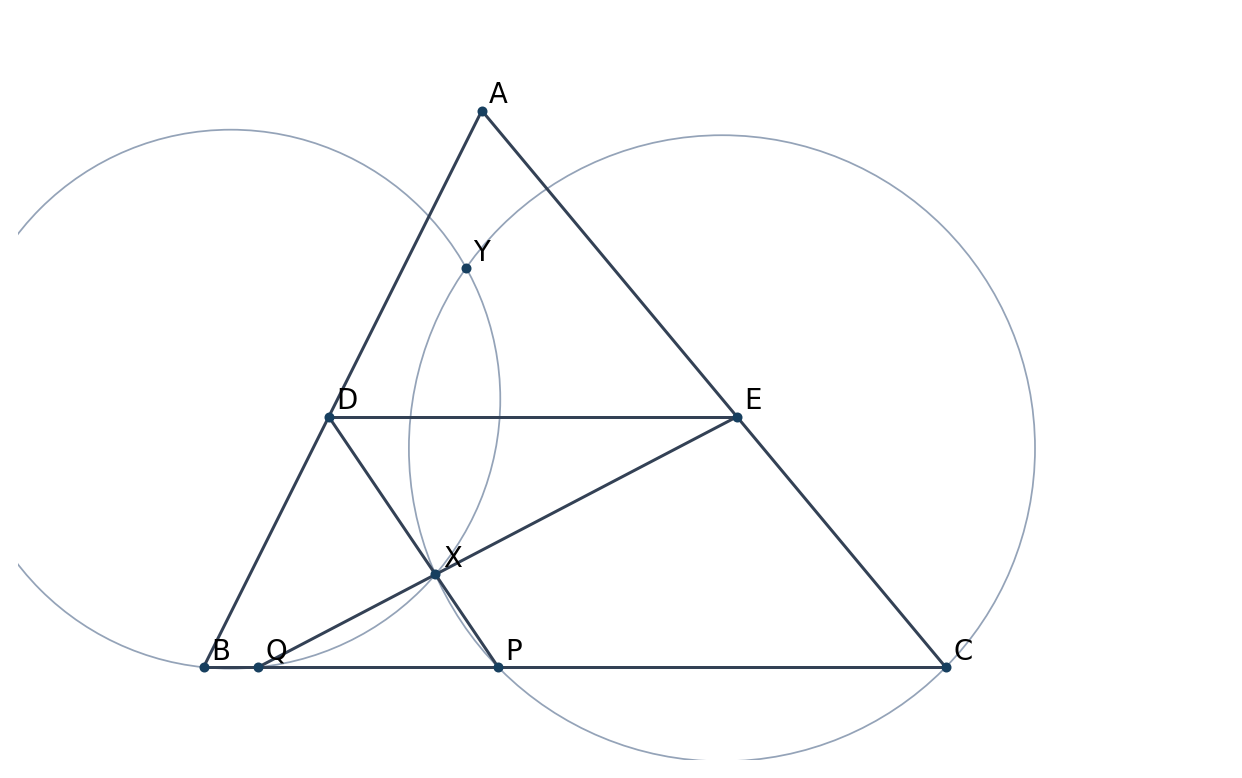
Let $ABC$ be an acute triangle. Let $D$ be a point on side $AB$ and $E$ a point on side $AC$ such that $BC\parallel DE$. Let $X$ be an interior point of $BCED$. Suppose rays $DX$ and $EX$ meet side $BC$ at points $P$ and $Q$, respectively, such that both $P,Q$ lie between $B,C$. Suppose the circumcircles of triangles $BQX$ and $CPX$ intersect at $Y\ne X$. Prove that $A,X,Y$ are collinear.
Consider a $100\times100$ table, and identify its cell in row $a$ and column $b$, $1\le a,b\le100$, with $(a,b)$. Let $51\le k\le99$ be an integer. A $k$-knight moves one cell vertically or horizontally and $k$ cells in the other direction: from $(a,b)$ to $(c,d)$ with $(|a-c|,|b-d|)$ equal to $(1,k)$ or $(k,1)$. It starts at $(1,1)$ and makes several moves. A sequence of moves is a sequence $(x_0,y_0)=(1,1),(x_1,y_1),\ldots,(x_n,y_n)$ such that all cells lie in the table and each successive pair is a legal move. Each visited cell is called reachable. For each $k$, find $L(k)$, the number of reachable cells.
Let $n$ be a positive integer and $a_1,a_2,\ldots,a_n$ positive real numbers. Prove that
$$\sum_{i=1}^n\frac1{2^i}\left(\frac2{1+a_i}\right)^{2^i}\ge\frac2{1+a_1a_2\cdots a_n}-\frac1{2^n}.$$
Prove that for every positive integer $t$ there is a unique permutation $a_0,a_1,\ldots,a_{t-1}$ of $0,1,\ldots,t-1$ such that, for every $0\le i\le t-1$, the binomial coefficient
$$\binom{t+i}{2a_i}$$
is odd and $2a_i\ne t+i$.
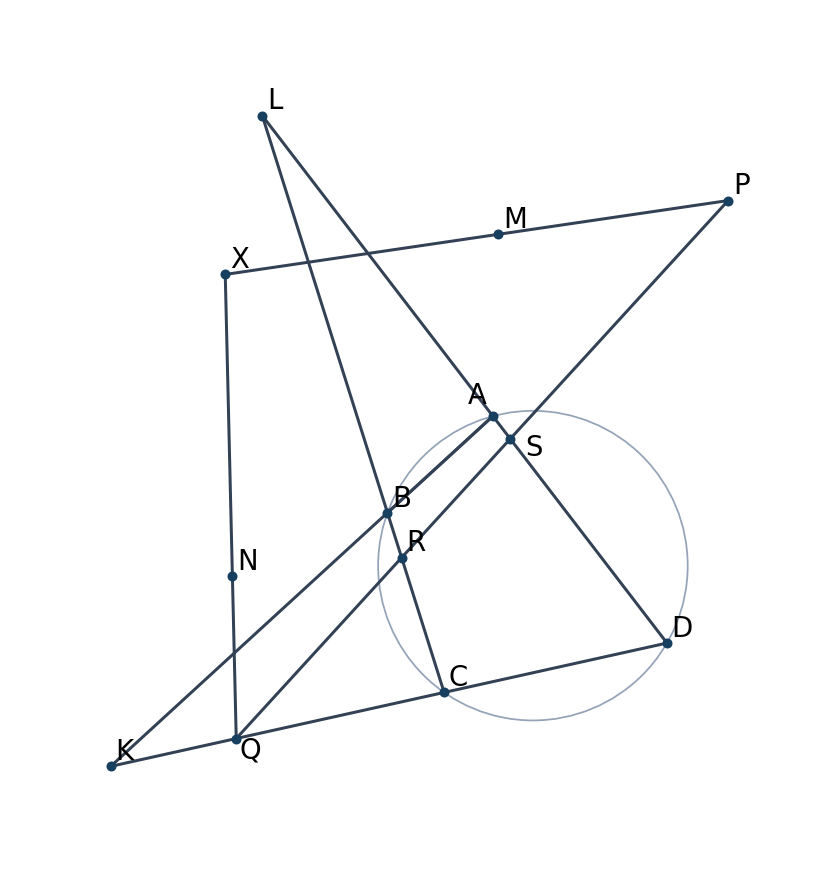
Line $\ell$ intersects sides $BC,AD$ of cyclic quadrilateral $ABCD$ at interior points $R,S$, respectively, and intersects ray $DC$ beyond $C$ at $Q$, and ray $BA$ beyond $A$ at $P$. Circumcircles of $QCR,QDS$ intersect at $N\ne Q$, while circumcircles of $PAS,PBR$ intersect at $M\ne P$. Let $MP$ and $NQ$ meet at $X$, $AB$ and $CD$ meet at $K$, and $BC$ and $AD$ meet at $L$. Prove that $X$ lies on $KL$.
AI-generated configuration (the line $KL$ is not added):
Let $n\ge5$ be an integer. Consider $n$ squares with side lengths $1,2,\ldots,n$, respectively. The squares are arranged in the plane with their sides parallel to the $x$ and $y$ axes. Suppose that no two squares touch, except possibly at their vertices.
Show that it is possible to arrange these squares in a way such that every square touches exactly two other squares.
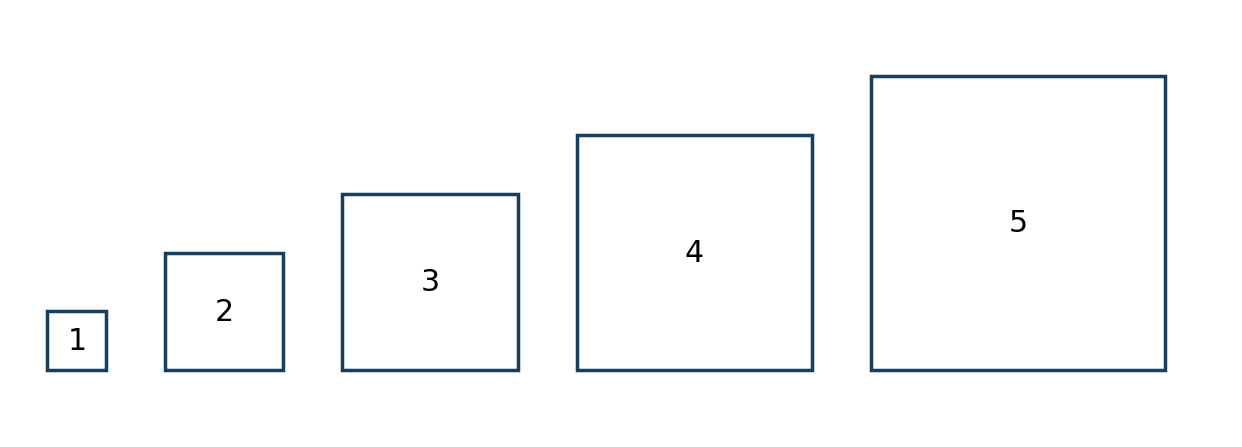
AI illustration of the input squares for $n=5$, before arranging them:
Find all integers $n$ satisfying $n\ge2$ and
$$\frac{\sigma(n)}{p(n)-1}=n,$$
where $\sigma(n)$ denotes the sum of all positive divisors of $n$, and $p(n)$ denotes the largest prime divisor of $n$.
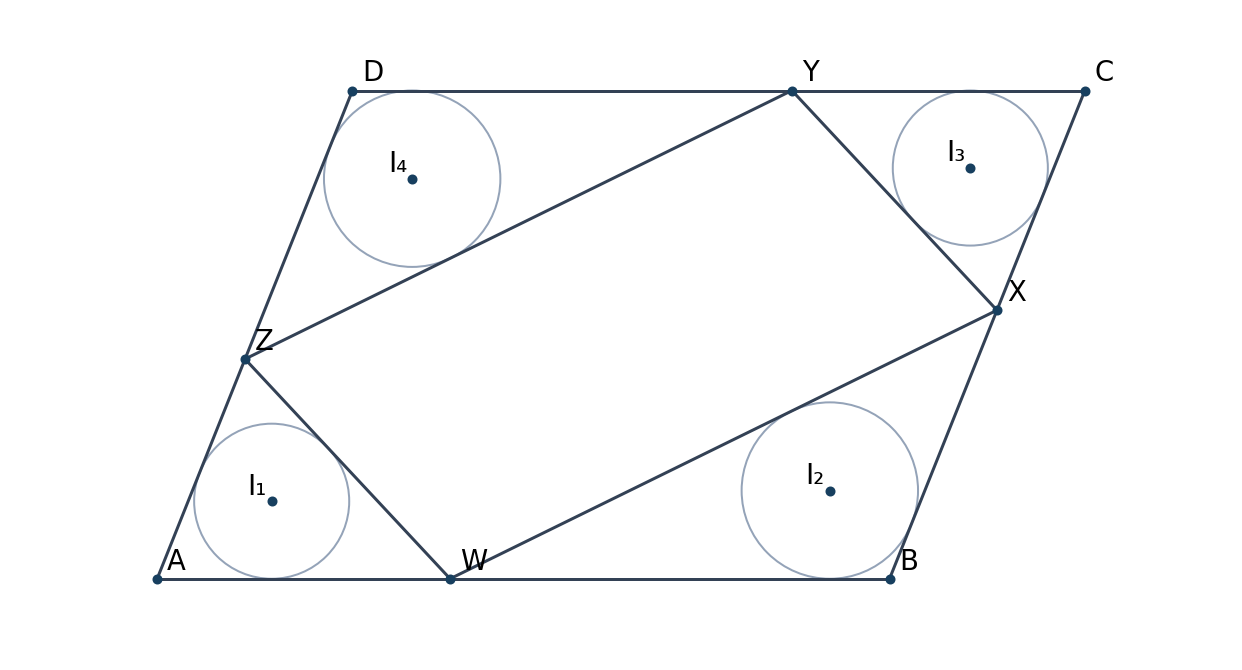
Let $ABCD$ be a parallelogram. Let $W,X,Y,Z$ be points on sides $AB,BC,CD,DA$, respectively, such that the incenters of triangles $AWZ,BXW,CYX,DZY$ form a parallelogram. Prove that $WXYZ$ is a parallelogram.
Let $c\gt 0$ be a given positive real and $\mathbb R_{\gt 0}$ the set of all positive reals. Find all functions $f:\mathbb R_{\gt 0}\to\mathbb R_{\gt 0}$ such that
$$f((c+1)x+f(y))=f(x+2y)+2cx$$
for all $x,y\in\mathbb R_{\gt 0}$.
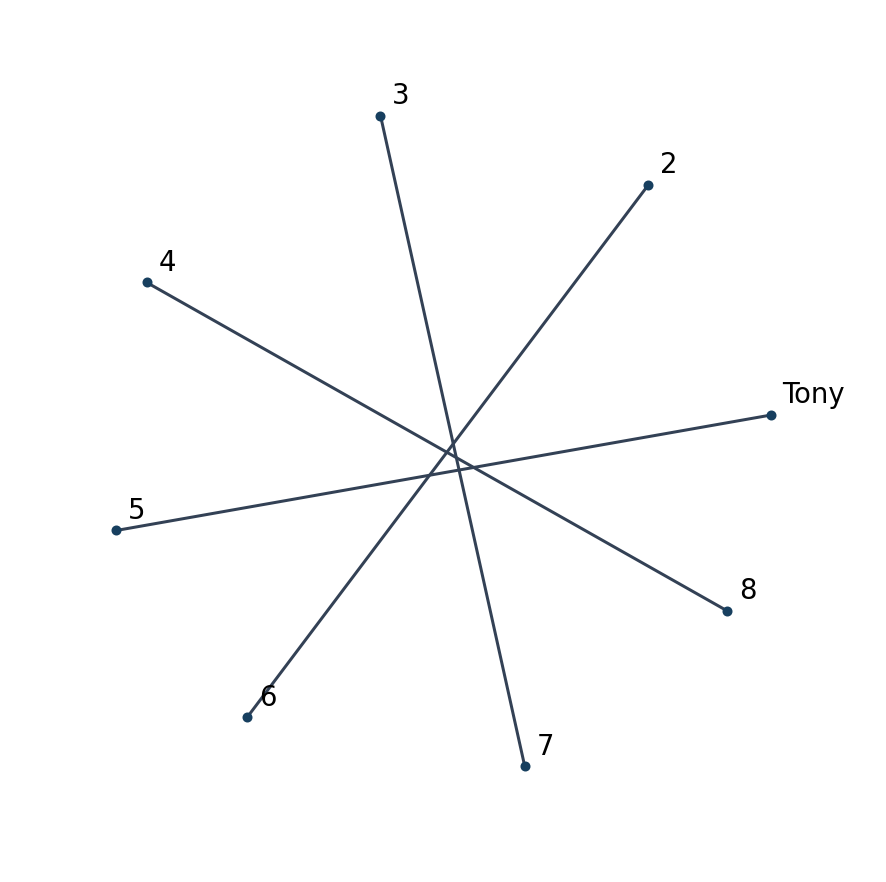
There are $n$ line segments in the plane, no three intersecting at a point, and each pair intersecting once in their respective interiors. Tony and his $2n-1$ friends each stand at a distinct endpoint of a line segment. Tony wishes to send Christmas presents to each of his friends as follows.
First, he chooses an endpoint of each segment as a “sink”. Then he places the present at the endpoint of the segment he is at. The present moves as follows:
- If it is on a line segment, it moves towards the sink.
- When it reaches an intersection of two segments, it changes the line segment it travels on and starts moving towards the new sink.
If the present reaches an endpoint, the friend on that endpoint can receive their present. Prove that Tony can send presents to exactly $n$ of his $2n-1$ friends.
AI-generated example of the initial segments, with no sinks chosen: