Let $ABCD$ be a rhombus and $E$ be a point on the diagonal $AC$. Let $F$ be the point on the side $BC$ such that $BF=DE$. Prove that
$$(AB+BF)\cdot FC=AE\cdot EC.$$
Lines are drawn inside a unit square partitioning it into squares, not necessarily of the same size. Choose one of the main diagonals of the unit square. A square is said to intersect the chosen main diagonal if it has at least one point in common with the diagonal. Is it possible to draw the lines so that the sum of the perimeters of the squares that intersect the chosen main diagonal exceeds 2026?
Alex and Bob take turns to select one number with no repetition allowed from $\{0,1,2,\ldots,14\}$, starting with Alex. Alex wins if he can form a 4-term arithmetic progression among the numbers in his selection. Does Alex have a winning strategy?
In square $ABCD$, $E,F$ are points on the sides $AB$ and $BC$ respectively. Let $N$ be the foot of the perpendicular from $B$ onto $CE$. The circular arc from $C$ to $A$ centred at $B$ with radius $BC$ intersects the segment $DN$ at $K$. If $\angle FND=90^\circ$ and $KF$ is parallel to $NB$, find the value of $\dfrac{BE+BF}{AB}$.
Let $P$ be a configuration of $n\ge3$ points in the plane, no three collinear and let $K$ be a maximal set of pairwise nonparallel lines, each joining two of these points. Let $M(P)$ be the largest possible size of $K$. What is the minimum value of $M(P)$ over all possible configurations $P$?
Fix a positive integer $N$. Let $a_k,b_k$ $(0\le k\le N)$ and $c_k$ $(1\le k\le N)$ be sequences of real numbers such that for all $1\le k\le N$, we have
$$a_k=\frac{4a_{k-1}+3b_{k-1}}5+c_k,$$
$$b_k=\frac{4b_{k-1}-3a_{k-1}}5.$$
If $a_0=b_0=0$ and $a_N\ge1$, determine the smallest possible value of
$$|c_1|+|c_2|+\cdots+|c_N|.$$
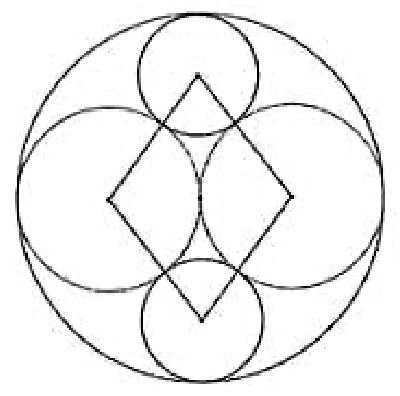
In the diagram below, five circles are arranged so that each inner circle is tangent to its adjacent inner circles and to the largest circle. The vertices of the shaded quadrilateral are the centres of the four circles inside the largest circle. If the diameter of the largest circle is $x$ cm, what is the area of the shaded quadrilateral in $\mathrm{cm}^2$ in terms of $x$?
Car $A$ left Village $X$ for Village $Y$ at the same time as Car $B$ which left Village $Y$ for Village $X$. Both cars travelled at constant speed. $5$ hours later the two cars passed each other. Another $3$ hours later, Car $A$ reached Village $Y$ but Car $B$ was still $90$ km away from Village $X$. Find the distance (in km) between the two villages.
Given four integers $a,b,c,d$, form another four new numbers, where each new number is obtained by adding to each of $a,b,c,d$ the average of the other three integers. In other words, add to $a$ the average of $b,c,d$ to form a new number; add to $b$ the average of $a,c,d$ to form another new number, and so on. If the four new numbers formed are $28,37,46,$ and $57$, find the average of $a,b,c,d$.
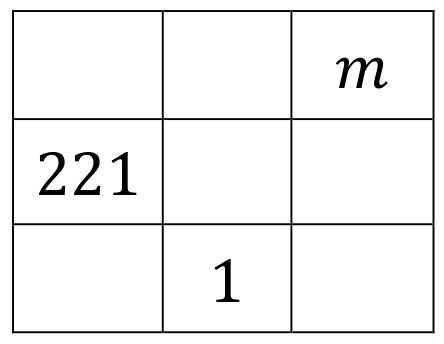
The following is a $3\times3$ grid with three cells filled in with three positive integers $1,221$ and $m$. Find the value of $m$ such that it is possible to fill in the remaining six empty cells with six distinct positive integers different from $1,221$ and $m$ such that the sums of the positive integers in every row, every column and every diagonal are the same.