Twelve students have pairwise different strengths. The coach divides them into two teams of six on ten occasions, with a different division each time. Could all ten tug-of-war games be draws, meaning that the total strengths of the two teams are equal each time?
Two players take stones from a pile of100. On move1 the first player takes1; on move2 the second takes1 or2; on move3 the first takes1,2 or3; and so on, with at most the move number taken each time. Whoever takes the last stone wins. Which player can force a win?
Tom chooses a positive reduced fraction$x=m/n$. You may choose a positive rational$y\lt 1$, and Tom reports only the numerator of$x+y$ after reduction. How can you determine$x$ with certainty using two such queries?
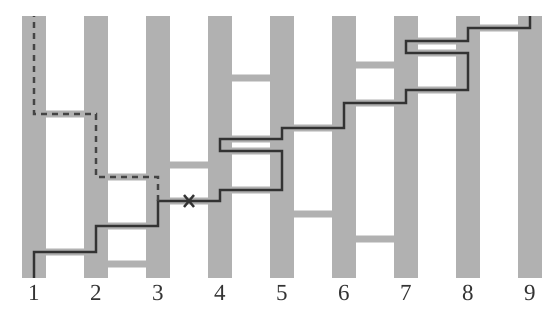
Nine vertical pillars stand in a row, with horizontal sticks between neighboring pillars at pairwise different heights. A beetle climbs upward; whenever it meets a stick it crosses to the neighboring pillar and continues upward. Starting at the bottom of pillar1, it finishes at the top of pillar9. Can one always remove a single stick so that a beetle starting at pillar1 finishes at pillar5?
In the source example, the original route is solid; removing its third encountered stick gives the dotted route.
On the circumcircle of triangle$ABC$, let$M,N,P,Q$ be the midpoints of arcs$BAC,CBA,BC,AC$, respectively; the two-letter arcs are the arcs not containing the third vertex. The$A$-excircle touches$BC$ at$A_1$ and the extensions of$AC,AB$. The$B$-excircle touches$AC$ at$B_1$ and the extensions of$BA,BC$. Suppose$A_1$ lies on segment$NP$. Prove that$B_1$ lies on segment$MQ$.
Distinct real numbers are written on99 cards, and their total sum is irrational. An ordering is called unfortunate if, for every$k=1,\ldots,99$, the sum of its first$k$ cards is irrational. What is the smallest possible number of unfortunate orderings?
Whenever Tom cuts a pie or a piece into two pieces, their weights are equal. Whenever he cuts one piece into more than two pieces, all resulting weights are pairwise different. After several cuts he has17 pieces. Can all17 have equal weight? Pieces cannot be joined together.
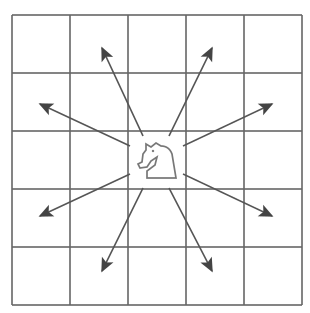
An $8\times8$ chessboard is colored, one color per square. Any two diagonally adjacent squares, or any two squares a knight move apart, have different colors. What is the minimum number of colors? The Vietnamese source includes the following illustration of knight moves.
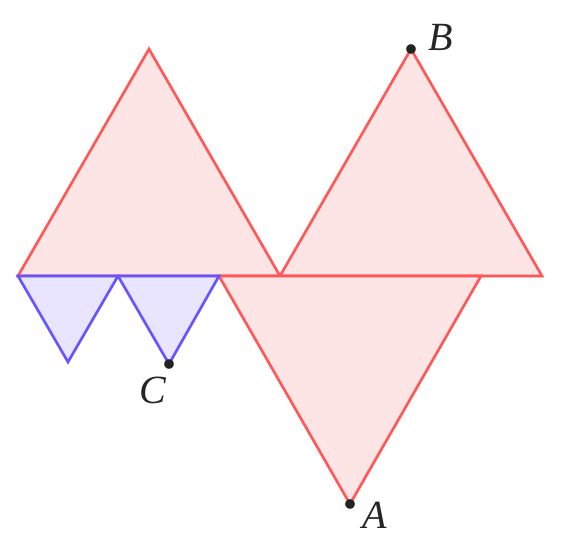
Five equilateral triangles are arranged as shown. The three large triangles are congruent, and the two small triangles are congruent. Find the angles of triangle$ABC$.
Twenty-five gold coins of different values occupy a$5\times5$ grid, one per cell. Two pirates alternately take one coin. A coin may be taken if no remaining coin lies to its left, or none lies to its right, or none lies above it, or none lies below it in the same row or column. Can the first pirate always guarantee at least half the total value?
There are$N$ boa snakes with distinct jaw sizes1,2,...,$N$ cm. A snake swallows every apple assigned to it whose diameter is at most its jaw size, and cannot swallow a larger apple. Jaw sizes cannot be recognized by appearance. In one evening, the keeper assigns any number of apples of chosen sizes to each snake; after the night he observes what each has eaten. What is the minimum total number of apples needed to determine every snake’s jaw size with certainty?
Find all positive integer pairs$(m,n)$ such that$m!!=n!$. Here$m!!$ is the product of the positive integers at most$m$ with the same parity as$m$; for example$5!!=15$, $6!!=48$.
A finite collection of radius1 disks is placed in three-dimensional space. Disks may intersect but no disk contains another disk’s center. A lamp at each center emits rays in every direction, and light passes through disks. Can every ray from every lamp meet at least one other disk?
Each cell of an$N\times N$ board contains a number. A cell is good if one side-neighbor contains a number greater by1 and another side-neighbor contains a number greater by3. What is the maximum possible number of good cells?
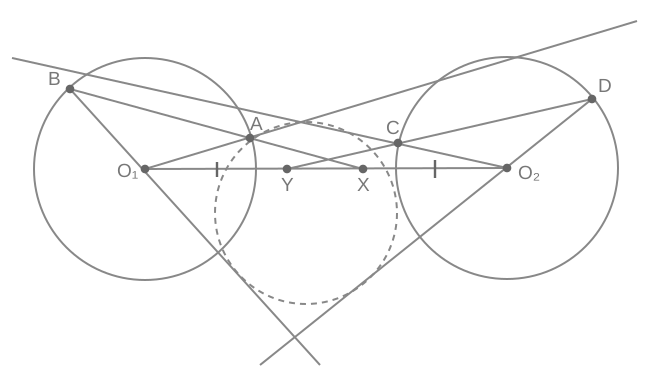
Two equal circles$\omega_1,\omega_2$ have centers$O_1,O_2$. Points$X,Y$ lie on segment$O_1O_2$ with$O_1Y=O_2X$. Points$A,B$ lie on$\omega_1$ and line$AB$ passes through$X$; points$C,D$ lie on$\omega_2$ and line$CD$ passes through$Y$. Prove that a circle tangent to all four lines$AO_1,BO_1,CO_2,DO_2$ exists.
The source’s assertion is preserved. Its unrestricted wording has a counterexample, explained in the editor-authored solution rather than silently adding a hypothesis.
A polynomial of degree$n>0$ has nonzero integer coefficients, and every coefficient is a root of the polynomial. Prove that every coefficient belongs to$\{1,-1,-2\}$.
Harry’s magic flute plays only notes$B,C$. Before he starts, Voldemort forbids one melody of each length5,6,...,30. If any consecutive block of the notes Harry has just played equals a forbidden melody, he loses. Can Harry always play a legal300-note melody, regardless of the forbidden choices?
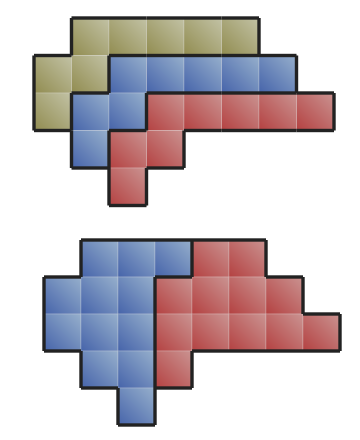
A strip is a grid-cell polygon whose cells can all be visited in a path using only upward or rightward steps between side-adjacent cells. Congruent copies can be fitted together by successive translations by$(-1,1)$. Prove that for every strip with an even number of cells there is an odd$k$ such that the union of$k$ successive translated copies can be cut along grid lines into two congruent parts. Congruence may include reflection or rotation.
A sequence of real numbers$a_1,a_2,\ldots$ satisfies$a_{n+2}=(a_n+a_{n+1})/2$ for every$n\ge1$. Prove that all parabolas$y=x^2+a_nx+a_{n+1}$ have a common point.