Two infinite rows of evenly-spaced dots are aligned as in the figure below. Arrows point from every dot in the top row to some dot in the lower row in such a way that:
- No two arrows point at the same dot.
- No arrow can extend right or left by more than $1006$ positions.
Show that at most $2012$ dots in the lower row could have no arrow pointing to them.
$N$ boys ($N \ge 3$), no two of them having the same height, are arranged along a circle. A boy in the given arrangement is said to be *tall* if he is taller than both of his neighbors; a boy is said to be *short* if he is shorter than both of his neighbors.
Prove that the number of tall boys is equal to the number of short boys in any arrangement of the boys along the circle.
Original English statement:
A number of robots are placed on the squares of a finite, rectangular grid of squares. A square can hold any number of robots. Every edge of the grid is classified as either *passable* or *impassable*. All edges on the boundary of the grid are *impassable*.
You can give any of the commands *up*, *down*, *left*, or *right*. All of the robots then simultaneously try to move in the specified direction. If the edge adjacent to a robot in that direction is passable, the robot moves across the edge and into the next square. Otherwise, the robot remains on its current square. You can then give another command of *up*, *down*, *left*, or *right*, then another, for as long as you want.
Suppose that for any individual robot, and any square on the grid, there is a finite sequence of commands that will move that robot to that square. Prove that you can also give a finite sequence of commands such that *all* of the robots end up on the same square at the same time.
Translation of the parallel French statement:
A number of robots are placed on the squares of a finite, rectangular grid of squares. A square can hold any number of robots. Every edge of the grid is classified as either *passable* or *impassable*. All edges on the boundary of the grid are *impassable*.
You can give any of the commands *up*, *down*, *left*, or *right*. All of the robots then simultaneously try to move in the specified direction. If the edge adjacent to a robot in that direction is passable, the robot moves across the edge and into the next square. Otherwise, the robot remains on its current square. You can then give another command of *up*, *down*, *left*, or *right*, then another, for as long as you want.
Suppose that for any individual robot, and any square on the grid, there is a finite sequence of commands that will move that robot to that square. Prove that you can also give a finite sequence of commands such that *all* of the robots end up on the same square at the same time.
Ten points are marked in the plane so that no three of them lie on the same straight line. All points are connected with segments. Each of these segments is painted one of the $k$ colors.
For what positive integer $k$ ($1 \le k \le 5$) is it possible to paint the segments so that for any $k$ of the given 10 points there are $k$ segments with the ends at these $k$ points, all of these segments being painted $k$ different colors?
Find all quadruples $(a, b, c, d)$ of positive real numbers such that $a b c d = 1$, $a^{2012} + 2012 b = 2012 c + d^{2012}$ and $2012 a + b^{2012} = c^{2012} + 2012 d$.
Laura won the local math olympiad and was awarded a "magical" ruler. With it, she can draw (as usual) lines in the plane, and she can also measure segments and replicate them anywhere in the plane. She can also divide a segment into as many equal parts as she wishes; for instance, she can divide any segment into 17 equal parts. Laura drew a parallelogram $A B C D$ and decided to try out her magical ruler. With it, she found the midpoint $M$ of side $C D$, and she extended side $C B$ beyond $B$ to point $N$ so that segments $C B$ and $B N$ were equal in length. Unfortunately, her mischievous little brother came along and erased everything on Laura's picture except for points $A, M$ and $N$. Using Laura's magical ruler, help her reconstruct the original parallelogram $A B C D$: write down the steps that she needs to follow and prove why this will lead to reconstructing the original parallelogram $A B C D$.
Let $ABCD$ be a square in the plane $P$. Find the minimum and the maximum values of the function $f: P \to \mathbb{R}$ defined by
$$
f(P) = \frac{PA + PB}{PC + PD}
$$
where $\mathbb{R}$ is the set of all real numbers.
Determine the largest number $m$ such that the inequality
$$
(a^2 + 4(b^2 + c^2))(b^2 + 4(c^2 + a^2))(c^2 + 4(a^2 + b^2)) \geq m
$$
holds for all real numbers $a, b$ and $c$ not equal to $0$ and satisfying the condition $\left|\frac{1}{a}\right| + \left|\frac{1}{b}\right| + \left|\frac{1}{c}\right| \le 3$.
Point $M$ is marked inside the convex quadrilateral $ABCD$ so that the ratio of the areas of the triangles $AMC$ and $BMD$ is equal to the ratio of the tangents of the angles $AMC$ and $BMD$, i.e. $S(AMC) : S(BMD) = \tan \angle AMC : \tan \angle BMD$.
Prove that $AM^2 + MC^2 + BD^2 = AC^2 + BM^2 + MD^2$ if $M$ does not belong to any of the diagonals of the quadrilateral.
The lengths of some three sides of a quadrilateral are equal to $2$, $7$, and $11$.
Find the area of the quadrilateral if it has the greatest area among all quadrilaterals with the mentioned lengths of their sides.
Let $ABC$ be a triangle with incenter $I$. The circumcircle of $\triangle AIB$ meets the lines $CA$ and $CB$ again at $P$ (different from $A$) and $Q$ (different from $B$) respectively. Prove that $A$, $B$, $P$, and $Q$ are (in some order) the vertices of a trapezoid.
Determine all functions $f$ mapping the integers to the integers with the following property: For any two (not necessarily different) numbers $m$ and $n$, $\text{gcd}(m, n)$ is a divisor of $f(m) + f(n)$. (Note that $\text{gcd}(m, n) = \text{gcd}(|m|, |n|)$ and $\text{gcd}(m, 0) = |m|$ holds for all integers $m$ and $n$.)
Two distinct points $A$ and $B$ are marked on the left half of the parabola $y = x^2$. Consider any pair of parallel lines which pass through $A$ and $B$ and intersect the right half of the parabola at points $C$ and $D$. Let $K$ be the intersection point of the diagonals $AC$ and $BD$ of the obtained trapezoid $ABCD$. Let $M, N$ be the midpoints of the bases of $ABCD$.
Prove that the difference $KM - KN$ depends only on the choice of points $A$ and $B$ but does not depend on the pair of parallel lines described above.
(I. Voronovich)
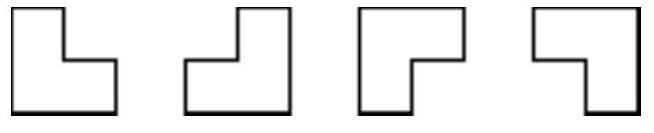
Fix a positive integer $n$. Two players, Phil and Ellie, play the following game. First, Phil fills the squares of an $n \times n$ chessboard with nonnegative integers less than $n$. Then, Ellie chooses three squares making an L, as in any of the following pictures:
Ellie adds 1 to each of the three squares making the L, except that if the number $n$ appears in a square, it is immediately replaced by 0. Ellie wins if, after modifying finitely many L's in this way, she can change all the numbers on the board into 0's; otherwise Phil wins.
Which player has a winning strategy if
Determine the greatest possible value of $n$ that satisfies the following condition: for any choice of $n$ subsets $M_1, ..., M_n$ of the set $M = \{1, 2, ..., n\}$ satisfying the conditions
i) $i \in M_i$; and
ii) $i \in M_j \Leftrightarrow j \notin M_i$ for all $i \neq j$,
there exist $M_k$ and $M_l$ such that $M_k \cup M_l = M$.
Determine the maximum possible number of distinct real roots of a polynomial $P(x)$ of degree $2012$ with real coefficients satisfying the condition
$$
P(a)^3 + P(b)^3 + P(c)^3 \geq 3P(a)P(b)P(c)
$$
for all real numbers $a, b, c$ with $a + b + c = 0$.