C1 (HUN) IMO4. A magician has one hundred cards numbered $1$ to $100$. He puts them into three boxes, a red one, a white one, and a blue one, so that each box contains at least one card. A member of the audience draws two cards from two different boxes and announces the sum of numbers on those cards. Given this information, the magician locates the box from which no card has been drawn. How many ways are there to put the cards in the three boxes so that the trick works?
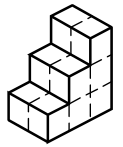
C2 (ITA). A brick staircase with three steps of width $2$ is made of twelve unit cubes. Determine all integers $n$ for which it is possible to build a cube of side $n$ using such bricks.
C3 (COL). Let $n\ge4$ be a fixed positive integer. Given a set $S=\{P_1,P_2,\ldots,P_n\}$ of points in the plane such that no three are collinear and no four concyclic, let $a_t$, $1\le t\le n$, be the number of circles $P_iP_jP_k$ that contain $P_t$ in their interior, and let
$$m(S)=a_1+a_2+\cdots+a_n.$$
Prove that there exists a positive integer $f(n)$, depending only on $n$, such that the points of $S$ are the vertices of a convex polygon if and only if $m(S)=f(n)$.
C4 (CZE). Let $n$ and $k$ be positive integers such that $n/2\lt k\le2n/3$. Find the least number $m$ for which it is possible to place $m$ pawns on $m$ squares of an $n\times n$ chessboard so that no column or row contains a block of $k$ adjacent unoccupied squares.
C5 (RUS). In the plane we have $n$ rectangles with parallel sides. The sides of distinct rectangles lie on distinct lines. The boundaries of the rectangles cut the plane into connected regions. A region is nice if it has at least one of the vertices of the $n$ rectangles on its boundary. Prove that the sum of the numbers of the vertices of all nice regions is less than $40n$. (There can be nonconvex regions as well as regions with more than one boundary curve.)
C6 (FRA). Let $p$ and $q$ be relatively prime positive integers. A subset $S$ of $\{0,1,2,\ldots\}$ is called ideal if $0\in S$ and for each element $n\in S$, the integers $n+p$ and $n+q$ belong to $S$. Determine the number of ideal subsets of $\{0,1,2,\ldots\}$.
A1 (USA) IMO2. Let $a,b,c$ be positive real numbers with product $1$. Prove that
$$\left(a-1+\frac1b\right)\left(b-1+\frac1c\right)\left(c-1+\frac1a\right)\le1.$$
A2 (GBR). Let $a,b,c$ be positive integers satisfying the conditions $b\gt 2a$ and $c\gt 2b$. Show that there exists a real number $t$ with the property that all the three numbers $ta,tb,tc$ have their fractional parts lying in the interval $(1/3,2/3]$.
A3 (BLR). Find all pairs of functions $f:\mathbb R\to\mathbb R$, $g:\mathbb R\to\mathbb R$ such that
$$f(x+g(y))=xf(y)-yf(x)+g(x).$$
for all $x,y\in\mathbb R$.
A4 (GBR). The function $F$ is defined on the set of nonnegative integers and takes nonnegative integer values satisfying the following conditions: For every $n\ge0$,
(i) $F(4n)=F(2n)+F(n)$;
(ii) $F(4n+2)=F(4n)+1$;
(iii) $F(2n+1)=F(2n)+1$.
Prove that for each positive integer $m$, the number of integers $n$ with $0\le n\lt 2^m$ and $F(4n)=F(3n)$ is $F(2^{m+1})$.
A5 (BLR) IMO3. Let $n\ge2$ be a positive integer and $\lambda$ a positive real number. Initially there are $n$ fleas on a horizontal line, not all at the same point. We define a move of choosing two fleas at some points $A$ and $B$, with $A$ to the left of $B$, and letting the flea from $A$ jump over the flea from $B$ to the point $C$ such that $BC/AB=\lambda$.
Determine all values of $\lambda$ such that for any point $M$ on the line and for any initial position of the $n$ fleas, there exists a sequence of moves that will take them all to the position right of $M$.
A6 (IRE). A nonempty set $A$ of real numbers is called a $B_3$-set if the conditions $a_1,a_2,a_3,a_4,a_5,a_6\in A$ and $a_1+a_2+a_3=a_4+a_5+a_6$ imply that the sequences $(a_1,a_2,a_3)$ and $(a_4,a_5,a_6)$ are identical up to a permutation. Let $A=\{a_0=0\lt a_1\lt a_2\lt \cdots\}$, $B=\{b_0=0\lt b_1\lt b_2\lt \cdots\}$ be infinite sequences of real numbers with $D(A)=D(B)$, where, for a set $X$ of real numbers, $D(X)$ denotes the difference set $\{|x-y|\mid x,y\in X\}$. Prove that if $A$ is a $B_3$-set, then $A=B$.
A7 (RUS). For a polynomial $P$ of degree $2000$ with distinct real coefficients let $M(P)$ be the set of all polynomials that can be produced from $P$ by permutation of its coefficients. A polynomial $P$ will be called $n$-independent if $P(n)=0$ and we can get from any $Q$ in $M(P)$ a polynomial $Q_1$ such that $Q_1(n)=0$ by interchanging at most one pair of coefficients of $Q$. Find all integers $n$ for which $n$-independent polynomials exist.
N1 (JAP). Determine all positive integers $n\ge2$ that satisfy the following condition: For all integers $a,b$ relatively prime to $n$,
$a\equiv b\pmod n$ if and only if $ab\equiv1\pmod n$.
N5 (BUL). Prove that there exist infinitely many positive integers $n$ such that $p=nr$, where $p$ and $r$ are respectively the semiperimeter and the inradius of a triangle with integer side lengths.
G1 (NET). In the plane we are given two circles intersecting at $X$ and $Y$. Prove that there exist four points $A,B,C,D$ with the following property: For every circle touching the two given circles at $A$ and $B$, and meeting the line $XY$ at $C$ and $D$, each of the lines $AC,AD,BC,BD$ passes through one of these points.