Determine the smallest positive integer $k$ for which there exists a set $A$ of 10 points in the plane, no three of which are collinear, having the following property: it is possible to color the 45 segments with endpoints in $A$ using $k$ colors so that any two segments of the same color intersect either in their interior or at an endpoint.
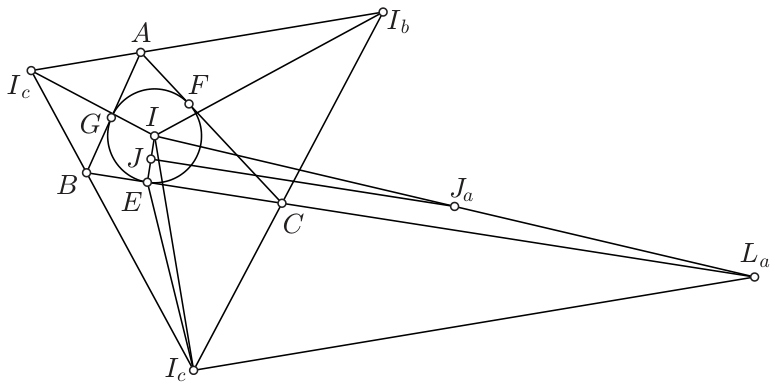
Consider an arbitrary triangle $ABC$ with incenter $I$, and let $I_a$, $I_b$, and $I_c$ be the excenters of triangle $ABC$ opposite to vertices $A$, $B$, and $C$, respectively, tangent to sides $BC$, $CA$, and $AB$. Let $E$, $F$, and $G$ be the points of tangency of the incircle with the sides $BC$, $CA$, and $AB$, respectively.
Prove that the circumcircles of triangles $IEI_a$, $IFI_b$, and $IGI_c$ intersect in a second common point different from $I$.
Petru Braica
Let $n \ge 3$ be a natural number. John draws a regular $n$-gon and connects every pair of vertices. On each segment, John writes a nonzero natural number such that in any triangle formed by three vertices, one of the numbers on its sides equals the sum of the other two.
Determine the smallest number of distinct values John can write.
Let $ABC$ be a triangle with $\angle ABC = 2 \cdot \angle ACB$. Let $X$ and $Y$ be the midpoints of arcs $AB$ and $BC$ (not containing $C$ and $A$, respectively) of the circumcircle of triangle $ABC$. Let $BL$ be the angle bisector of $\angle ABC$, with $L \in AC$. Given that $\angle XLY = 90^\circ$, determine the measures of the angles of triangle $ABC$.
Let $n \ge 2$ and consider a table with $n+1$ rows and $n$ columns, in which, on each of the first $n$ rows, Nicuşor writes, in some order, the numbers $1, 2, \dots, n$. Then, he chooses a permutation $a_1, a_2, \dots, a_n$ of the numbers $1, 2, \dots, n$ and completes the last row as follows: for each $j \in \{1, 2, \dots, n\}$, he writes in the cell at column $j$ the number of occurrences of $a_j$ in the cells located at the intersection of column $j$ with the first $n$ rows.
Determine all $n$ for which Nicuşor can complete the table and choose $a_1, a_2, \dots, a_n$ so that the last row contains, in some order, the numbers $1, 2, \dots, n$.
Cristi Săvescu
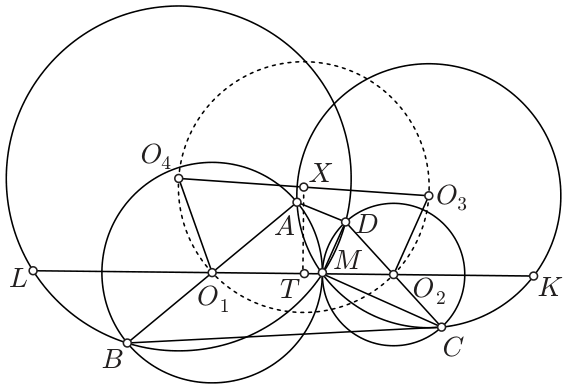
Let $ABCD$ be a convex quadrilateral with the property that the circles having the segments $AB$ and $CD$ as diameters are tangent externally at a point $M$, different from the intersection point of the diagonals of the quadrilateral.
Let $K$ be the second point of intersection of the circumcircle of triangle $AMC$ with the line determined by $M$ and the midpoint of segment $AB$, and let $L$ be the second point of intersection of the circumcircle of triangle $BMD$ with the line determined by $M$ and the midpoint of segment $CD$.
Prove that $|MK - ML| = |AB - CD|$.
Let $n \gt 10$ be an integer, and let $A_1, A_2, \dots, A_n$ be distinct points in the plane such that the distances between the points are pairwise different. Define $f_{10}(j, k)$ to be the 10th smallest of the distances from $A_j$ to $A_1, A_2, \dots, A_k$, excluding $A_j$ if $k \ge j$. Suppose that for all $j$ and $k$ satisfying $11 \le j \le k \le n$, we have $f_{10}(j, j-1) \ge f_{10}(k, j-1)$. Prove that $f_{10}(j, n) \ge \frac{1}{2}f_{10}(n, n)$ for all $j$ in the range $1 \le j \le n-1$.
Iran, Morteza Saghafian
Fix an integer $n \ge 3$. Determine the smallest positive integer $k$ satisfying the following condition:
For any tree $T$ with vertices $v_1, v_2, \dots, v_n$ and any pairwise distinct complex numbers $z_1, z_2, \dots, z_n$, there is a polynomial $P(X, Y)$ with complex coefficients of total degree at most $k$ such that for all $i \ne j$ satisfying $1 \le i, j \le n$, we have $P(z_i, z_j) = 0$ if and only if there is an edge in $T$ joining $v_i$ to $v_j$.
*Note, for example, that the total degree of the polynomial $9X^3Y^4 + XY^5 + X^6 - 2$ is 7 because $7 = 3 + 4$.*
Let $ABC$ be an acute triangle with $AB \lt AC$ and let $H$ and $O$ be its orthocentre and circumcentre, respectively. Let $\Gamma$ be the circle $BOC$. The line $AO$ and the circle of radius $AO$ centred at $A$ cross $\Gamma$ again at $A'$ and $F$, respectively. Prove that $\Gamma$, the circle on diameter $AA'$ and the circle $AFH$ are concurrent.
Let $k$ and $m$ be integers greater than $1$. Consider $k$ pairwise disjoint sets $S_1, S_2, \dots, S_k$; each of these sets has exactly $m+1$ elements, one of which is red and the other $m$ are all blue. Let $\mathcal{F}$ be the family of all subsets $F$ of $S_1 \cup S_2 \cup \dots \cup S_k$ such that, for every $i$, the intersection $F \cap S_i$ is monochromatic; the empty set is monochromatic. Determine the largest possible cardinality of a subfamily $\mathcal{G} \subseteq \mathcal{F}$, no two sets of which are disjoint.
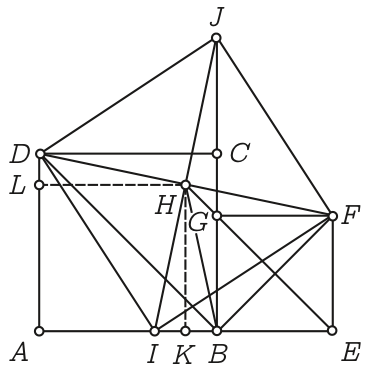
Consider the squares $ABCD$ and $BEFG$, such that $B$ lies on the segment $AE$ and $G$ lies on the segment $BC$. Let $H$ be the intersection of the lines $DF$ and $EG$. The perpendicular from $H$ to the line $DF$ intersects the lines $AE$ and $BC$ at points $I$ and $J$, respectively. Prove that the quadrilateral $DIFJ$ is a square.
Valeriu Bărbieru
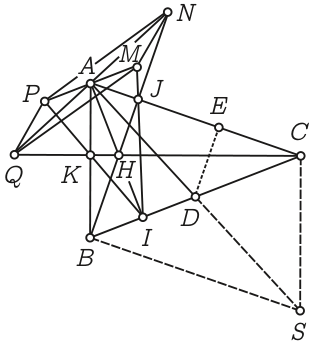
Let $ABC$ be an acute triangle, with $AB \neq AC$. Let $D$ be the midpoint of $BC$ and $I, J, K$ be the feet of the altitudes from $A, B$ and $C$, respectively, in the triangle $ABC$. The perpendicular from $A$ to the line $AD$ meets the lines $BJ$ and $CK$ at points $N$ and $Q$, respectively, and the parallel to $BC$ through $A$ intersects the lines $IJ$ and $IK$ at $M$ and $P$, respectively. Prove that $MNPQ$ is a parallelogram.
Petru Braica
a) Let $a, b \in \mathbb{R}$ be two real numbers, with $a \lt b$, and $f : [a, b] \to \mathbb{R}$ a strict monotone function such that $\int_a^b f(x) dx = 0$. Show that $f(a) \cdot f(b) \lt 0$.
b) Determine the convergent sequences $(a_n)_{n \ge 1}$ of real numbers, for which there is a strict monotone function $f : \mathbb{R} \to \mathbb{R}$ such that
$$
\int_{a_{n-1}}^{a_n} f(x) \, dx = \int_{a_n}^{a_{n+1}} f(x) \, dx, \quad \text{for any } n \in \mathbb{N}, n \ge 2.
$$
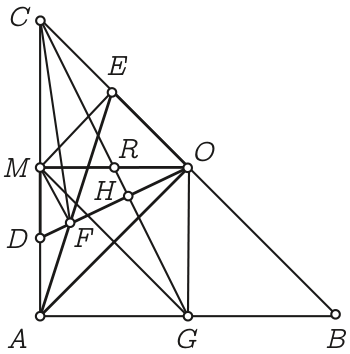
Let $ABC$ be a right isosceles triangle with right angle at $A$, $O$ the midpoint of the hypotenuse $BC$, $E$ the midpoint of the segment $CO$, $M$ the midpoint of $AC$, and $D$ the midpoint of $AM$. Let $F$ be the intersection of lines $OD$ and $AE$.
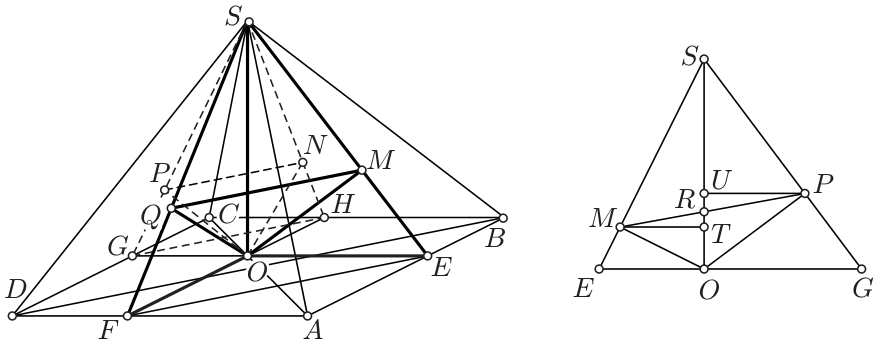
From a point $O$ inside the square $ABCD$ the perpendicular line $OS$ is raised to the plane of the square. Let $M, N, P, Q$ be projections of point $O$ onto the planes $(SAB), (SBC), (SCD)$, respectively $(SDA)$. Prove that the points $M, N, P, Q$ are coplanar if and only if $O$ lies on one of the diagonals of the square.
Let $m \in \mathbb{N}$, $m \ge 2$ be a fixed natural number, and let $(a_n)_{n \ge 1}$ be a sequence of nonnegative real numbers such that $a_{n+1} \le a_n - a_{mn}$, $\forall n \ge 1$.
a) Prove that the sequence $(b_n)_{n \ge 1}$, $b_n = \sum_{k=1}^{n} a_k$ is bounded above.
b) Prove that the sequence $(c_n)_{n \ge 1}$, $c_n = \sum_{k=1}^{n} k^2 a_k$ is bounded above.