A $3 \times 3$ grid made up of $9$ $1 \times 1$ squares is given. Suppose you want to distribute $9$ distinct positive integers chosen from the integers greater than or equal to $1$ and less than or equal to $9$ into $9$ square boxes of the grid. How many distinct ways of distributing the $9$ numbers are there if for any pair of boxes sharing a side the difference of the numbers inserted must be $3$ or less? Even when the two configurations of the result of distribution coincide under a rotation or flipping over, regard the configurations distinct.
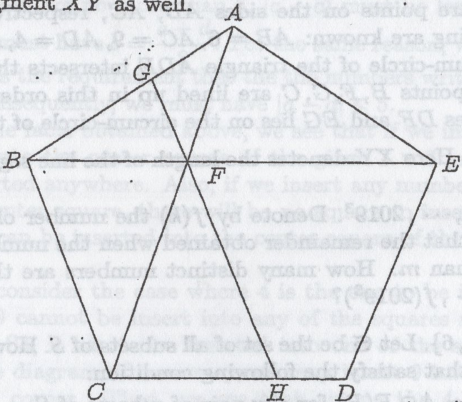
Suppose a regular pentagon $ABCDE$ is given. Let $F$ be the point of intersection of the lines $BE$ and $AC$. Suppose that a straight line going through $F$ intersects sides $AB$ and $CD$ at the points $G$, $H$, respectively, and $BG = 4$ and $CH = 5$ hold. Find the length of the line segment $AG$. Here by $XY$ we denote the length of the line segment $XY$ as well.
Find the smallest positive integer $n$ with the following property:
Remainders obtained when $n$ is divided by $97$, $100$, $103$ are $32$, $33$, $34$, respectively.
Some of the vertices of a regular $120$-gon are labeled by $*$. What is the maximal possible number of vertices labeled with $*$ if the following condition must be satisfied?
There exists no isosceles triangle with the angle at the top vertex of $18^\circ$ formed by $*$-labeled vertices of the $120$-gon.
Suppose quadratic polynomials $P$, $Q$, $R$ with integer coefficients satisfy the following properties:
* $P(1) = P(2) = Q(3) = 0$.
* $P(x)^2 + Q(x)^2 = R(x)^2$ holds for any real number $x$.
* There exists no integer greater than or equal to $2$, which divides all of the numbers appearing as a coefficient of any of $P$, $Q$, $R$.
* The coefficients of the quadratic terms of $P$ and $Q$ are not $0$, and the coefficient of the quadratic term of $R$ is positive.
Find all possible forms of $R(x)$ satisfying the conditions above.
A $4 \times 4$ grid made up of $16$ $1 \times 1$ squares is given. Suppose we want to color each of the squares by using one of the four colors, red, blue, yellow or green. How many ways of painting all of the boxes are there if the following requirement must be met:
For any row and any column one of the following 3 conditions must be satisfied:
* all four squares must be colored by the same color.
* use two colors, each one to be used to color two squares.
* use all four colors, each one to be used to color one square.
Suppose $D$, $E$ are points on the sides $AB$, $AC$, respectively, of a triangle $ABC$, and the following are known: $AB = 6$, $AC = 9$, $AD = 4$, $AE = 6$. Suppose, furthermore, the circumcircle of the triangle $ADE$ intersects the side $BC$ at two points $F$, $G$ and the points $B$, $F$, $G$, $C$ are lined up in this order. If the point of intersection of the lines $DF$ and $EG$ lies on the circumcircle of the triangle $ABC$, find the value of $\frac{FG}{BC}$. Here $XY$ denotes the length of the line segment $XY$ as well.
Let $S = \{1, 2, \dots, 6\}$. Let $\mathcal{S}$ be the set of all subsets of $S$. How many mappings $F: \mathcal{S} \to \mathcal{S}$ are there that satisfy the following condition:
$$
F(F(A) \cup B) = A \cap F(B) \text{ for any pair of subsets of } S.
$$
Let $I$ be the incenter of a triangle $ABC$ satisfying $AB \gt AC$, and let $D, E$ be points on the sides $AB, AC$, respectively, dividing the sides into two segments with $1:8$ ratio. If the triangle $DIE$ becomes the regular triangle with side length $1$, what is the length of $AB$? Here by $XY$ we denote the length of the line segment $XY$ as well.
Let $n$ be an odd integer greater than or equal to $3$. Suppose you play the following game using an $n \times n$ grid made up of $n^2$ $1 \times 1$ squares. The game consists of $n^2$ turns, and at each turn the following actions must be performed in the order specified:
* Choose one empty square and insert one positive integer greater than or equal to $1$ and less than or equal to $n^2$. Throughout the game, any integer can be used only once.
* You gain $1$ point if the sum of numbers written into the squares lying on the same row as the square you chose is a multiple of $n$, and the same rule applies for the column (you get $2$ points if both row sum and column sum are multiples of $n$.)
Find the maximum possible value for the total sum of the points you gain by the end of the game.
Let $I$ be the incenter and $\Omega$ be the inscribed circle of a triangle $ABC$, and let $M$ be the midpoint of the side $BC$. Let $K$ be the point of intersection of the line, going through $A$ and perpendicular to line $BC$, and the line, going through $M$ and perpendicular to the line $AI$. Prove that the circle having the line segment $AK$ as a diameter is tangent to the circle $\Omega$.
Determine the smallest and the greatest possible values of the expression
$$
\left(\frac{1}{a^{2}+1}+\frac{1}{b^{2}+1}+\frac{1}{c^{2}+1}\right)\left(\frac{a^{2}}{a^{2}+1}+\frac{b^{2}}{b^{2}+1}+\frac{c^{2}}{c^{2}+1}\right)
$$
provided $a$, $b$, and $c$ are non-negative real numbers satisfying $ab+bc+ca=1$.
Let $\alpha$ be a real number. Determine all polynomials $P$ with real coefficients such that
$$
P(2x+\alpha) \leq (x^{20} + x^{19}) P(x)
$$
holds for all real numbers $x$.
There are $n$ boys and $n$ girls in a school class, where $n$ is a positive integer. The heights of all the children in this class are distinct. Every girl determines the number of boys that are taller than her, subtracts the number of girls that are taller than her, and writes the result on a piece of paper. Every boy determines the number of girls that are shorter than him, subtracts the number of boys that are shorter than him, and writes the result on a piece of paper. Prove that the numbers written down by the girls are the same as the numbers written down by the boys (up to a permutation).
Prove that every integer from $1$ to $2019$ can be represented as an arithmetic expression consisting of up to $17$ symbols $2$ and an arbitrary number of additions, subtractions, multiplications, divisions and brackets. The $2$'s may not be used for any other operation, for example to form multi-digit numbers (such as $222$) or powers (such as $2^{2}$).
Let $ABC$ be an acute-angled triangle such that $AB \lt AC$. Let $D$ be the point of intersection of the perpendicular bisector of the side $BC$ with the side $AC$. Let $P$ be a point on the shorter arc $AC$ of the circumcircle of the triangle $ABC$ such that $DP \parallel BC$. Finally, let $M$ be the midpoint of the side $AB$. Prove that $\angle APD = \angle MPB$.
Let $ABC$ be a right-angled triangle with its right angle at $B$ and circumcircle $c$. Denote by $D$ the midpoint of the shorter arc $AB$ of $c$. Let $P$ be the point on the side $AB$ such that $CP = CD$ and let $X$ and $Y$ be two distinct points on $c$ satisfying $AX = AY = PD$. Prove that the points $X$, $Y$ and $P$ are collinear.
Let $N$ be a positive integer such that the sum of the squares of all positive divisors of $N$ is equal to the product $N(N+3)$. Prove that there exist two indices $i$ and $j$ such that $N=F_{i} \cdot F_{j}$, where $\left(F_{n}\right)_{n=1}^{\infty}$ is the Fibonacci sequence defined by $F_{1}=F_{2}=1$ and $F_{n}=F_{n-1}+F_{n-2}$ for all $n \geq 3$.