Find the angles of a convex quadrilateral $ABCD$ such that $\hat{ABD} = 29^\circ$, $\hat{ADB} = 41^\circ$, $\hat{ACB} = 82^\circ$ and $\hat{ACD} = 58^\circ$.
Let $a$ and $b$ be rational numbers such that $a+b = a^2 + b^2$. Suppose that the common value $s = a+b = a^2 + b^2$ is not an integer, and write it as an irreducible fraction: $s = \frac{m}{n}$. Let $p$ be the least prime divisor of $n$. Find the minimum value of $p$.
A circle of length $999$ is divided into unit arcs by $999$ black points. Then $d$ arcs with lengths $1$, $2$, ..., $d$ are placed on the circle, with their end points black, so that none of these arcs contains another (otherwise the arcs may overlap). Find all $d$ for which such a configuration exists.
The nonnegative real numbers $a$ and $b$ satisfy $a + b = 1$. Prove that
$$
\frac{1}{2} \le \frac{a^3 + b^3}{a^2 + b^2} \le 1.
$$
When do we have equality in the left inequality, and when in the right one?
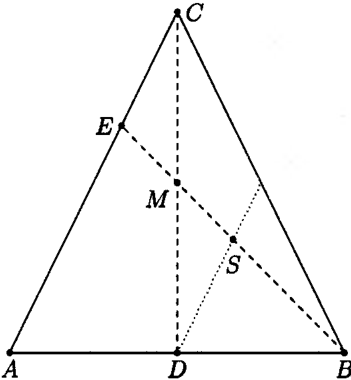
In the isosceles triangle $ABC$ with $\overline{AC} = \overline{BC}$, let $D$ be the foot of the altitude through $C$ and let $M$ be the midpoint of the segment $CD$. The line $BM$ intersects $AC$ at $E$. Prove that $AC$ is three times as long as $CE$.
(Erich Windischbacher)
Anton writes down, in order, all positive integers that are divisible by $2$. Berta writes down, in order, all positive integers that are divisible by $3$. Clara writes down, in order, all positive integers that are divisible by $4$. Orderly Dora notes down the numbers written by the others. In doing so, she orders the numbers by size and does not write any number more than once. What is the $2017$th number in her list?
(Richard Henner)
How many solutions does the equation
$$
\lfloor \frac{x}{20} \rfloor = \lfloor \frac{x}{17} \rfloor
$$
have in the set of positive integers?
Here $\lfloor a \rfloor$ denotes the greatest integer that is less than or equal to $a$.
(Karl Czakler)
Let $ABCDE$ be a regular pentagon. A point $P \neq M$ is chosen on the segment between the centre $M$ of the pentagon and the vertex $D$. The circumcircle of $ABP$ intersects the side $AE$ at the points $A$ and $Q$, and the perpendicular to $CD$ through $P$ at the points $P$ and $R$.
Show that $AR$ and $QR$ have the same length.
(Stephan Wagner)
Anna and Berta play a game in which they take turns removing marbles from the table. Anna makes the first move. If at the beginning of a move there are $n \ge 1$ marbles on the table, then the player whose turn it is removes $k$ marbles, where $k \ge 1$ is either an even number with $k \le \frac{n}{2}$ or an odd number with $\frac{n}{2} \le k \le n$. A player wins the game if she removes the last marble from the table.
Determine the smallest number $N \ge 100\,000$ such that Berta can force a win if there are exactly $N$ marbles on the table at the beginning.
(Gerhard Woeginger)
Determine all polynomials $P(x) \in \mathbb{R}[x]$ satisfying the following two conditions:
(a) $P(2017) = 2016$ and
(b) $(P(x)+1)^2 = P(x^2+1)$ for all real numbers $x$.
Let $ABCDE$ be a regular pentagon with center $M$. A point $P \neq M$ is chosen on the line segment $MD$. The circumcircle of $ABP$ intersects the line segment $AE$ in $A$ and $Q$ and the line through $P$ perpendicular to $CD$ in $P$ and $R$.
*Prove that $AR$ and $QR$ are of the same length.*
Anna and Berta play a game in which they take turns in removing marbles from a table. Anna takes the first turn. When at the beginning of a turn there are $n \ge 1$ marbles on the table, then the player whose turn it is removes $k$ marbles, where $k \ge 1$ either is an even number with $k \le \frac{n}{2}$ or an odd number with $\frac{n}{2} \le k \le n$. A player wins the game if she removes the last marble from the table.
*Determine the smallest number $N \ge 100\,000$ such that Berta can enforce a victory if there are exactly $N$ marbles on the table in the beginning.*
The nonnegative real numbers $a$ and $b$ satisfy $a + b = 1$. Prove that
$$
\frac{1}{2} \le \frac{a^3 + b^3}{a^2 + b^2} \le 1.
$$
When do we have equality in the right inequality and when in the left inequality?
In the isosceles triangle $ABC$ with $\overline{AC} = \overline{BC}$ we denote by $D$ the foot of the altitude through $C$. The midpoint of $CD$ is denoted by $M$. The line $BM$ intersects $AC$ in $E$. Prove that the length of $AC$ is three times that of $CE$.
Anthony writes down in order all positive integers which are divisible by $2$. Bertha writes down in order all positive integers which are divisible by $3$. Claire writes down in order all positive integers which are divisible by $4$. Orderly Dora writes all numbers written by the other three. Thereby she puts them in order by size and does not repeat a number. What is the $2017$th number in her list?
(Richard Henner)
Let a real number $\alpha$ be given.
Determine, depending on $\alpha$, all functions $f: \mathbb{R} \to \mathbb{R}$ with
$$
f(f(x+y)f(x-y)) = x^2 + \alpha y f(y)
$$
for all $x, y \in \mathbb{R}$.