Abe can paint the room in $15$ hours, Bea can paint $50$ percent faster than Abe, and Coe can paint twice as fast as Abe. Abe begins to paint the room and works alone for the first hour and a half. Then Bea joins Abe, and they work together until half the room is painted. Then Coe joins Abe and Bea, and they work together until the entire room is painted. Find the number of minutes after Abe begins for the three of them to finish painting the room.
Arnold is studying the prevalence of three health risk factors, denoted by $A,$ $B,$ and $C,$ within a population of men. For each of the three factors, the probability that a randomly selected man in the population has only this risk factor (and none of the others) is $0.1.$ For any two of the three factors, the probability that a randomly selected man has exactly these two risk factors (but not the third) is $0.14.$ The probability that a randomly selected man has all three risk factors, given that he has $A$ and $B,$ is $\frac{1}{3}.$ The probability that a man has none of the three risk factors given that he does not have risk factor $A$ is $\frac{p}{q},$ where $p$ and $q$ are relatively prime positive integers. Find $p + q.$
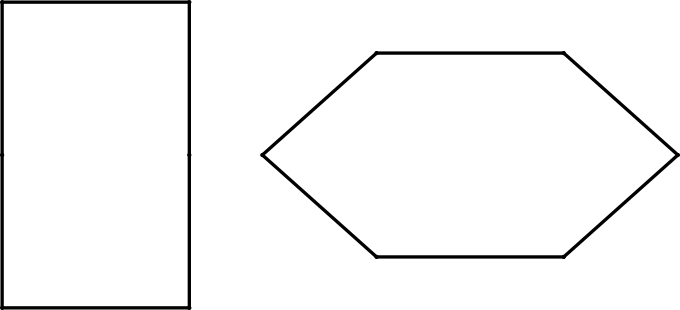
A rectangle has sides of length $a$ and $36.$ A hinge is installed at each vertex of the rectangle and at the midpoint of each side of length $36.$ The sides of length $a$ can be pressed toward each other keeping those two sides parallel so the rectangle becomes a convex hexagon as shown. When the figure is a hexagon with the sides of length $a$ parallel and separated by a distance of $24,$ the hexagon has the same area as the original rectangle. Find $a^2.$
The repeating decimals $0.abab\overline{ab}$ and $0.abcabc\overline{abc}$ satisfy $$
0.abab\overline{ab} + 0.abcabc\overline{abc} = \frac{33}{37},
$$ where $a,$ $b,$ and $c$ are (not necessarily distinct) digits. Find the three-digit number $abc.$
Real numbers $r$ and $s$ are roots of $p(x) = x^3 + ax + b,$ and $r + 4$ and $s - 3$ are roots of $q(x) = x^3 + ax + b + 240.$ Find the sum of all possible values of $|b|.$
Charles has two six-sided dice. One of the dice is fair, and the other die is biased so that it comes up six with probability $\frac{2}{3},$ and each of the other five sides has probability $\frac{1}{15}.$ Charles chooses one of the two dice at random and rolls it three times. Given that the first two rolls are both sixes, the probability that the third roll will also be a six is $\frac{p}{q},$ where $p$ and $q$ are relatively prime positive integers. Find $p + q.$
Let $f(x) = \left(x^2 + 3x + 2\right)^{\cos(\pi x)}.$ Find the sum of all positive integers $n$ for which $$
\left|\sum_{k=1}^{n} \log_{10} f(k)\right| = 1.
$$
Circle $C$ with radius $2$ has diameter $\overline{AB}.$ Circle $D$ is internally tangent to circle $C$ at $A.$ Circle $E$ is internally tangent to circle $C,$ externally tangent to circle $D,$ and tangent to $\overline{AB}.$ The radius of circle $D$ is three times the radius of circle $E$ and can be written in the form $\sqrt{m} - n,$ where $m$ and $n$ are positive integers. Find $m + n.$
Let $z$ be a complex number with $|z| = 2014.$ Let $P$ be the polygon in the complex plane whose vertices are $z$ and every $w$ such that $\frac{1}{z+w} = \frac{1}{z} + \frac{1}{w}.$ Then the area enclosed by $P$ can be written in the form $n\sqrt{3},$ where $n$ is an integer. Find the remainder when $n$ is divided by $1000.$
In $\triangle RED,$ $RD = 1,$ $\angle DRE = 75^\circ$ and $\angle RED = 45^\circ.$ Let $M$ be the midpoint of segment $\overline{RD}.$ Point $C$ lies on side $\overline{ED}$ such that $\overline{RC} \perp \overline{EM}.$ Extend segment $\overline{DE}$ through $E$ to point $A$ such that $CA = AR.$ Then $AE = \frac{a - \sqrt{b}}{c},$ where $a$ and $c$ are relatively prime positive integers, and $b$ is a positive integer. Find $a + b + c.$
Suppose that the angles of $\triangle ABC$ satisfy $\cos(3A) + \cos(3B)$ $+ \cos(3C) = 1.$ Two sides of the triangle have lengths $10$ and $13.$ There is a positive integer $m$ so that the maximum possible length for the remaining side of $\triangle ABC$ is $\sqrt{m}.$ Find $m.$
Ten adults enter a room, remove their shoes, and toss their shoes into a pile. Later, a child randomly pairs each left shoe with a right shoe without regard to which shoes belong together. The probability that for every positive integer $k \lt 5,$ no collection of $k$ pairs made by the child contains the shoes from exactly $k$ of the adults is $\frac{m}{n},$ where $m$ and $n$ are relatively prime positive integers. Find $m + n.$
In $\triangle ABC,$ $AB = 10,$ $\angle A = 30^\circ,$ and $\angle C = 45^\circ.$ Let $H,$ $D,$ and $M$ be points on line $\overline{BC}$ such that $\overline{AH} \perp \overline{BC},$ $\angle BAD = \angle CAD,$ and $BM = CM.$ Point $N$ is the midpoint of segment $\overline{HM},$ and point $P$ is on ray $AD$ such that $\overline{PN} \perp \overline{BC}.$ Then $AP^2 = \frac{m}{n},$ where $m$ and $n$ are relatively prime positive integers. Find $m + n.$
For any integer $k \ge 1,$ let $p(k)$ be the smallest prime which does not divide $k.$ Define the integer function $X(k)$ to be the product of all primes less than $p(k)$ if $p(k) \gt 2,$ and $X(k) = 1$ if $p(k) = 2.$ Let $\{x_n\}$ be the sequence defined by $x_0 = 1,$ and $x_{n+1} X(x_n) = x_n p(x_n)$ for $n \ge 0.$ Find the smallest positive integer $t$ such that $x_t = 2090.$
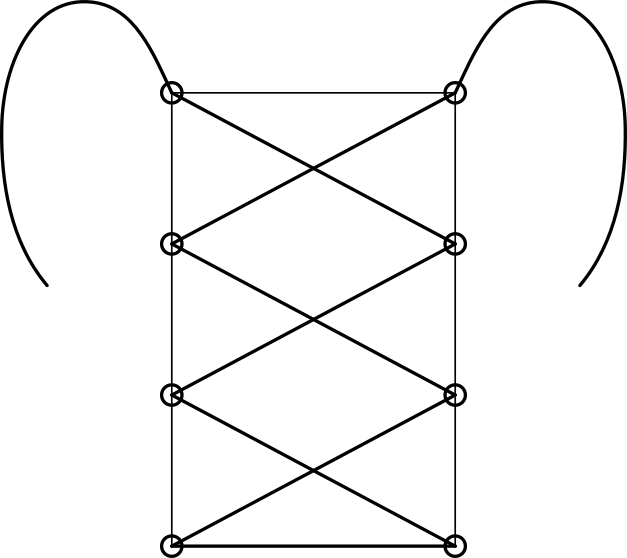
The $8$ eyelets for the lace of a sneaker all lie on a rectangle, four equally spaced on each of the longer sides. The rectangle has a width of $50$ mm and a length of $80$ mm. There is one eyelet at each vertex of the rectangle. The lace itself must pass between the vertex eyelets along a width side of the rectangle and then crisscross between successive eyelets until it reaches the two eyelets at the other width side of the rectangle as shown. After passing through these final eyelets, each of the ends of the lace must extend at least $200$ mm farther to allow a knot to be tied. Find the minimum length of the lace in millimeters.
An urn contains $4$ green balls and $6$ blue balls. A second urn contains $16$ green balls and $N$ blue balls. A single ball is drawn at random from each urn. The probability that both balls are of the same color is $0.58.$ Find $N.$
Find the number of rational numbers $r,$ $0 \lt r \lt 1,$ such that when $r$ is written as a fraction in lowest terms, the numerator and the denominator have a sum of $1000.$
Jon and Steve ride their bicycles on a path that parallels two side-by-side train tracks running in the east/west direction. Jon rides east at $20$ miles per hour, and Steve rides west at $20$ miles per hour. Two trains of equal length, traveling in opposite directions at constant but different speeds, each pass the two riders. Each train takes exactly $1$ minute to go past Jon. The westbound train takes $10$ times as long as the eastbound train to go past Steve. The length of each train is $\frac{m}{n}$ miles, where $m$ and $n$ are relatively prime positive integers. Find $m + n.$
Let the set $S = \{P_1, P_2, \ldots, P_{12}\}$ consist of the twelve vertices of a regular $12$-gon. A subset $Q$ of $S$ is called *communal* if there is a circle such that all points of $Q$ are inside the circle, and all points of $S$ not in $Q$ are outside of the circle. How many communal subsets are there? (Note that the empty set is a communal subset.)