In the triangle $ABC$, $AC=BC$, $\angle C=90^\circ$, $D$ is the midpoint of $BC$, $E$ is the point on $AB$ such that $AD$ is perpendicular to $CE$. Prove that $AE=2EB$.
There are 315 marbles divided into three piles of 81, 115 and 119. In each move Ah Meng can either merge several piles into a single pile or divide a pile with an even number of marbles into 2 equal piles. Can Ah Meng divide the marbles into 315 piles, each with a single marble?
Let $n$ be a positive integer and consider an arrangement of $2n$ blocks in a straight line, where $n$ of them are red and the rest blue. A swap refers to choosing two consecutive blocks and then swapping their positions. Let $A$ be the minimum number of swaps needed to make the first $n$ blocks all red and $B$ be the minimum number of swaps needed to make the first $n$ blocks all blue. Show that $A+B$ is independent of the starting arrangement and determine its value.
In the acute-angled triangle $ABC$ with circumcircle $\omega$ and orthocenter $H$, points $D$ and $E$ are the feet of the perpendiculars from $A$ onto $BC$ and from $B$ onto $AC$ respectively. Let $P$ be a point on the minor arc $BC$ of $\omega$. Points $M$ and $N$ are the feet of the perpendiculars from $P$ onto lines $BC$ and $AC$ respectively. Let $PH$ and $MN$ intersect at $R$. Prove that $\angle DMR=\angle MDR$.
A robot is placed at a point $P$ on the $x$-axis but different from $(0,0)$ and $(1,0)$ and can move only along the axis either to the left or to the right. Two players play the following game. Player $A$ gives a distance and $B$ gives a direction and the robot will move the indicated distance along the indicated direction. Player $A$ aims to move the robot to either $(0,0)$ or $(1,0)$. Player $B$'s aim is to stop $A$ from achieving his aim. For which $P$ can $A$ win?
Let $p\equiv2\pmod3$ be a prime, $k$ a positive integer and let $P(x)=3x^{(2p-1)/3}+3x^{(p+1)/3}+x+1$. For any integer $n$, let $R(n)$ denote the remainder when $n$ is divided by $p$ and let $S=\{0,1,\ldots,p-1\}$. At each step, you can either (a) replace every element $i$ of $S$ with $R(P(i))$ or (b) replace every element $i$ of $S$ with $R(i^k)$. Determine all $k$ such that there exists a finite sequence of steps that reduces $S$ to $\{0\}$.
In an $m\times n$ chessboard $(m,n\ge2)$, some dominoes are placed (without overlap) with each domino covering exactly two adjacent cells. Show that if no more dominoes can be added to the grid, then at least $2/3$ of the chessboard is covered by dominoes.
In a parallelogram $ABCD$, the bisector of $\angle A$ intersects $BC$ at $M$ and the extension of $DC$ at $N$. Let $O$ be the circumcentre of the triangle $MCN$. Prove that $\angle OBC=\angle ODC$.
Let $n,m$ be positive integers such that $n\ge2m+1$. Given $n$ distinct points and $nm$ distinct line segments, each joining a pair of points, prove that there exist distinct points $A_0,A_1,\ldots,A_m$, so that for each $i=0,\ldots,m-1$, there is a line segment joining $A_i$ to $A_{i+1}$.
Let $a_1,a_2,\ldots,a_{2000}$ be distinct positive integers such that $1\le a_1<a_2<\cdots<a_{2000}<4000$ such that the LCM (least common multiple) of any two of them is $\ge4000$. Prove that $a_1\ge1334$.
Let $m,n,k$ be positive integers so that $m\ge n$ and $1+2+\cdots+n=mk$. Show that the numbers $1,2,\ldots,n$ can be partitioned into $k$ groups so that the sum of the numbers in each of the groups is $m$.
Determine all integer $n\ge2$ such that it is possible to construct an $n\times n$ array where each entry is either $0$, $1$ or $-1$ so that the sums of elements in every row and every column are distinct.
In a strange island, there are only two types of inhabitants: truth-tellers who only tell the truth and liars who only tell lies. One day, you meet two such inhabitants $A$ and $B$. $A$ said: “Exactly one of us is a truth-teller.” $B$ kept silent. Which of the following must be true?
Let $x,y$ and $z$ be positive integers satisfying $$x^2+y^2+z^2=2(xy+1)\qquad\text{and}\qquad x+y+z=2022.$$ If $x_1$ and $x_2$ are two distinct solutions for $x$, what is the value of $x_1+x_2$?
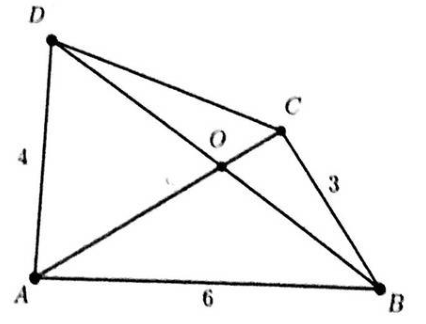
In a quadrilateral $ABCD$, the diagonals $AC$ and $BD$ intersect at the point $O$. Suppose that $\angle BAD+\angle ACB=180^\circ$, $|BC|=3$, $|AD|=4$, $|AC|=5$ and $|AB|=6$. What is the value of $\frac{|OD|}{|OB|}$?