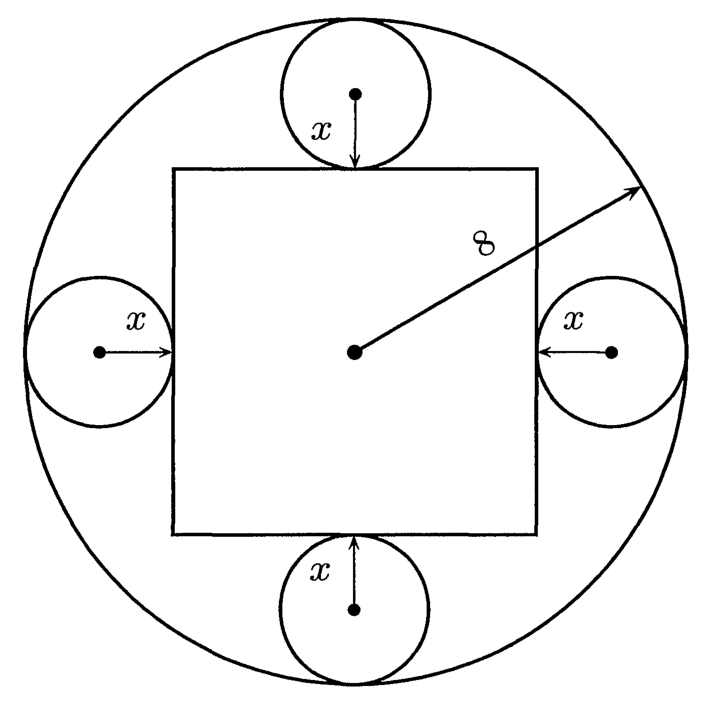
$AB$ is a chord of a circle with centre $O$. The diameter $CD$ is perpendicular to $AB$, with $AB$ closer to $C$ than to $D$. Given $\angle AOB=90^\circ$, find the quotient $[ABC]/[AOD]$.
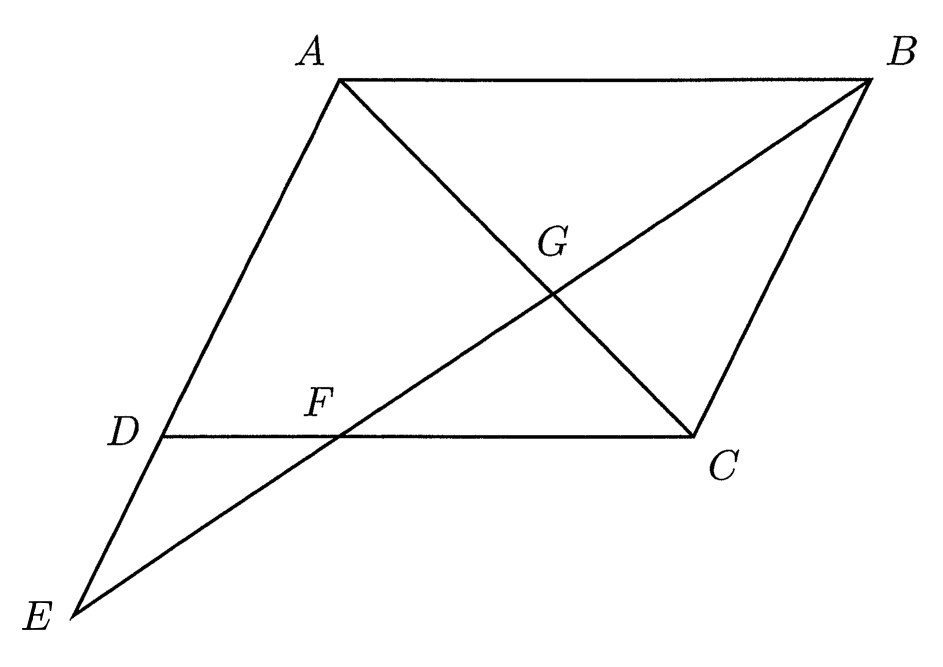
In the diagram, $ABCD$ is a parallelogram, and $AE,BE$ are straight lines. Let $F,G$ be the intersections of $BE$ with $CD,AC$, respectively. Given $BG=EF$, find $DE/AE$.
Adam has a triangular field $ABC$ with $AB=5$, $BC=8$, $CA=11$. He plans a straight fence from $A$ to a point $D$ on $BC$ so that $AD$ bisects $\angle BAC$. Find the area of the part $ABD$.
For a real number $x$, let $\lfloor x\rfloor$ be the largest integer at most $x$, and let $\{x\}=x-\lfloor x\rfloor$. Real numbers $a,b$, with $b\ne0$, satisfy
$$a=b\left\lfloor\frac ab\right\rfloor-b\left\{\frac ab\right\}.$$
Which statement is incorrect?
If b is an integer, then a is an integer.
If a is a nonzero integer, then b is an integer.
If b is rational, then a is rational.
If a is a nonzero rational number, then b is rational.
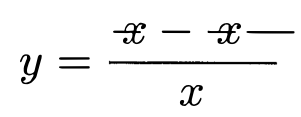
Given that $y$, defined by the expression below, is an integer, which statement is incorrect?
Editorial transcription note: the numerator's special symbols are corrupted in the supplied PDF and cannot be transcribed reliably. The original formula is retained here for review; no definite replacement is assumed.
Teachers $A,B,C$ work in different schools $X,Y,Z$ and specialize in different subjects: Mathematics, Latin and Music. It is known that:
(i) $A$ does not teach Mathematics and $B$ does not work in $Z$;
(ii) the teacher in $Z$ teaches Music;
(iii) the teacher in $X$ does not teach Latin;
(iv) $B$ does not teach Mathematics.
Which statement is correct?
Find the four-digit number $\overline{abcd}$ satisfying $2\overline{abcd}+1000=\overline{dcba}$. (For example, if $a=1,b=2,c=3,d=4$, then $\overline{abcd}=1234$.)
For real $x$, let $\lfloor x\rfloor$ be the largest integer at most $x$. Find $\lfloor x\rfloor$ for the smallest $x$ satisfying $\lfloor x^2\rfloor-\lfloor x\rfloor^2=100$.
Let $A$ be a four-digit integer. Increase its first (leftmost) and third digits by $n$, and decrease its second and fourth digits by $n$. The resulting number is $nA$. Find $A$.