In a plane rectangular coordinate system $xOy$, the graph of function $y = \frac{1}{|x|}$ is $\Gamma$. Let points $P, Q$ on $\Gamma$ satisfy: $P$ is in the first quadrant, $Q$ is in the second quadrant, and line $PQ$ is tangent to the part of $\Gamma$ in the second quadrant at point $Q$. Find the minimum of $|PQ|$.
Given function $f(x) = |2 - \log_3 x|$, positive real numbers $a, b, c$ satisfy $a \lt b \lt c$ and $f(a) = 2f(b) = 2f(c)$. Find the minimum of $\frac{ac}{b}$.
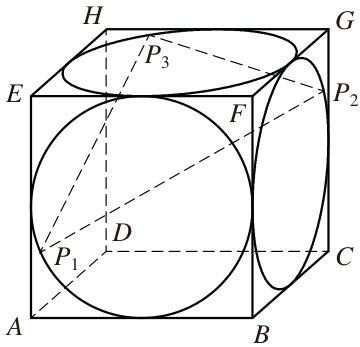
As shown in Fig. 11.1, the edge length of cube $ABCD$–$EFGH$ is $2$. Take any point $P_1$ on the incircle of square $ABFE$, take any point $P_2$ on the incircle of square $BCGF$, and take any point $P_3$ on the incircle of square $EFGH$. Find the minimum and maximum of $|P_1P_2| + |P_2P_3| + |P_3P_1|$.
As shown in Fig. 11.1, in a plane rectangular coordinate system $xOy$, the left and right foci of the ellipse $\Gamma : \frac{x^2}{2} + y^2 = 1$ are $F_1, F_2$, respectively. Let $P$ be a point on $\Gamma$ in the first quadrant, and the extensions of $PF_1, PF_2$ intersect $\Gamma$ at points $Q_1, Q_2$, respectively. Let $r_1, r_2$ be the radii of the incircles of $\triangle PF_1Q_2, \triangle PF_2Q_1$, respectively. Find the maximum of $r_1 - r_2$.
Let $a, b$ be real numbers and function $f(x) = x^3 + a x^2 + b x$. If there exist three real numbers $x_1, x_2, x_3$ satisfying $x_1 + 1 \le x_2 \le x_3 - 1$ and $f(x_1) = f(x_2) = f(x_3)$. Find the minimum of $|a| + 2|b|$.
As shown in Fig. 11.1, in a plane rectangular coordinate system $xOy$, the left and right foci of ellipse $\Gamma: \frac{x^2}{2} + y^2 = 1$ are $F_1, F_2$, respectively. Let $P$ be a point on $\Gamma$ in the first quadrant and the extensions of $PF_1, PF_2$ intersect $\Gamma$ at points $Q_1(x_1, y_1), Q_2(x_2, y_2)$, respectively.
At a dinner party there are $N$ hosts and $N$ guests, seated around a circular table, where $N \geq 4$. A pair of two guests will chat with one another if either there is at most one person seated between them or if there are exactly two people between them, at least one of whom is a host. Prove that no matter how the $2N$ people are seated at the dinner party, at least $N$ pairs of guests will chat with one another.
A function $f$ from the positive integers to the positive integers is called Canadian if it satisfies
$$
\operatorname{gcd}(f(f(x)), f(x+y)) = \operatorname{gcd}(x, y)
$$
for all pairs of positive integers $x$ and $y$.
Find all positive integers $m$ such that $f(m) = m$ for all Canadian functions $f$.
Nina and Tadashi play the following game. Initially, a triple $(a, b, c)$ of nonnegative integers with $a+b+c=2021$ is written on a blackboard. Nina and Tadashi then take moves in turn, with Nina first. A player making a move chooses a positive integer $k$ and one of the three entries on the board; then the player increases the chosen entry by $k$ and decreases the other two entries by $k$. A player loses if, on their turn, some entry on the board becomes negative.
Find the number of initial triples $(a, b, c)$ for which Tadashi has a winning strategy.
Given a convex $n$-gon ($n \ge 5$) $\Omega: P_1P_2...P_n$, of which no three diagonals are concurrent inside $\Omega$. Prove that one can choose a point inside every quadrilateral $P_iP_jP_kP_l$ ($1 \le i \lt j \lt k \lt l \le n$) and not on any diagonal of $\Omega$, such that the $C_n^4$ points obtained are distinct and the segment connecting any two of them intersects with at least one diagonal of $\Omega$.
(Contributed by Leng Fusheng)
Given integer $n \ge 2$. Find the least positive integer $m$, such that there are $n^2$ distinct positive real numbers $x_{i,j}$ ($1 \le i, j \le n$) satisfying the following conditions:
(1) For every $i, j$,
$$
x_{i,j} = \max\{x_{i,1}, x_{i,2}, \dots, x_{i,j}\} \text{ or}
$$
$$
x_{i,j} = \max\{x_{1,j}, x_{2,j}, \dots, x_{i,j}\};
$$
(2) For every $i$, there are at most $m$ indices $k$, with
$$
x_{i,k} = \max\{x_{i,1}, x_{i,2}, \dots, x_{i,k}\};
$$
(3) For every $j$, there are at most $m$ indices $k$, with
$$
x_{k,j} = \max\{x_{1,j}, x_{2,j}, \dots, x_{k,j}\}.
$$
Given positive integers $n$ and $k$, $n \gt k^2 \gt 4$. In an $n \times n$ grid, any $k$ squares in distinct rows and distinct columns are called a $k$-set. Find the largest positive integer $N$ satisfying that: one can choose $N$ squares of the $n \times n$ grid and colour them in a certain way, such that for any coloured $k$-set, some two squares have the same colour, and some two squares have different colours.
Given positive integers $k$ and $n$ ($n \ge 2$), find the minimum constant $c$ satisfying this assertion: if $G$ is a simple $kn$-regular graph (the degree of each vertex is $kn$) with $m$ vertices, then each vertex can be coloured one of $n$ colours, such that the number of “mono edges” is at most $cm$. Here, a mono edge is an edge incident to two vertices of the same colour.
Given $2021$ distinct positive integers $a_1, a_2, \dots, a_{2021}$. Define the sequence $\{a_n\}$ inductively as follows: for each integer $n \ge 2022$, $a_n$ is the smallest positive integer different from $a_1, a_2, \dots, a_{n-1}$ and not dividing the product $a_{n-1}a_{n-2}\dots a_{n-2021}$. Prove: there exists a positive integer $M$, such that all integers greater than or equal to $M$ appear in $\{a_n\}$.
As described in Fig. 2.1, let $ABC$ be an acute triangle with $AB\lt AC$, incentre $I$, and circumcircle with centre $O$. Let $M,N$ be the midpoints of arc $BAC$ and of arc $BC$ not containing $A$, respectively. Let $D$ lie on arc $AC$ with $AD\parallel BC$. The $A$-excircle touches $BC$ at $E$. A point $F$ inside triangle $ABC$ satisfies $IF\parallel BC$ and $\angle BAF=\angle CAE$. The line $NF$ meets the circumcircle again at $R\ne N$, the lines $AF$ and $DI$ meet at $K$, and the lines $AR$ and $IF$ meet at $L$. Prove that $NK\perp ML$.
Source wording correction: $\odot O$ denotes the circumcircle with centre $O$, not the circumcentre itself. The phrase “inscribed circle ... against $\angle BAC$” is rendered as the $A$-excircle, consistently with the source proof's explicit use of excircle contact lengths $BZ=CE$; it is not the incircle. Figure labels 2.1–2.3 occur in the source text, but the record contains no corresponding image or image link.
Find the largest constant $C \gt 0$, such that for any integer $n \ge 2$, one can find real numbers $x_1, x_2, \dots, x_n \in [-1, 1]$ satisfying
$$
\prod_{1 \le i \lt j \le n} (x_i - x_j) \ge C^{\frac{n(n-1)}{2}}.
$$
Let $S(k)$ denote the sum of all digits of $k$ in base 10. Find all integers $n \ge 2$ and rational numbers $\beta \in (0,1)$, such that there exist $n$ distinct positive integers $a_1, a_2, \dots, a_n$ that satisfy: for any subset $I \subseteq \{1, 2, \dots, n\}$ with two or more elements,
$$ S\left(\sum_{i \in I} a_i\right) = \beta \cdot \sum_{i \in I} S(a_i). $$
For a positive integer $n$, let $\varphi(n)$ represent the number of positive integers not exceeding $n$ and relatively prime to $n$. Find all functions $f:\mathbb{N}_+ \to \mathbb{N}_+$ satisfying that for any positive integers $m, n$ with $m \ge n$,
$$f(m\varphi(n^3)) = f(m)\varphi(n^3).$$
For each positive integer $N$, let $\tau(N)$ be the number of positive factors of $N$; $\omega(N)$ be the number of distinct prime factors of $N$; $\Omega(N)$ be the number of prime factors (counts multiplicities) of $N$. Prove: for each positive integer $n$,
$$
\sum_{m=1}^{n} 5^{\omega(m)} \le \sum_{k=1}^{n} \lfloor \frac{n}{k} \rfloor \tau(k)^2 \le \sum_{m=1}^{n} 5^{\Omega(m)}.
$$
Here, $\lfloor x \rfloor$ is the largest integer not exceeding $x$.