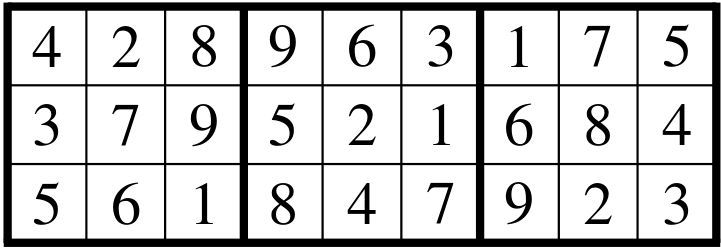
The 27 cells of a $3 \times 9$ grid are filled in using the numbers 1 through 9 so that each row contains 9 different numbers, and each of the three $3 \times 3$ blocks heavily outlined in the example below contains 9 different numbers, as in the first three rows of a Sudoku puzzle.
The number of different ways to fill such a grid can be written as $p^a \cdot q^b \cdot r^c \cdot s^d$, where $p, q, r$, and $s$ are distinct prime numbers and $a, b, c$, and $d$ are positive integers. Find $p \cdot a + q \cdot b + r \cdot c + s \cdot d$.
Let $k$ be a real number such that the system
$$
\begin{aligned}
|25 + 20i - z| &= 5 \\
|z - 4 - k| &= |z - 3i - k|
\end{aligned}
$$
has exactly one complex solution $z$. The sum of all possible values of $k$ can be written as $\frac{m}{n}$, where $m$ and $n$ are relatively prime positive integers. Find $m+n$. Here $i = \sqrt{-1}$.
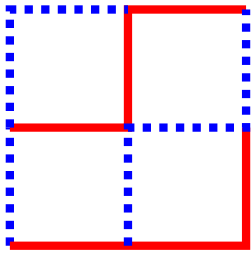
Four unit squares form a $2 \times 2$ grid. Each of the $12$ unit line segments forming the sides of the squares is colored either red or blue in such a way that each unit square has $2$ red sides and $2$ blue sides. One example is shown below (red is solid, blue is dashed). Find the number of such colorings.
Let $\triangle ABC$ be a right triangle with $\angle A = 90^\circ$ and $BC = 38$. There exist points $K$ and $L$ inside the triangle such that
$$
AK = AL = BK = CL = KL = 14.
$$
The area of the quadrilateral $BKLC$ can be expressed as $n\sqrt{3}$ for some positive integer $n$. Find $n$.
The chess King was placed on a cell of the board $8 \times 8$, and then he made $64$ moves so that he visited all the cells and returned back to the initial cell. At each moment, we calculate the distance from the center of the cell occupied by the King to the center of the board. We call the move *pleasant* if after the move this distance became less than it was before the move. Find the greatest possible number of pleasant moves.
(By one move the chess King moves to a cell adjacent by a side or by a vertex.)
Diagonals of a convex quadrilateral $ABCD$ intersect at $E$. The four points of tangency of the circles $(ABE)$ and $(CDE)$ with their external common tangents lie on a circle $\omega$. Analogously, the four points of tangency of the circles $(ADE)$ and $(BCE)$ with their external common tangents lie on a circle $\gamma$. Prove that the centers of $\omega$ and $\gamma$ coincide.
On the boundary of triangle $ABC$ points $D_1, D_2, E_1, E_2, F_1, F_2$ are chosen so that when going around the perimeter, the points are encountered in the following order: $A, F_1, F_2, B, D_1, D_2, C, E_1, E_2$. Given that $AD_1 = AD_2 = BE_1 = BE_2 = CF_1 = CF_2$, prove that two triangles formed by the triples of lines $AD_1, BE_1, CF_1$, and $AD_2, BE_2, CF_2$, have equal perimeters.
Let $P$ be a point lying inside triangle $ABC$. Let $Q$ be a point on the segment $AB$, and let $R$ be a point on the segment $AC$ such that both circles ($BPQ$) and ($CPR$) are tangent to line $AP$. Through $B$ and $C$ we draw the lines passing through the center of the circle ($BPC$), and through $Q$ and $R$ we draw the lines passing through the center of the circle ($PQR$). Prove that there exists a circle tangent to the four drawn lines.
A right prism $ABC A_1 B_1 C_1$ is given. It is known that triangles $A_1 BC$, $AB_1 C$, $ABC_1$, and $ABC$ are acute-angled. Prove that the orthocenters of these triangles, and the centroid of $ABC$ lie on a sphere.
Let $\triangle ABC$ be a triangle with $\angle BAC = 2\angle CBA$ and $AB \lt AC$. A point $P$ lies on segment $AC$ such that $PC = AB + AP$. Let $O$ be the circumcentre of triangle $\triangle ABP$, and let the line through $O$ parallel to $AB$ intersect $BP$ at $Q$. Show that $AQ$ passes through the midpoint of segment $BC$.
Let $\triangle ABC$ be an acute-angled triangle with orthocenter $H$ and let $D$ be an arbitrary point on side $BC$. Let $E$ and $Z$ be the points on the segments $AB$ and $AC$ respectively such that the quadrilaterals $ABDZ$ and $ACDE$ are cyclic, and let segments $BZ$ and $CE$ intersect at $P$. Let $L$ be the intersection point of line $HA$ and the tangent to the circumcircle of triangle $\triangle PBC$ at point $C$. If lines $BH$ and $CP$ intersect at $X$, prove that $D$ lies on the line $LX$.
Let $I$ be the incenter of triangle $\triangle ABC$, and $D$ be an arbitrary point on arc $\widehat{AB}$, not containing point $C$, of the circumcircle of $\triangle ABC$. Let $I_A$ and $I_B$ be the incenters of $\triangle BCD$ and $\triangle ACD$ respectively. Lines $DI_A$ and $II_B$ intersect at point $X_A$, and lines $DI_B$ and $II_A$ intersect at point $X_B$. Prove that the intersection of lines $X_A X_B$ and $I_A I_B$ lies on a fixed line, independent of the choice of $D$.
Let $ABCD$ be a convex quadrilateral such that $AB^2 + BC^2 = AD^2 + CD^2$. Points $X$ and $Y$ are chosen such that $XD \perp CD$, $XB \perp AB$, $YB \perp BC$ and $YD \perp AD$. Let lines $AC$ and $XY$ meet at $T$ and $M$ be the midpoint of segment $XY$. Prove that points $T, M, B, D$ lie on a circle.
A graph is *good* if its edges can be colored with 2 colors so that no cycle has two consecutive edges of the same color. What is the maximum number of edges in a *good* graph with 1000 vertices?
A rabbit is at some point $(x, y)$ in the Euclidean plane. There are some (possibly infinitely many) landmines, which are circles with any radius that do not intersect except possibly at one point (tangent). Every move, the rabbit can hop a distance of exactly $1$, but cannot land in the interior of a landmine (but may possibly land on the edge). Suppose that neither the rabbit nor the origin is in a landmine. Find the minimum $\varepsilon$ so that the rabbit can always reach a point with a distance of at most $\varepsilon$ from the origin, regardless of the landmine configuration.
Let $ABC$ be a triangle with incentre $I$ and circumcircle $\Omega$. Let $D, E, F$ be the midpoints of the arcs $\overline{BC}, \overline{CA}, \overline{AB}$ of $\Omega$ not containing $A, B, C$, respectively. Let $D'$ be the point of $\Omega$ diametrically opposite to $D$. Show that $I, D'$, and the midpoint $M$ of $[EF]$ lie on a line.
A group of 4050 friends is playing a video game tournament. There are 2025 computers labelled $a_1, \dots, a_{2025}$ in one room and 2025 computers labelled $b_1, \dots, b_{2025}$ in another room at the tournament. The player on computer $a_i$ always plays against the players $b_i, b_{i+2}, b_{i+3}$ and $b_{i+4}$ (in particular, not against $b_{i+1}$), where the numbers of the computers are considered modulo 2025. After the first round, all players choose a computer within their room for the second round. Afterwards, they note that everyone has the same opponents in the second round as in the first round.
Prove that if someone chose the same computer in both rounds, then everyone chose the same computer in both rounds.
The plane was divided by vertical and horizontal lines into unit squares. Determine whether it is possible to write integers into cells of this infinite grid so that:
(i) every cell contains exactly one integer
(ii) every integer appears exactly once
(iii) for every two cells $A$ and $B$ sharing exactly one vertex, if they contain integers $a$ and $b$ then at least one of the cells sharing a common side with both $A$ and $B$ contains an integer between $a$ and $b$.
Let point $P$ lie on the nine-point circle of triangle $ABC$. A line through $P$ perpendicular to $AP$ intersects $BC$ at $Q$. A line through $A$ perpendicular to $AQ$ intersects $PQ$ at $X$. Let $H$ be the orthocenter of triangle $ABC$, and let $D$ and $M$ be the midpoints of segments $BC$ and $AQ$, respectively. Prove that $XH \perp DM$.
Let $\triangle ABC$ be a triangle with circumcircle $\Gamma$. Let $M$ be the midpoint of the arc $BC$ of $\Gamma$ on which $A$ does not lie. The point $N$ on $\Gamma$ is the antipode of $A$. The line through $B$ perpendicular to $AM$ intersects $AM$ at the point $D$ and intersects $\Gamma$ a second time at the point $P \neq B$. The line through $D$ perpendicular to $AC$ intersects $AC$ at the point $E$ and intersects $BC$ at the point $F$.
Prove that $ND$, $MF$ and $PE$ are concurrent.