On a square $2012 \times 2012$ checkerboard, L-triominoes like those shown below are placed without overlapping (each L-triomino covers exactly $3$ squares of the board). Determine how many L-triominoes can be placed as a maximum on the board if for any two rows and any two columns, at least one of the four intersection unit squares is not covered by an L-triomino.
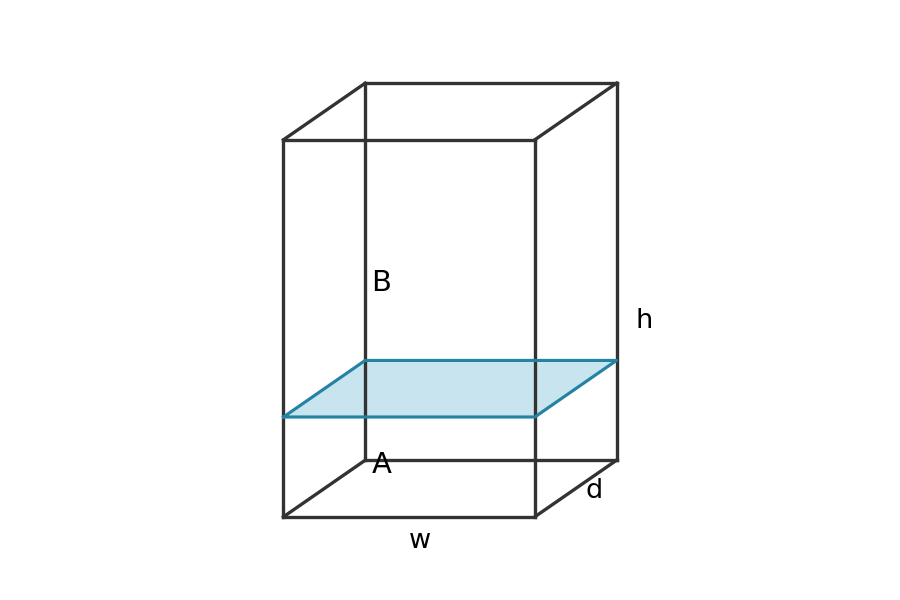
David is a very curious child. He has a container in the shape of a rectangular cuboid such that its three dimensions (width, height and depth) are different positive integers. The container is filled with two different unmixable liquids, $A$ and $B$, and the volume of $A$ is $36\%$ of the volume of $B$.
David observes that, when laying the recipient on any of its six faces, the height that each liquid reaches is a positive integer.
Which is the smallest possible volume of David's container?
Let $N = 2012$. Find all $N^2$-uples of real numbers $a_{i,j}$, $1 \le i, j \le N$, such that the following limit is convergent:
$$
\lim_{x \to +\infty} \sum_{1 \le i,j \le N} \left(a_{i,j} \sqrt[j]{x+i}\right)
$$
Let $n \in \mathbb{N}$ be such that $n^3 + 1$ is divisible by $56$, and $d_1^6 + d_2^6 + \dots + d_k^6$ is divisible by $112$, where $d_1, d_2, \dots, d_k$ are all the positive divisors of $n$. Which is the smallest amount of divisors that $n$ can have?
Find all integer positive numbers $r$ and $s$ such that the integer positive number $n = 2^r - 16^s$ gives remainder $5$ when divided by $7$. Find the smallest $n$ satisfying this condition.
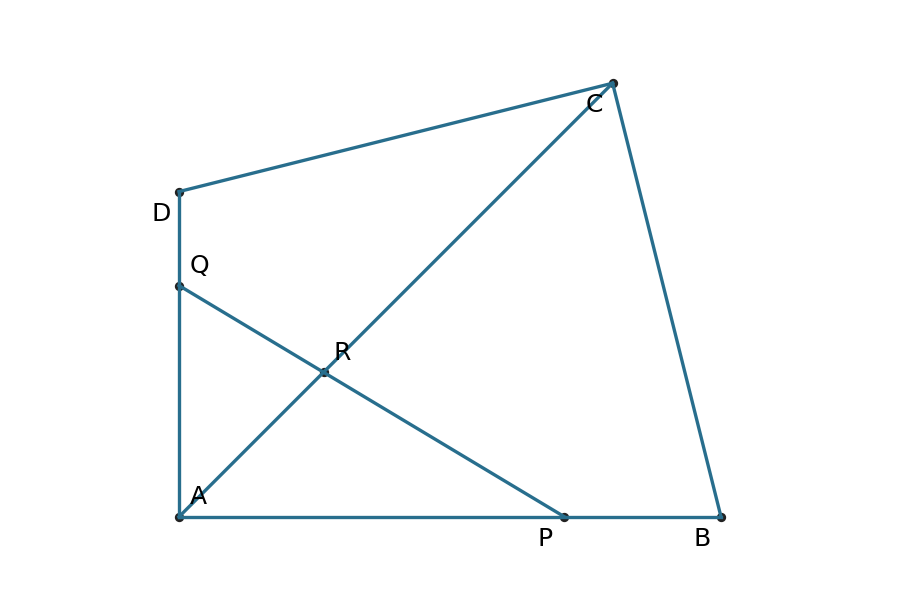
Let $ABCD$ be a convex quadrilateral. Let $P$ and $Q$ be points on the sides $AB$ and $AD$, respectively, such that $area(ABQ) = area(ADP) = \frac{1}{3} area(ABCD)$.
$PQ$ and the diagonal $AC$ meet at the point $R$.
Calculate the ratio $\frac{AR}{RC}$.
In this problem, a box is a parallelepiped $P \in \mathbb{R}^3$. We define the size of a box $P$ as $a^s + b^s + c^s$, $a, b, c$ being its dimensions and $s$ a fixed integer.
Find all values of $s$ such that the following statement is true: if a box $P_1$ is inside box $P_0$ then the size of $P_1$ does not exceed size of box $P_0$.
The boxes are allowed to be in any position; in particular, they need not to have its edges parallel to the axes.
Decide, with proof, if each of the following statement is true.
a. If $(a_n)_{n \ge 1}$ is a decreasing sequence with positive terms such that $\sum a_n = +\infty$ then there exists a decreasing sequence $(b_n)_{n \ge 1}$ with positive terms with $b_n \le a_n$ for all $n$, $\sum b_n = +\infty$ and $\lim(n b_n) = 0$.
b. If $(a_n)_{n \ge 1}$ is a decreasing sequence with positive terms such that $\sum a_n = +\infty$ then there exists a decreasing sequence $(b_n)_{n \ge 1}$ with positive terms with $b_n \le a_n$ for all $n$, $\sum b_n = +\infty$ and $(n b_n)_{n \ge 1}$ decreasing.
Let be given two positive real numbers $a_0$ and $a_1$. The sequence $(a_n)$ is defined by
$$
a_{n+2} = 1 + \frac{a_{n+1}}{a_n}, \quad n = 0,1,2,\ldots
$$
Prove that $|a_{2012} - 2| \lt 10^{-200}$.
Let $x_1,x_2,\ldots$ be defined by $x_1=1$, $x_2=2011$, and $x_{n+2}=4022x_{n+1}-x_n$ for every $n\ge1$. Prove that $\frac{x_{2012}+1}{2012}$ is a perfect square.
There are 42 contestants in the selection contest for the International Mathematical Olympiad team. Each contestant knows exactly 20 other contestants. Prove that the contestants can be divided either into 2 groups or into 21 groups, with equal group sizes in the chosen partition and every two people in each group knowing one another.
On a right-angled triangle with hypotenuse length $1$, $25$ points are drawn. Prove that at least $9$ of them can always be covered by a $\frac{3}{10}$ radius half-circle.
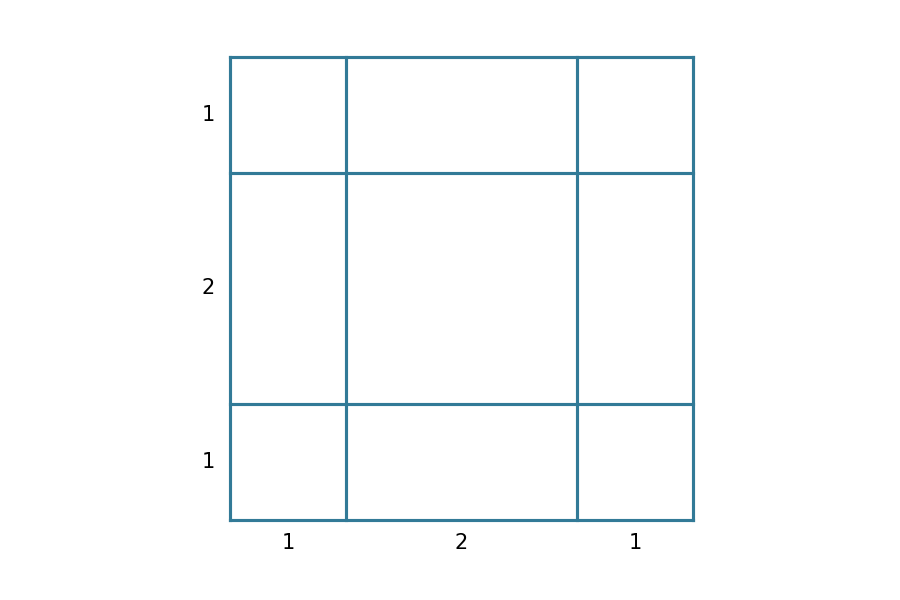
A rectangle is divided in $n^2$ smaller rectangles by means of $n-1$ horizontal lines and $n-1$ vertical lines. Among those rectangles, there are exactly 5660 which are not congruent. For which minimum value of $n$ is this possible?
Consider all matrices of order $4n$ with $4n$ entries equal to $1$, $4n$ entries equal to $-1$ and all remaining entries equal to $0$. Find, in terms of $n$, the maximum of its determinant.
Let $ABC$ be a triangle inscribed in a circle $(O)$. Let $D$ be a point on the arc $BC$ not containing $A$. Suppose that the tangent of $(O)$ at $D$ meets $BC$ at $E$. The circumcircle of $ODE$ meets $AD$ at second point $F$ (different to $D$). The line $EF$ meets $AB$ at $M$, the line $DM$ meet $(O)$ at the second point $K$ (different to $D$).
Prove that $K,F,C$ are collinear.
Each member of a population has two genes (possibly repeated) among the genes $G_1, G_2, \dots, G_n$. Suppose that, in generation 0 of this population, $p_{ij}(0)$ ($1 \le i, j \le n$) is the proportion of members of this population with genotype $G_i G_j$ (or $G_j G_i$, which is biologically identical to $G_i G_j$).
To generate each member of generation $k+1$, two members of generation $k$ are chosen independently and at random, and one gene of each member is chosen independently and at random: these two genes will be the genotype of their breed. Let $p_{ij}(k)$ be the probability that a member of generation $k$ has genotype $G_i G_j$ (or $G_j G_i$). Suppose the population is big enough in a way that at least two members are generated.
Prove that $p_{ij}(2012) = p_{ij}(2013)$ for all $i, j$ ($1 \le i, j \le n$).
Let $ABC$ be a triangle, $P$ an interior point, and points $H_A$, $H_B$ and $H_C$ the orthocenter of triangles $PBC$, $PAC$ and $PAB$ respectively. Prove that triangles $H_AH_BH_C$ and $ABC$ have the same area.
Let $p$ be a prime number, and let $x$ and $n$ be integers such that $1 \le x \lt n$. We have $x + 1$ different boxes and $n - x$ identical balls. Let us call $f(n,x)$ the number of ways in which one can distribute the $n - x$ into the $x + 1$ boxes. Find all integers $n$ greater than $1$ such that $p$ divides $f(n,x)$ for every $x \in \{1,2,...,n\}$