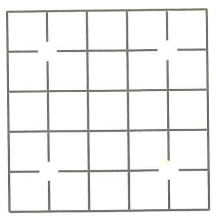
An ant starts at $(0,0)$ in the southwest corner of a $5\times5$ grid and moves east or north along its lines to $(5,5)$. It cannot pass through the four broken intersections $(1,1),(1,4),(4,1),(4,4)$. How many different paths are possible?
On a circle are $n$ numbers with sum ninety-four. Each equals the absolute difference of the next two in clockwise order. Find the sum of all possible values of $n$.
Decreasing the thousands digit of a four-digit square by three and increasing its units digit by three gives another four-digit square. What is the original number?
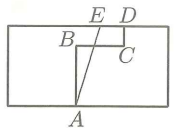
The broken line $A-B-C-D$ consists of segments parallel to rectangle edges and bisects its area. Point $E$ on the perimeter makes $AE$ also bisect the area. Given $AB=30$, $BC=24$, $CD=10$ cm, find $DE$ in cm.
Two facing vertical mirrors form a thirty-degree angle at $V$. A horizontal beam from $S$, parallel to one mirror, strikes the other at $A$ and eventually returns to $S$. If $SA=AV=1$ cm, find its total travel distance in cm.
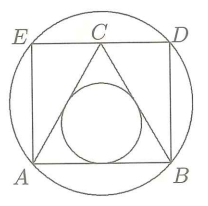
$ABC$ is equilateral, and $ABDE$ is a rectangle whose side $DE$ passes through $C$. The incircle of $ABC$ has radius one cm. Find the diameter of the circle through $A,B,D,E$ in cm.
Find $\left\lfloor\sqrt{2008+\sqrt{2008+\sqrt{2008+\cdots}}}\right\rfloor$, with exactly $2008$ occurrences of $2008$. Here the brackets denote the greatest integer not exceeding the number.
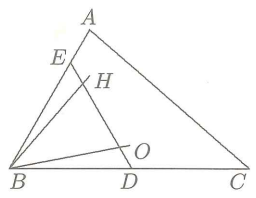
Triangle $ABC$ has $\angle ABC=60^\circ$, circumcentre $O$, orthocentre $H$. Points $D\in BC$, $E\in AB$ satisfy $BD=BH$, $BE=BO$. If $BO=1$ cm, find area $BED$ in square cm.
The fraction $p/q$ is in lowest terms and has decimal expansion $0.ababab\ldots$. Digits $a,b$ may coincide but cannot both be zero. How many different numerators $p$ are possible?
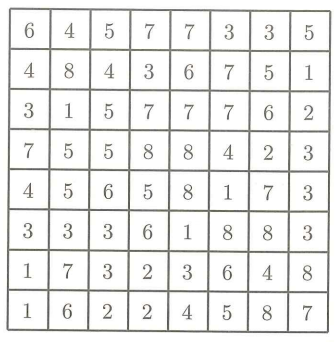
Cover as few cells as possible in the shown $8\times8$ number table so no equal uncovered numbers share a row or column. Two cells sharing an edge cannot both be covered.
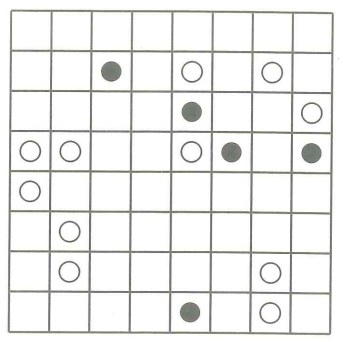
Draw one closed, non-self-intersecting path through edge-adjacent cells of the shown $8\times8$ board. It must visit every circled cell, but need not visit all cells. At every black circle it turns, but at neither the previous nor the next cell may it turn. At every white circle it continues straight, but must turn at the previous or next cell, or both.
Consider boxes with integer dimensions $1\le a\le b\le c\le5$. One box fits inside another exactly when all three corresponding dimensions do not exceed the other dimensions. What is the greatest number of boxes one can choose with none fitting inside another?
Initially one and four are on a blackboard. At each move choose numbers $a,b$ on it and add $c=ab+a+b$. Find the smallest number at least $2008$ that can appear.