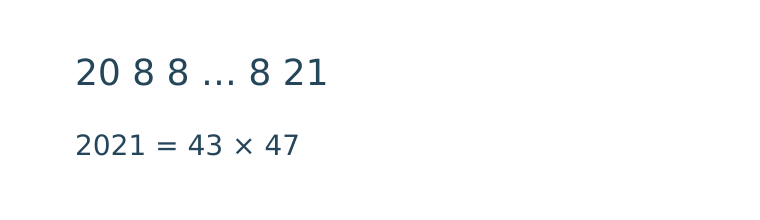
The number $2021=43\cdot47$ is composite. Prove that inserting any number of digits 8 between 20 and 21 gives another composite number. (4 points)
Neutral editorial illustration.
Practice scoring adds all whole-question scores (maximum 52). Official ITOT scoring adds only the three highest whole-question scores (maximum 30), after summing subparts within each question. The importer does not enforce best-three scoring. Duration: 300 minutes from historical organizer general rules, not an individually printed duration on this paper.
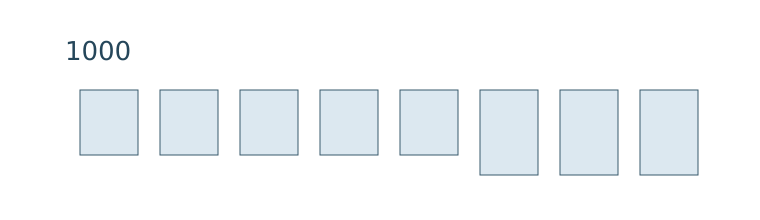
A room contains several children and a bag of 1000 sweets. In some order each child divides the current number of sweets by the number of children still in the room, rounds the result if needed, takes that many sweets and leaves. Boys always round upwards and girls downwards. The process continues until the room is empty. Prove that the total sweets received by the boys does not depend on the order. (5 points)
In equilateral triangle $ABC$, point $E$ lies on $AB$, point $F$ on $AC$, and point $K$ on the line $AB$ outside segment $AB$, with $AE=CF=BK$. Let $P$ be the midpoint of $EF$. Prove that $\angle KPC$ is a right angle. (6 points)
An island has 50 natives standing in a circle. Each announces first the age of the neighbour on the left, then the age of the neighbour on the right. A truth-teller gives both ages correctly; a liar decreases one age by 1 and increases the other by 1, choosing which. From all the announcements, can a visitor always determine the type of every native? (7 points)
At the centre of every cell of a rectangular grid $M$ is a point-sized light bulb, initially off. In one turn choose a line passing through no bulb such that all bulbs on one side are off, and switch on all bulbs on that side. At least one bulb must be switched on each turn. Find the largest possible number of turns to switch on all bulbs for:
100 tourists arrive at a hotel with single rooms numbered $1,2,\ldots,n$. Exactly $k$ rooms, with unknown numbers, are under repair; the others are vacant. Each tourist checks rooms in a chosen order, possibly different for different tourists, and takes the first room not under repair. They cannot see occupancy before checking a room and must never check a room already occupied by another tourist. They coordinate a strategy beforehand. For each $k$, find the smallest $n$ guaranteeing success. (10 points)
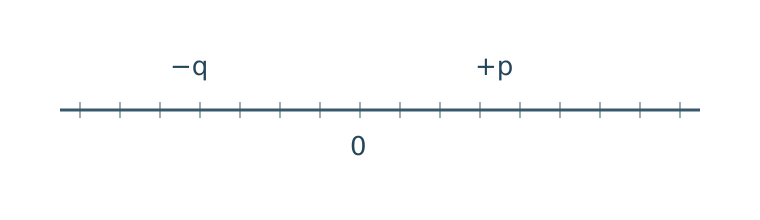
Let $p,q$ be coprime positive integers. A frog starts at 0 on the integer line and makes a nonempty sequence of hops, each either $p$ units right or $q$ units left, eventually returning to 0. Prove that for every positive integer $d<p+q$, two positions visited by the frog differ by exactly $d$. (12 points)
Is it possible that the product of nine consecutive positive integers equals the sum of nine consecutive positive integers (not necessarily the same nine integers)? (4 points)
Editorial illustration; no extra mathematical assumptions.
Practice scoring: add all five whole-question scores (maximum 24). Original ITOT scoring adds only the three highest whole-question scores (maximum 16); sum each question’s subparts before ranking. The importer does not enforce best-three scoring. Duration: 300 minutes, based on historical organizer general rules, not an individually printed time on this paper.
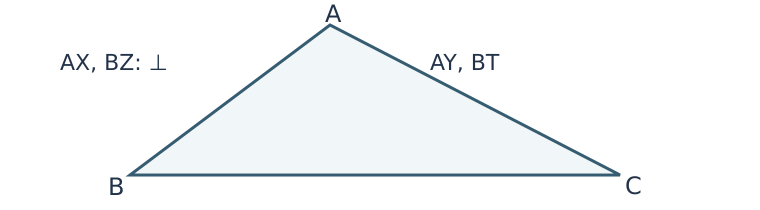
Let $AX$ and $BZ$ be altitudes of triangle $ABC$, and let $AY$ and $BT$ be its angle bisectors. Given $\angle XAY=\angle ZBT$, must triangle $ABC$ be isosceles? (4 points)
Editorial illustration; no extra mathematical assumptions.
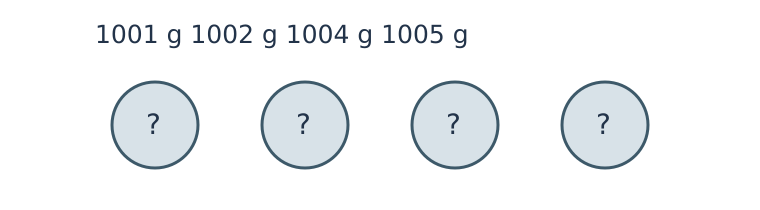
Maria has four weights that look the same but have masses 1001 g,1002 g,1004 g and 1005 g. Using a balance scale that distinguishes a heavier pan from equal weights, can she certainly determine the mass of each weight in four weighings? Later weighings may depend on earlier results. (4 points)
Editorial illustration; no extra mathematical assumptions.
A rectangular grid consists of square cells. Some dominoes occupy two side-adjacent cells each; no two dominoes touch, even at a vertex. The bottom-left and top-right cells are unoccupied. A token starts at the bottom-left and may move one cell right or one cell up through side-adjacent unoccupied cells. Is it always possible to reach the top-right if the board has:
Several children are in a room with 1000 sweets in a bag. In some order, each child divides the current number of sweets by the current number of children in the room, rounds if necessary, takes that many sweets and leaves. Boys always round up and girls always round down. Prove that the total number of sweets taken by the boys is independent of the order. (4 points)
Neutral editorial illustration.
Practice scoring adds all whole-question scores (maximum 53). Official ITOT scoring adds only the three highest whole-question scores (maximum 31), after summing subparts within each question. The importer does not enforce best-three scoring. Duration: 300 minutes from historical organizer general rules, not an individually printed duration on this paper.
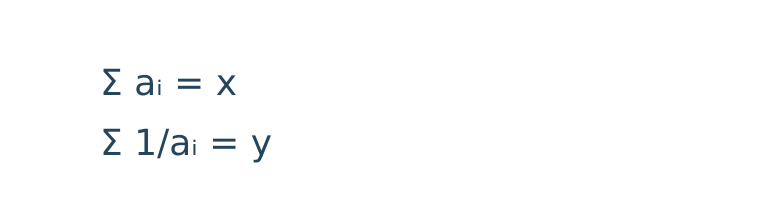
Does there exist a positive integer $n$ such that for every pair of real numbers $x,y$ there are nonzero real numbers $a_1,\ldots,a_n$ satisfying
$$x=a_1+\cdots+a_n,\qquad y=\frac1{a_1}+\cdots+\frac1{a_n}?$$
(5 points)
Let $M$ be the midpoint of side $BC$ of triangle $ABC$. A circle $\omega$ through $A$ touches $BC$ at $M$ and meets $AB,AC$ again at $D,E$, respectively. Let $X,Y$ be the midpoints of $BE,CD$, respectively. Prove that the circumcircle of $MXY$ is tangent to $\omega$. (5 points)
There is a row of $100N$ ham sandwiches. In one action a boy eats the first sandwich from either end; in one action his cat either eats the ham from one remaining sandwich or does nothing. The boy performs 100 actions per turn, the cat one action per turn, and they alternate, with the boy starting. The boy wins if the last sandwich he eats contains ham. Can he guarantee a win for every positive integer $N$, regardless of the cat's play? (8 points)
100 tourists arrive at a hotel with single rooms numbered $1,2,\ldots,n$. Exactly $k$ rooms, with unknown numbers, are under repair; the others are vacant. Each tourist checks rooms in a chosen order, possibly different for different tourists, and takes the first room not under repair. They cannot see occupancy before checking a room and must never check a room already occupied by another tourist. They coordinate a strategy beforehand. For each $k$, find the smallest $n$ guaranteeing success. (8 points)
Find at least one real number $A$ such that for every positive integer $n$, the distance from $\lceil A^n\rceil$ to the nearest perfect square of an integer is exactly 2. Here $\lceil x\rceil$ is the smallest integer not less than $x$. (10 points)
Let $n>2$ be an integer. Peter wants to draw $n$ pairwise disjoint arcs of length $\alpha$ on great circles of the unit sphere. Prove: (a) this is possible for every $\alpha\lt \pi+2\pi/n$; (6 points) (b) this is impossible for every $\alpha>\pi+2\pi/n$. (7 points) Arc lengths are positive; endpoints count as part of an arc.
(a) A convex pentagon is divided into three triangles by non-crossing diagonals. Can the three triangle centroids be collinear? (2 points) (b) Answer the same question for a non-convex pentagon. (2 points)
Neutral editorial illustration.
Practice scoring adds all whole-question scores (maximum 24). Official ITOT scoring adds only the three highest whole-question scores (maximum 16), after summing subparts within each question. The importer does not enforce best-three scoring. Duration: 300 minutes from historical organizer general rules, not an individually printed duration on this paper.