Does there exist a positive integer divisible by 2020 in which all ten digits 0,1,…,9 occur equally often? The book’s printed sentence only asks that the digits occur; the equal-frequency condition is present in the official original and is used here.
Three knights attack a dragon. The first removes half its current heads plus 1; the second removes one third plus 2; the third removes one quarter plus 3. Each attack must remove an integer number of existing heads. They may choose any order and repeat attacks; if no legal attack exists the dragon wins. Can they remove all heads when the initial count is $41!$?
Can an $N$-gon be inscribed in a circle so that all side lengths are distinct and all its interior angles are integers in degrees, for (a) $N=19$; (b) $N=20$?
For which positive integers $N$ can an $N\times N$ grid be filled with real numbers so that the sums over all side-adjacent pairs are exactly the integers 1 through $2N(N-1)$, each once? Include the degenerate one-cell case explicitly.
Alice divides a 36-card deck, with 4 suits and 9 ranks, into 18 cards for herself and 18 for Bob. Each round Alice plays one remaining card, then Bob plays one. Bob scores 1 if their cards have the same suit or rank. What score can Bob guarantee against every initial division and every play by Alice? The official original says the cards are face up; the book says face down. Use the official face-up rule for the intended problem.
Gleb chooses positive integers $a\lt N$ and writes $a$. Repeatedly divide fixed $N$ by the last positive number written and append the remainder; stop when 0 appears. Can the sum of all written numbers exceed $100N$? This is the official original rule. The book reverses the division, saying to divide the last number by $N$; that literal version is discussed separately below.
Squareland is a6-by 6 grid. Each cell is either a kingdom or a disputed territory; there are 27 kingdoms and 9 disputed territories. A kingdom claims a disputed cell exactly when it shares a side or a vertex with it. Can the nine disputed cells all have different numbers of claimants?
Let $ABCD$ be a rhombus and $APQC$ a parallelogram with $B$ inside it and $AP$ equal to a side of the rhombus. Prove that $B$ is the orthocentre of triangle $DPQ$.
Let $n$ be an integer. If $x^2+y^2+z^2-xy-yz-zx=n$ has an integer solution, prove that $u^2+v^2-uv=n$ also has an integer solution. (The source reuses the letters $x,y$ for the second equation.)
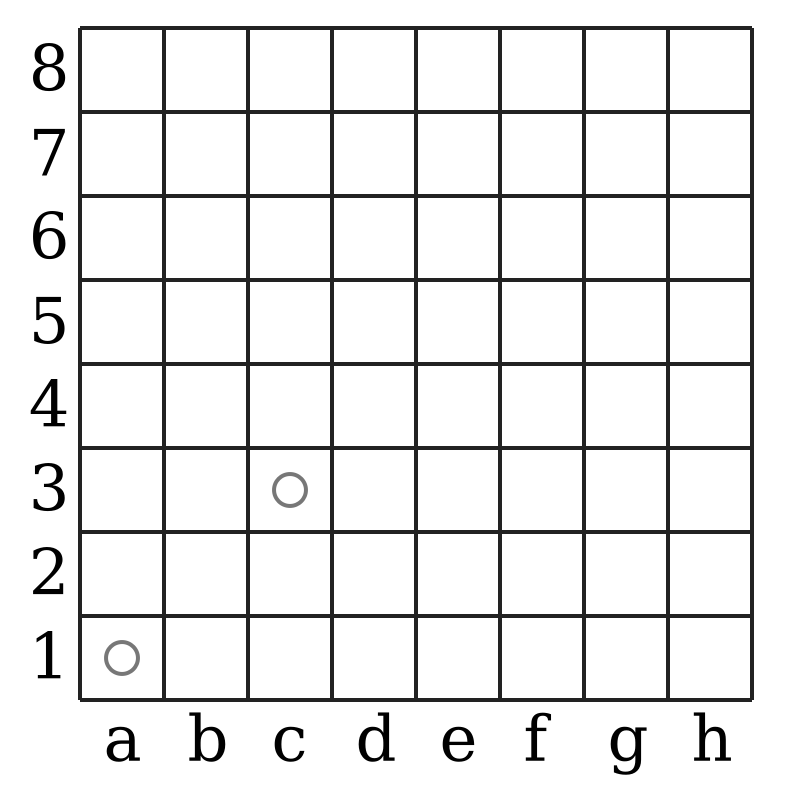
Two identical counters occupy a1 and c3 on an 8-by 8 chessboard. Alice and Bob alternate, Alice first. A move chooses either counter and moves it any positive number of squares rightwards or upwards. At most one counter can occupy a square, and counters cannot jump over each other. The player placing a counter on h8 wins. Who can force a win?
Alice chooses positive integers $a,b,c$. There is exactly one ordered triple of positive integers $(x,y,z)$ satisfying $a=\operatorname{lcm}(x,y)$, $b=\operatorname{lcm}(x,z)$, $c=\operatorname{lcm}(y,z)$. She tells Bob that the triple exists uniquely and gives him $a,b$. Prove that Bob can determine $c$.
Henry has 2 N distinct guests and N identical white hats and N identical black hats. He distributes all hats and arranges the guests into one or more circles, each containing at least two people, with adjacent hat colors different. Prove the number of arrangements is $(2N)!$. Circular order is taken in the usual oriented sense: rotations are identical, reversal is not identified.
Let $ABCD$ be cyclic. The circles with diameters $AB,CD$ intersect at $X_1,Y_1$; those with diameters $BC,AD$ at $X_2,Y_2$; and those with diameters $AC,BD$ at $X_3,Y_3$. Prove the lines $X_1Y_1,X_2Y_2,X_3Y_3$ have a common point. The stated intersections are assumed to be two distinct points for each pair.
There are 2 n consecutive integers on a board. Partition them into pairs and simultaneously replace each pair by its sum and one of its two signed differences. Prove that the resulting 2 n integers cannot again be consecutive.
An infinite square grid is initially white. For which positive integers k can finitely many, but at least one, cells be colored black so that every horizontal, vertical and either-direction diagonal line of cells contains exactly k black cells or none?