Two geometric sequences $a_1,$ $a_2,$ $a_3,$ $\ldots$ and $b_1,$ $b_2,$ $b_3,$ $\ldots$ have the same common ratio, with $a_1 = 27,$ $b_1 = 99,$ and $a_{15} = b_{11}.$ Find $a_9.$
At a certain university, the division of mathematical sciences consists of the departments of mathematics, statistics, and computer science. There are two male and two female professors in each department. A committee of six professors is to contain three men and three women and must also contain two professors from each of the three departments. Find the number of possible committees that can be formed subject to these requirements.
Ana, Bob, and Cao bike at constant rates of $8.6$ meters per second, $6.2$ meters per second, and $5$ meters per second, respectively. They all begin biking at the same time from the northeast corner of a rectangular field whose longer side runs due west. Ana starts biking along the edge of the field, initially heading west, Bob starts biking along the edge of the field, initially heading south, and Cao bikes in a straight line across the field to a point $D$ on the south edge of the field. Cao arrives at point $D$ at the same time that Ana and Bob arrive at $D$ for the first time. The ratio of the field’s length to the field’s width to the distance from point $D$ to the southeast corner of the field can be represented as $p : q : r,$ where $p,$ $q,$ and $r$ are positive integers with $p$ and $q$ relatively prime. Find $p + q + r.$
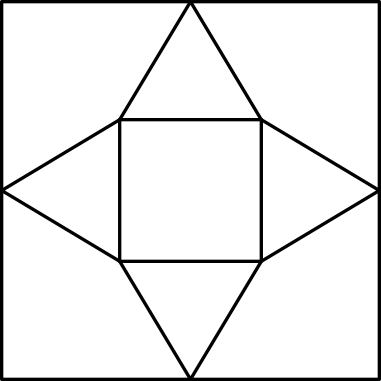
In the accompanying figure, the outer square $S$ has side length $40.$ A second square $S'$ of side length $15$ is constructed inside $S$ with the same center as $S$ and with sides parallel to those of $S.$ From each midpoint of a side of $S,$ segments are drawn to the two closest vertices of $S'.$ The result is a four-pointed starlike figure inscribed in $S.$ The star figure is cut out and then folded to form a pyramid with base $S'.$ Find the volume of this pyramid.
Let $z = a + b\mathrm{i}$ be the complex number with $|z| = 5$ and $b \gt 0$ such that the distance between $(1 + 2\mathrm{i})z^3$ and $z^5$ is maximized, and let $z^4 = c + d\mathrm{i}.$ Find $c + d.$
Let $S$ be the increasing sequence of positive integers whose binary representation has exactly $8$ ones. Let $N$ be the $1000$th number in $S.$ Find the remainder when $N$ is divided by $1000.$
The complex numbers $z$ and $w$ satisfy the system $$
z + \frac{20\mathrm{i}}{w} = 5 + \mathrm{i},
$$ $$
w + \frac{12\mathrm{i}}{z} = -4 + 10\mathrm{i}.
$$
Let $x$ and $y$ be real numbers such that $\frac{\sin x}{\sin y} = 3$ and $\frac{\cos x}{\cos y} = \frac{1}{2}.$ The value of $\frac{\sin 2x}{\sin 2y} + \frac{\cos 2x}{\cos 2y}$ can be expressed in the form $\frac{p}{q},$ where $p$ and $q$ are relatively prime positive integers. Find $p + q.$
Let $f_1(x) = \frac{2}{3} - \frac{3}{3x + 1},$ and for $n \ge 2,$ define $f_n(x) = f_1(f_{n-1}(x)).$ The value of $x$ that satisfies $f_{1001}(x) = x - 3$ can be expressed in the form $\frac{m}{n},$ where $m$ and $n$ are relatively prime positive integers. Find $m + n.$
For a positive integer $p,$ define the positive integer $n$ to be $p$-*safe* if $n$ differs in absolute value by more than $2$ from all multiples of $p.$ For example, the set of $10$-safe numbers is $\{3,$ $4,$ $5,$ $6,$ $7,$ $13,$ $14,$ $15,$ $16,$ $17,$ $23,$ $\ldots\}.$ Find the number of positive integers less than or equal to $10{,}000$ which are simultaneously $7$-safe, $11$-safe, and $13$-safe.
Equilateral $\triangle ABC$ has side length $\sqrt{111}.$ There are four distinct triangles $AD_1E_1,$ $AD_1E_2,$ $AD_2E_3,$ and $AD_2E_4,$ each congruent to $\triangle ABC,$ with $BD_1 = BD_2 = \sqrt{11}.$ Find $\sum_{k=1}^{4}(CE_k)^2.$
In a group of nine people each person shakes hands with exactly two of the other people from the group. Let $N$ be the number of ways this handshaking can occur. Consider two handshaking arrangements different if and only if at least two people who shake hands under one arrangement do not shake hands under the other arrangement. Find the remainder when $N$ is divided by $1000.$
Triangle $ABC$ is inscribed in circle $\omega$ with $AB = 5,$ $BC = 7,$ and $AC = 3.$ The bisector of angle $A$ meets side $\overline{BC}$ at $D$ and circle $\omega$ at a second point $E.$ Let $\gamma$ be the circle with diameter $\overline{DE}.$ Circles $\omega$ and $\gamma$ meet at $E$ and a second point $F.$ Then $AF^2 = \frac{m}{n},$ where $m$ and $n$ are relatively prime positive integers. Find $m + n.$
Find the number of positive integers with three not necessarily distinct digits, $abc,$ with $a \ne 0$ and $c \ne 0$ such that both $abc$ and $cba$ are multiples of $4.$
The terms of an arithmetic sequence add to $715.$ The first term of the sequence is increased by $1,$ the second term is increased by $3,$ the third term is increased by $5,$ and in general, the $k$th term is increased by the $k$th odd positive integer. The terms of the new sequence add to $836.$ Find the sum of the first, last, and middle terms of the original sequence.
Nine people sit down for dinner where there are three choices of meals. Three people order the beef meal, three order the chicken meal, and three order the fish meal. The waiter serves the nine meals in random order. Find the number of ways in which the waiter could serve the meal types to the nine people so that exactly one person receives the type of meal ordered by that person.
Butch and Sundance need to get out of Dodge. To travel as quickly as possible, each alternates walking and riding their only horse, Sparky, as follows. Butch begins by walking while Sundance rides. When Sundance reaches the first of the hitching posts that are conveniently located at one-mile intervals along their route, he ties Sparky to the post and begins walking. When Butch reaches Sparky, he rides until he passes Sundance, then leaves Sparky at the next hitching post and resumes walking, and they continue in this manner. Sparky, Butch, and Sundance walk at $6,$ $4,$ and $2.5$ miles per hour, respectively. The first time Butch and Sundance meet at a milepost, they are $n$ miles from Dodge, and they have been traveling for $t$ minutes. Find $n + t.$
Let $B$ be the set of all binary integers that can be written using exactly $5$ zeros and $8$ ones where leading zeros are allowed. If all possible subtractions are performed in which one element of $B$ is subtracted from another, find the number of times the answer $1$ is obtained.