Professor Oak is feeding his 100 Pokémon. Each Pokémon has a bowl whose capacity is a positive real number of kilograms. These capacities are known to Professor Oak. The total capacity of all the bowls is 100 kilograms. Professor Oak distributes 100 kilograms of food in such a way that each Pokémon receives a non-negative integer number of kilograms of food (which may be larger than the capacity of their bowl). The dissatisfaction level of a Pokémon who received $N$ kilograms of food and whose bowl has a capacity of $C$ kilograms is equal to $|N-C|$.
Find the smallest real number $D$ such that, regardless of the capacities of the bowls, Professor Oak can distribute the food in a way that the sum of the dissatisfaction levels over all the 100 Pokémon is at most $D$.
Let $\mathbb{R}$ be the set of real numbers. Let $f: \mathbb{R} \rightarrow \mathbb{R}$ be a function such that
$$
f(x+y) f(x-y) \geqslant f(x)^{2}-f(y)^{2}
$$
for every $x, y \in \mathbb{R}$. Assume that the inequality is strict for some $x_{0}, y_{0} \in \mathbb{R}$.
Prove that $f(x) \geqslant 0$ for every $x \in \mathbb{R}$ or $f(x) \leqslant 0$ for every $x \in \mathbb{R}$.
Let $a_{1}, a_{2}, \ldots, a_{2023}$ be positive integers such that
- $a_{1}, a_{2}, \ldots, a_{2023}$ is a permutation of $1,2, \ldots, 2023$, and
- $\left|a_{1}-a_{2}\right|,\left|a_{2}-a_{3}\right|, \ldots,\left|a_{2022}-a_{2023}\right|$ is a permutation of $1,2, \ldots, 2022$.
Prove that $\max \left(a_{1}, a_{2023}\right) \geqslant 507$.
Let $k \geqslant 2$ be an integer. Determine all sequences of positive integers $a_{1}, a_{2}, \ldots$ for which there exists a monic polynomial $P$ of degree $k$ with non-negative integer coefficients such that
Let $N$ be a positive integer. Prove that there exist three permutations $a_{1}, a_{2}, \ldots, a_{N}$; $b_{1}, b_{2}, \ldots, b_{N}$; and $c_{1}, c_{2}, \ldots, c_{N}$ of $1,2, \ldots, N$ such that
Let $m$ and $n$ be positive integers greater than 1 . In each unit square of an $m \times n$ grid lies a coin with its tail-side up. A move consists of the following steps:
1. select a $2 \times 2$ square in the grid;
2. flip the coins in the top-left and bottom-right unit squares;
3. flip the coin in either the top-right or bottom-left unit square.
Determine all pairs $(m, n)$ for which it is possible that every coin shows head-side up after a finite number of moves.
Determine the maximal length $L$ of a sequence $a_{1}, \ldots, a_{L}$ of positive integers satisfying both the following properties:
- every term in the sequence is less than or equal to $2^{2023}$, and
- there does not exist a consecutive subsequence $a_{i}, a_{i+1}, \ldots, a_{j}$ (where $1 \leqslant i \leqslant j \leqslant L$ ) with a choice of signs $s_{i}, s_{i+1}, \ldots, s_{j} \in\{1,-1\}$ for which
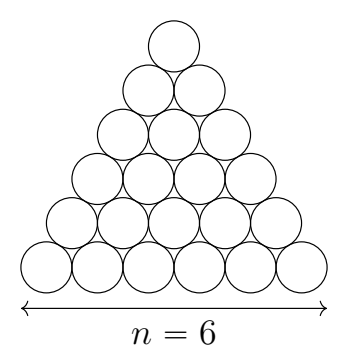
Let $n$ be a positive integer. We arrange $1+2+\cdots+n$ circles in a triangle with $n$ rows, such that the $i^{\text {th }}$ row contains exactly $i$ circles. The following figure shows the case $n=6$.
In this triangle, a ninja-path is a sequence of circles obtained by repeatedly going from a circle to one of the two circles directly below it. In terms of $n$, find the largest value of $k$ such that if one circle from every row is coloured red, we can always find a ninja-path in which at least $k$ of the circles are red.
Let $n \geqslant 2$ be a positive integer. Paul has a $1 \times n^{2}$ rectangular strip consisting of $n^{2}$ unit squares, where the $i^{\text {th }}$ square is labelled with $i$ for all $1 \leqslant i \leqslant n^{2}$. He wishes to cut the strip into several pieces, where each piece consists of a number of consecutive unit squares, and then translate (without rotating or flipping) the pieces to obtain an $n \times n$ square satisfying the following property: if the unit square in the $i^{\text {th }}$ row and $j^{\text {th }}$ column is labelled with $a_{i j}$, then $a_{i j}-(i+j-1)$ is divisible by $n$.
Determine the smallest number of pieces Paul needs to make in order to accomplish this.
Elisa has 2023 treasure chests, all of which are unlocked and empty at first. Each day, Elisa adds a new gem to one of the unlocked chests of her choice, and afterwards, a fairy acts according to the following rules:
- if more than one chests are unlocked, it locks one of them, or
- if there is only one unlocked chest, it unlocks all the chests.
Given that this process goes on forever, prove that there is a constant $C$ with the following property: Elisa can ensure that the difference between the numbers of gems in any two chests never exceeds $C$, regardless of how the fairy chooses the chests to lock.
Let $N$ be a positive integer, and consider an $N \times N$ grid. A right-down path is a sequence of grid cells such that each cell is either one cell to the right of or one cell below the previous cell in the sequence. A right-up path is a sequence of grid cells such that each cell is either one cell to the right of or one cell above the previous cell in the sequence.
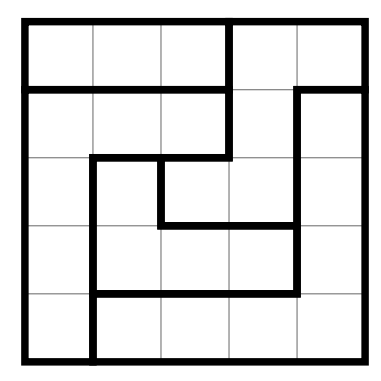
Prove that the cells of the $N \times N$ grid cannot be partitioned into less than $N$ right-down or right-up paths. For example, the following partition of the $5 \times 5$ grid uses 5 paths.
The Imomi archipelago consists of $n \geqslant 2$ islands. Between each pair of distinct islands is a unique ferry line that runs in both directions, and each ferry line is operated by one of $k$ companies. It is known that if any one of the $k$ companies closes all its ferry lines, then it becomes impossible for a traveller, no matter where the traveller starts at, to visit all the islands exactly once (in particular, not returning to the island the traveller started at).
Determine the maximal possible value of $k$ in terms of $n$.
Let $A B C D E$ be a convex pentagon such that $\angle A B C=\angle A E D=90^{\circ}$. Suppose that the midpoint of $C D$ is the circumcentre of triangle $A B E$. Let $O$ be the circumcentre of triangle $A C D$.
Prove that line $A O$ passes through the midpoint of segment $B E$.
Let $A B C$ be a triangle with $A C\gt B C$. Let $\omega$ be the circumcircle of triangle $A B C$ and let $r$ be the radius of $\omega$. Point $P$ lies on segment $A C$ such that $B C=C P$ and point $S$ is the foot of the perpendicular from $P$ to line $A B$. Let ray $B P$ intersect $\omega$ again at $D$ and let $Q$ lie on line $S P$ such that $P Q=r$ and $S, P, Q$ lie on the line in that order. Finally, let the line perpendicular to $C Q$ from $A$ intersect the line perpendicular to $D Q$ from $B$ at $E$.
Let $A B C D$ be a cyclic quadrilateral with $\angle B A D\lt \angle A D C$. Let $M$ be the midpoint of the arc $C D$ not containing $A$. Suppose there is a point $P$ inside $A B C D$ such that $\angle A D B=$ $\angle C P D$ and $\angle A D P=\angle P C B$.
Let $A B C$ be an acute-angled triangle with $A B\lt A C$. Denote its circumcircle by $\Omega$ and denote the midpoint of $\operatorname{arc} C A B$ by $S$. Let the perpendicular from $A$ to $B C$ meet $B S$ and $\Omega$ at $D$ and $E \neq A$ respectively. Let the line through $D$ parallel to $B C$ meet line $B E$ at $L$ and denote the circumcircle of triangle $B D L$ by $\omega$. Let $\omega$ meet $\Omega$ again at $P \neq B$.
Prove that the line tangent to $\omega$ at $P$, and line $B S$ intersect on the internal bisector of $\angle B A C$.
Let $A B C$ be an acute-angled triangle with circumcircle $\omega$ and circumcentre $O$. Points $D \neq B$ and $E \neq C$ lie on $\omega$ such that $B D \perp A C$ and $C E \perp A B$. Let $C O$ meet $A B$ at $X$, and $B O$ meet $A C$ at $Y$.
Prove that the circumcircles of triangles $B X D$ and $C Y E$ have an intersection on line $A O$.
Let $A B C$ be an acute-angled triangle with circumcircle $\omega$. A circle $\Gamma$ is internally tangent to $\omega$ at $A$ and also tangent to $B C$ at $D$. Let $A B$ and $A C$ intersect $\Gamma$ at $P$ and $Q$ respectively. Let $M$ and $N$ be points on line $B C$ such that $B$ is the midpoint of $D M$ and $C$ is the midpoint of $D N$. Lines $M P$ and $N Q$ meet at $K$ and intersect $\Gamma$ again at $I$ and $J$ respectively. The ray $K A$ meets the circumcircle of triangle $I J K$ at $X \neq K$.