Given an acute-angled triangle $ABC$. The points $B'$ and $C'$ lie on the rays opposite to $CA$ and $BA$, respectively, such that $|B'C| = |AB|$ and $|C'B| = |AC|$. Prove that the circumcenter of $AB'C'$ lies on the circumcircle of $ABC$. (Patrik Bak)
Given two odd positive integers $k$ and $n$. For each two positive integers $i, j$ satisfying $1 \le i \le k$ and $1 \le j \le n$ Martin wrote the fraction $i/j$ on the board. Determine the median of all these fractions, that is a real number $q$ such that if we order all the fractions on the board by their values from smallest to largest (fractions with the same value in any order), in the middle of this list will be a fraction with value $q$. (Martin Melicher)
Given an acute-angled scalene triangle $ABC$. The angle bisector of the angle $BAC$ and the perpendicular bisectors of the sides $AB$, $AC$ define a triangle. Prove that its orthocenter lies on the median from the vertex $A$.
Consider the sequence $(a_n)_{n=1}^\infty$ defined as follows:
$$
a_1 = 3 \quad a_n = a_1a_2a_3 \dots a_{n-1} - 1 \quad \text{for all } n \ge 2.
$$
*Prove that there exist*
a) infinitely many primes dividing at least one member of this sequence;
b) infinitely many primes dividing no member of this sequence.
In a convex quadrilateral $ABCD$, $|AB| = |BC| = |CD|$. Let furthermore, for the intersection $P$ of its diagonals, $|\angle APD| \lt 90^\circ$. Let $R$ and $S$ be reflections of $A$ and $D$ with respect to $BD$ and $AC$, respectively. Prove that the lines $BC$ and $RS$ are parallel.
Find all triples of positive integers $a$, $b$, $c$ for which the product
$$(a+b)(b+c)(c+a)(a+b+c+2036)$$
is equal to the power of a prime number with an integer exponent.
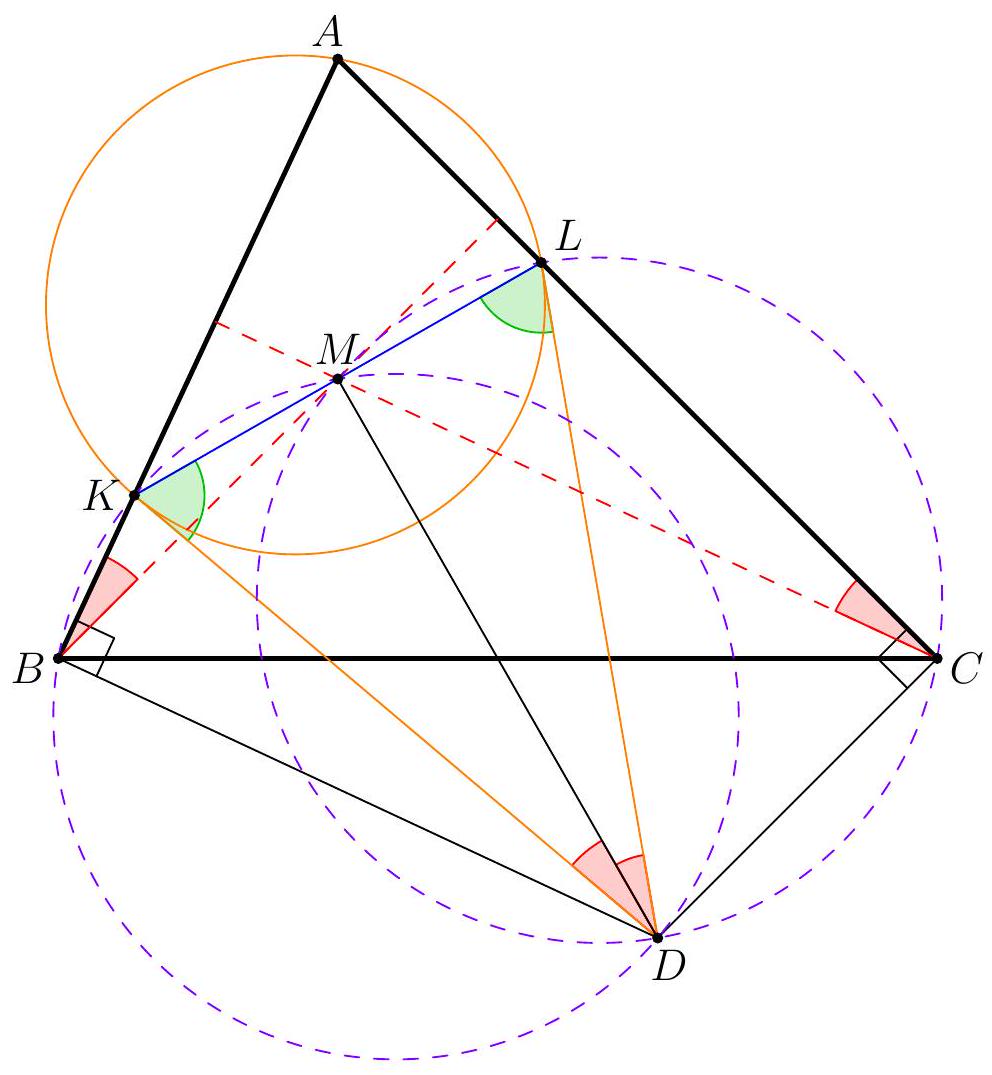
We are given an acute triangle $A B C$. Let $D$ be the point on its circumcircle such that $A D$ is a diameter. Suppose that points $K$ and $L$ lie on segments $A B$ and $A C$, respectively, and that $D K$ and $D L$ are tangent to circle $A K L$.
Show that line $K L$ passes through the orthocentre of $A B C$.
The altitudes of a triangle meet at its orthocentre.
Let $k$ be a positive integer. Lexi has a dictionary $\mathcal{D}$ consisting of some $k$-letter strings containing only the letters $A$ and $B$. Lexi would like to write either the letter $A$ or the letter $B$ in each cell of a $k \times k$ grid so that each column contains a string from $\mathcal{D}$ when read from top-to-bottom and each row contains a string from $\mathcal{D}$ when read from left-to-right.
What is the smallest integer $m$ such that if $\mathcal{D}$ contains at least $m$ different strings, then Lexi can fill her grid in this manner, no matter what strings are in $\mathcal{D}$ ?
We are given a positive integer $s \geqslant 2$. For each positive integer $k$, we define its twist $k^{\prime}$ as follows: write $k$ as $a s+b$, where $a, b$ are non-negative integers and $b \lt s$, then $k^{\prime}=b s+a$. For the positive integer $n$, consider the infinite sequence $d_{1}, d_{2}, \ldots$ where $d_{1}=n$ and $d_{i+1}$ is the twist of $d_{i}$ for each positive integer $i$.
Prove that this sequence contains 1 if and only if the remainder when $n$ is divided by $s^{2}-1$ is either 1 or $s$.
Let $ABC$ be a triangle and $H_C$ the foot of the altitude from $C$. Let $P$ be a point on the segment $[CH_C]$ (other than $C$), and let $E, F, G, H$ be the midpoints of $[AP]$, $[BP]$, $[BC]$, $[AC]$, respectively. Show that $EFGH$ is a rectangle.
Let $ABC$ be an acute triangle (all of whose angles are acute) with $BA \neq BC$. Let $O$ be the centre of its circumcircle. The line $(AB)$ meets the circumcircle of $BOC$ a second time at $P \neq B$. Show that $PA = PC$.
Let $ABC$ be a triangle with a right angle at $B$ and $BC \lt BA$. Let $D$ be the point of the segment $[AB]$ such that $BD = BC$. The perpendicular to $(AC)$ through $D$ meets $(AC)$ at $E$. Let $B'$ be the reflection of $B$ in $(CD)$. Show that $(EC)$ is the bisector of the angle $\widehat{BEB'}$.
Let $ABC$ be a triangle and $I$ the centre of its incircle. The perpendicular bisector of $[BC]$ meets $(AI)$ at $S$ and $(BI)$ at $T$. Show that $C$, $I$, $S$ and $T$ are concyclic.
Let $ABCDE$ be a convex cyclic pentagon such that $AB = BD$. Let $P$ be the intersection point of the lines $(EB)$ and $(AC)$. Let $Q$ be the intersection point of the lines $(BC)$ and $(DE)$. Show that $(PQ)$ and $(AD)$ are parallel.
Let $ABC$ be a triangle isosceles at $A$, $O$ the centre of its circumcircle and $I$ the centre of its incircle. The line through $I$ parallel to $(AB)$ meets $(AC)$ at $D$. Show that $(CI)$ and $(DO)$ are perpendicular.
Let $ABC$ be a triangle, and $D, E$ the feet of the altitudes from $A$ and $B$, respectively. The line $(DE)$ meets the circumcircle of $ABC$ at two points $P$ and $Q$. Let $A'$, $B'$ be the reflections of $A$ and $B$ in $(BC)$ and $(AC)$, respectively. Show that $A'$, $B'$, $P$, $Q$ are concyclic.
Let $ABC$ be a triangle with circumcircle $\Gamma$, $D$ a point on $(AB)$ and $E$ a point on $(AC)$ such that $(DE)$ and $(BC)$ are parallel. The circumcircle of $ABC$ meets the circumcircle of $BDE$ a second time at $K$ and the circumcircle of $CDE$ a second time at $L$. Let $T$ be the intersection point of $(BK)$ and $(CL)$. Show that $(TA)$ is tangent to the circle $\Gamma$.
Let $ABC$ be a non-isosceles triangle and $I$ the centre of its incircle. Let $D$ be a point on $[BC]$ (other than $B$ and $C$). The circumcircle of $DIB$ meets $(AB)$ a second time at $E \neq B$, and the circumcircle of $DIC$ meets $(AC)$ a second time at $F \neq C$. The circumcircle of $DEF$ meets $(AB)$ and $(AC)$ a second time at $M$ and $N$, respectively. The lines $(IB)$ and $(DE)$ meet at $P$ and the lines $(IC)$ and $(DF)$ meet at $Q$. Show that the lines $(EN)$, $(FM)$ and $(PQ)$ are parallel.
Let $ABC$ be an acute triangle (all of whose angles are acute) with $BA \neq BC$. Let $O$ be the centre of its circumcircle. The line $(AB)$ meets the circumcircle of $BOC$ a second time at $P \neq B$. Show that $PA = PC$.