Show that real numbers $p$, $q$, $r$ satisfy the condition
$$
p^4(q-r)^2 + 2p^2(q+r) + 1 = p^4
$$
if and only if the quadratic equations
$$
x^2 + px + q = 0 \quad \text{and} \quad y^2 - py + r = 0
$$
have real roots (not necessarily distinct) which can be labelled by $x_{1,2}$ and $y_{1,2}$, respectively, in such way that the equality $x_1y_1 - x_2y_2 = 1$ holds.
In the interiors of the sides $AB$, $BC$, $CA$ of a given triangle $ABC$, points $K$, $L$ and $M$, respectively, are given such that
$$
\frac{|AK|}{|KB|} = \frac{|BL|}{|LC|} = \frac{|CM|}{|MA|}
$$
Show that the triangles $ABC$ and $KLM$ have a common orthocenter if and only if the triangle $ABC$ is equilateral.
Solve the system of equations
$$
\frac{1}{xy} = \frac{x}{z} + 1, \quad \frac{1}{yz} = \frac{y}{x} + 1, \quad \frac{1}{zx} = \frac{z}{y} + 1
$$
in the domain of the real numbers.
In the interior of a cyclic quadrangle $ABCD$ a point $P$ is given such that
$$
|\angle BPC| = |\angle BAP| + |\angle PDC|.
$$
Denote by $E$, $F$, and $G$ the feet of the perpendiculars from the point $P$ to the lines $AB$, $AD$ and $DC$, respectively. Show that the triangles $FEG$ and $PBC$ are similar.
Given $n$ are real numbers $x_{1}, x_{2}, \ldots, x_{n}$ and $y_{1}, y_{2}, \ldots, y_{n}$ respectively. The elements of a $n \times n$ matrix $A$ are defined as follows: ($1 \leq i, j \leq n$)
$$
a_{ij}= \begin{cases}1 & \text{if} x_{i}+y_{j} \geq 0 \\ 0 & \text{if} x_{i}+y_{j}\lt 0\end{cases}
$$
Furthermore, let $B$ be a $n \times n$ matrix with elements $0$ or $1$, such that the sum of the elements in each row and each column of $B$ is equal to the sum of the elements in the corresponding row or column of $A$.
Prove that $A=B$ then holds.
In triangle $A B C$, $A D$ ($D \in B C$) is a median, $E$ is a point on $A C$, and $F$ is the intersection of $B E$ with $A D$.
Prove: If $\frac{B F}{F E}=\frac{B C}{A B}+1$, then $B E$ is an angle bisector.
lie in the plane $n$ Completed circular discs $K_{1}, K_{2}, \ldots, K_{n}$ with the same radius $r$. Each point of the level is in at most $2003$ of these circular discs included. Prove that every circular disc $K_{i}$ not more than $14020$ cuts other circular discs.
The set of all integers is represented by $\mathbb{Z}$. Find all functions $f: \mathbb{Z} \rightarrow \mathbb{Z}$ such that, for any integers $x, y$ holds
$$
f(x+f(y))=f(x)-y
$$
Is there a power of 2, which when written in the decimal system has all its distinct digits of zero and is it possible to reorder them to form with them another distinct power of 2? Justify the answer.
We have a set of $221$ real numbers whose sum is $110721$. We arrange them forming a rectangular table so that all the rows and the first and last columns are arithmetic progressions of more than one element. Prove that the sum of the elements of the four corners is $2004$.
We place, forming a circle, 2004 two-color chips: white on one side and black on the other. A move consists of choosing a piece with the black side facing up and turning over three pieces: the chosen one, the one on its right, and the one on its left. Suppose there is initially a single token with the black side facing up. Will it be possible, by repeating the movement described, to ensure that all the pieces have the white side facing up? What if we had 2003 tiles, among which exactly one has the black side facing up at the beginning?
Demonstrate that the necessary and sufficient condition so that, in the triangle $ABC$, the median from $B$ is divided into three equal parts by the circumference inscribed in the triangle, is
$$
\frac{a}{5}=\frac{b}{10}=\frac{c}{13}
$$
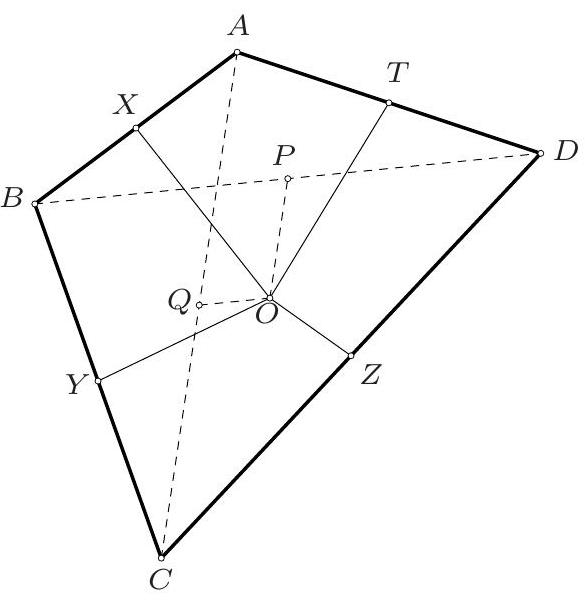
$ABCD$ is any quadrilateral, $P$ and $Q$ the midpoints of the diagonals $BD$ and $AC$, respectively. The parallels through $P$ and $Q$ to the other diagonal intersect at $O$. If we join $O$ with the four midpoints of the sides $X, Y, Z$ and $T$, four quadrilaterals $OXBY$, $OYCZ$, $OZDT$ and $OTAX$ are formed.
On the sides $AB$ and $AC$ of triangle $ABC$, there are points $P$ and $Q$ respectively such that $\angle APC = \angle AQB = 45^\circ$. Let the perpendicular line to side $AB$ through $P$ intersects line $BQ$ at $S$. Let the perpendicular line to side $AC$ through $Q$ intersects line $CP$ at $R$. Let $D$ be on side $BC$ such that $AD \perp BC$. Prove that the lines $PS, AD, QR$ meet at a common point and lines $SR$ and $BC$ are parallel.
A positive integer $n$ is said to be *good* if there exist positive integers $a$ and $b$ such that $a+b=n$ and $ab$ is divisible by $n$. For instance, $9$ is good since $3+6=9$ and $3 \times 6$ is divisible by $9$. Furthermore, $n$ is said to be *very good* if we can choose $a$ and $b$ to be distinct. Hence $9$ is very good.
a. Given that $2003$ is a prime, show that $2003$ is not good.
b. Is $2002$ good?
c. Find all positive integers which are good but not very good. Justify your answers.
Given a set $S$ of $10$ distinct positive integers, all less than $118$, prove that $S$ contains at least two nonempty subsets $A$ and $B$, such that $A \cap B = \emptyset$, and the sums of the integers in $A$ and $B$ are equal.
In a school there are $b$ teachers and $c$ students. Suppose that
(i) each teacher teaches exactly $k$ students; and
(ii) for each pair of distinct students, exactly $h$ teachers teach both of them.
Show that
$$
\frac{b}{h} = \frac{c(c-1)}{k(k-1)}
$$