Let $\mathbb Z^+$ be the positive integers. Find all functions $f:\mathbb Z^+\to\mathbb Z^+$ such that, for all positive integers m,n,
$$m^2+f(n)\mid mf(m)+n.$$
For any positive integer $n$, define $f(n)$ as the sum of the squares of the digits of $n$ (in base ten). For example, $f(2012) = 2^2 + 0^2 + 1^2 + 2^2 = 9$. Find the greatest integer $n$ such that there exists a positive integer $d$ with $f(\underbrace{f(\cdots f(n)\cdots)}_{d \text{ times}}) = n$.
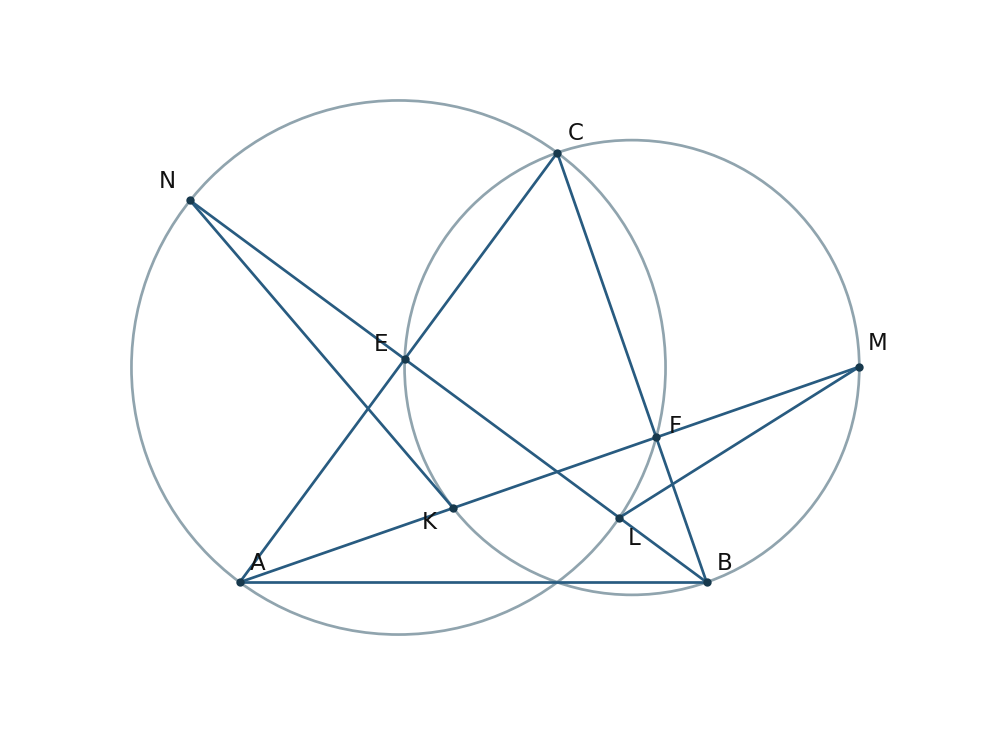
Let $ABC$ be an acute triangle. Circle $\omega_1$, with diameter $AC$, intersects side $BC$ at $F$ (other than $C$). Circle $\omega_2$, with diameter $BC$, intersects side $AC$ at $E$ (other than $C$). Ray $AF$ intersects $\omega_2$ at $K$ and $M$ with $AK \lt AM$. Ray $BE$ intersects $\omega_1$ at $L$ and $N$ with $BL \lt BN$. Prove that lines $AB$, $ML$, $NK$ are concurrent.
Find the least positive integer $n$, such that there exist positive integers $a$, $b$ and $c$, none of which is a perfect square and
$$
a^3 + b^3 + c^3 - 3abc = 2013^n.
$$
A Saudi company has two offices. One office is located in Riyadh and the other in Jeddah. To insure the connection between the two offices, the company has designated from each office a number of correspondents so that
(a) each pair of correspondents from the same office share exactly one common correspondent from the other office.
(b) there are at least 10 correspondents from Riyadh.
(c) Zayd, one of the correspondents from Jeddah, is in contact with exactly 8 correspondents from Riyadh.
What is the minimum number of correspondents from Jeddah who are in contact with the correspondent Amr from Riyadh?
Adel draws an $m \times n$ grid of dots on the coordinate plane, at the points of integer coordinates $(a, b)$ where $1 \leq a \leq m$ and $1 \leq b \leq n$. He proceeds to draw a closed path along $k$ of these dots, $(a_{1}, b_{1}),(a_{2}, b_{2}), \ldots,(a_{k}, b_{k})$, such that $(a_{i}, b_{i})$ and $(a_{i+1}, b_{i+1})$ (where $(a_{k+1}, b_{k+1})=(a_{1}, b_{1})$ ) are 1 unit apart for each $1 \leq i \leq k$. Adel makes sure his path does not cross itself, that is, the $k$ dots are distinct. Find, with proof, the maximum possible value of $k$ in terms of $m$ and $n$.
In a convex quadrilateral $ABCD$, let $E$ be the intersection of the diagonals. It is given that $\angle EDC = \angle DEC = \angle BAD$. If $F$ is a point on the line segment $[BC]$ such that $\angle BAF + \angle EBF = \angle BFE$, then show that $A, B, F, D$ are concyclic.
Let $a$ and $n$ be integers. We define $a_n = 1 + a + a^2 + \dots + a^{n-1}$. Prove that if $a^p \equiv 1 \pmod p$ for every prime divisor $p$ of $n_2 - n_1$, then the number $\frac{a_{n_2} - a_{n_1}}{n_2 - n_1}$ is an integer.
For a positive integer $n$, a cubic polynomial $p(x)$ is said to be $n$-good if there exist $n$ distinct integers $a_1, a_2, \dots, a_n$ such that all the roots of the polynomial $p(x) + a_i = 0$ are integers for $1 \le i \le n$. Given a positive integer $n$ prove that there exists an $n$-good cubic polynomial.
Natural numbers $m$ and $n$ satisfy $n \gt m \ge 1$. Let $S$ be the set of all pairs of natural numbers $(x, y)$ where $1 \le x, y \le n$. Determine the least natural number $k$ such that for each subset $P \subseteq S$ with cardinality $k$ there exist $m+1$ pairs $(x_1, y_1), (x_2, y_2), \dots, (x_{m+1}, y_{m+1}) \in P$ where the numbers $x_1, x_2, \dots, x_{m+1}$ are pairwise distinct and the numbers $y_1, y_2, \dots, y_{m+1}$ are pairwise distinct.
A social club has $2k + 1$ members, each of whom is fluent in the same $k$ languages. Any pair of members always talk to each other in only one language. Suppose that there were no three members such that they use only one language among them. Let $A$ be the number of three-member subsets such that the three distinct pairs among them use different languages. Find the maximum possible value of $A$.
Let $ABC$ be an acute triangle, $M$ be the midpoint of $BC$ and $P$ be a point on line segment $AM$. Lines $BP$ and $CP$ meet the circumcircle of $ABC$ again at $X$ and $Y$, respectively, and sides $AC$ at $D$ and $AB$ at $E$, respectively. Prove that the circumcircles of $AXD$ and $AYE$ have a common point $T \neq A$ on line $AM$.
Let $n$ and $m$ be natural numbers. We want to color each cell of a $n \times m$ table either white or black. For what $n$ and $m$ can this be done so that each cell has an odd number of neighbouring cells that are of the same color? Two cells are called neighbouring if they have a common side.
We denote the set of all nonzero integers and the set of all nonnegative integers by $\mathbb{Z}^*$ and $\mathbb{N}_0$, respectively. Find all functions $f:\mathbb{Z}^* \to \mathbb{N}_0$ for which the following two conditions hold:
(1) for each $a,b \in \mathbb{Z}^*$ such that $a+b \in \mathbb{Z}^*$ it holds that $f(a+b) \ge \min\{f(a),f(b)\}$;
(2) for each $a,b \in \mathbb{Z}^*$ it holds that $f(ab)=f(a)+f(b)$.
Let $m$ and $n$ be coprime natural numbers of different parity. Prove that the numbers $2^{2m} + 2^{m+1} + 1$ and $2^{2n} + 2^{n+1} + 1$ are coprime as well.
In an acute triangle the feet of altitudes drawn from vertices $A$ and $B$ are $D$ and $E$, respectively. Let $M$ be the midpoint of side $AB$. Line $CM$ intersects the circumcircle of $CDE$ again in point $P$ and the circumcircle of $CAB$ again in point $Q$. Prove that
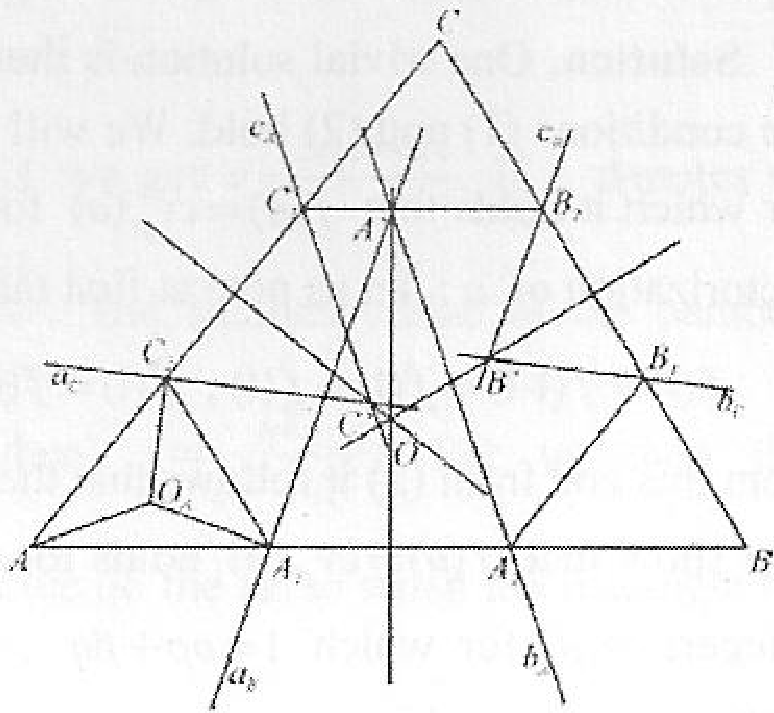
An acute-angled triangle $ABC$ is given. The points $A_1$, $A_2$, $B_1$, $B_2$, $C_1$ and $C_2$ lie on its sides in such a way that $\overline{AA_1} = \overline{A_1A_2} = \overline{A_2B} = \frac{1}{3}\overline{AB}$, $\overline{BB_1} = \overline{B_1B_2} = \overline{B_2C} = \frac{1}{3}\overline{BC}$ and $\overline{CC_1} = \overline{C_1C_2} = \overline{C_2A} = \frac{1}{3}\overline{CA}$. Let $k_A$, $k_B$ and $k_C$ be the circumscribed circles of the triangles $AA_1C_2$, $BB_1A_2$ and $CC_1B_2$ respectively, $a_B$ and $a_C$ be the tangents of $k_A$ in $A_1$ and $C_2$, $b_C$ and $b_A$ be the tangents of $k_B$ in $B_1$ and $A_2$ and $c_A$ and $c_B$ be the tangents of $k_C$ in $C_1$ and $B_2$. Prove that the perpendiculars drawn from the intersection of $a_B$ and $b_A$ to $AB$, the intersection of $b_C$ and $c_B$ to $BC$ and the intersection of $c_A$ and $a_C$ to $CA$ intersect in one point.