If $a_1, a_2, \dots, a_{2017}$ are positive integers, show that the fraction
$$
\frac{9^{2017} - 7 \cdot 3^{2017} + 7}{9^{(a_1+a_2)(a_2+a_3)\dots(a_{2016}+a_{2017})(a_{2017}+a_1)} - 1}
$$
is reducible.
a) Show that in a right triangle with an angle of $30^\circ$, the leg opposite to the $30^\circ$-angle has half of the length of the hypotenuse.
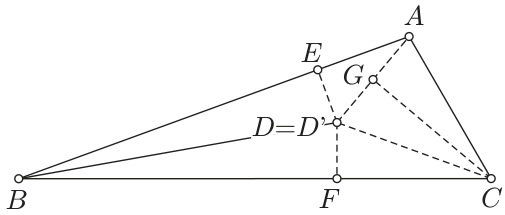
b) Inside the triangle $ABC$, with $m(\angle A) = 100^\circ$ and $m(\angle B) = 20^\circ$, we consider the point $D$, such that $m(\angle DAB) = 30^\circ$ and $m(\angle DBA) = 10^\circ$. Determine $m(\angle ACD)$.
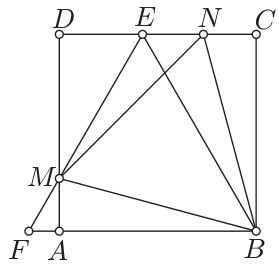
On the side $[CD]$ of the square $ABCD$ point $E$ is chosen such that $m(\angle ABE) = 60^{\circ}$. On the halfline $(BA$ point $F$ is chosen such that $[BE] = [BF]$. Let $M$ be the intersection between the lines $EF$ and $AD$.
a) Prove that $m(\angle BME) = 75^{\circ}$.
b) The bisector of angle $CBE$ intersects $CD$ at $N$. Prove that the triangle $BMN$ is equilateral.
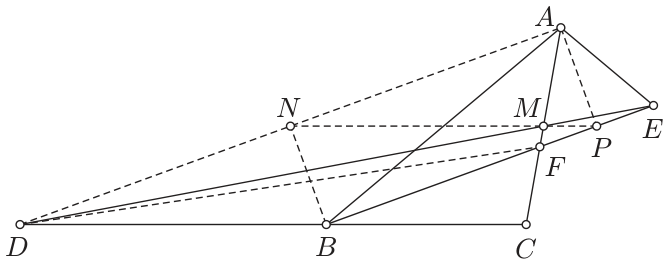
In triangle $ABC$, we have $m(\angle A) \lt m(\angle C)$. Let $E$ be a point on the bisector of angle $B$ such that $\angle EAB = \angle ACB$. Let $D$ be a point on line $BC$ such that $B \in (CD)$ and $[BD] = [AB]$. Prove that the midpoint $M$ of the line segment $[AC]$ belongs to the line $DE$.
Let $ABCDA'B'C'D'$, be a cube with side length $a$. Let $M$ and $P$ be the midpoints of the edges $[AB]$ and $[DD']$, respectively.
a) Prove that $MP \perp A'C$.
b) Find the distance between the lines $MP$ and $A'C$.
Let $ABCD A'B'C'D'$ be a cube with side length $1$. An ant walks on the cube's faces, starting from $A$ and ending at $C'$. The ant moves only on the cube's edges or on the diagonals of its faces. Knowing that the ant never passes through the same point twice, find the maximal length of such a walk.
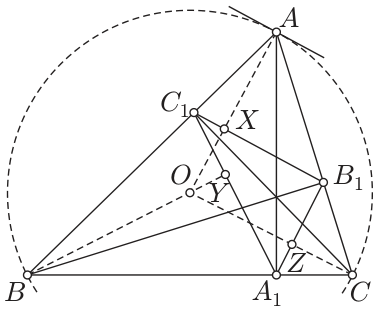
Let $A_1$, $B_1$ and $C_1$ be the feet of the altitudes in the acute triangle $ABC$. On the line segments $B_1C_1$, $C_1A_1$, $A_1B_1$ one considers the points $X$, $Y$, and $Z$, respectively, such that
$$
\frac{C_1X}{XB_1} = \frac{b \cos C}{c \cos B}, \quad \frac{A_1Y}{YC_1} = \frac{c \cos A}{a \cos C} \quad \text{and} \quad \frac{B_1Z}{ZA_1} = \frac{a \cos B}{b \cos A}.
$$
Prove that the lines $AX$, $BY$ and $CZ$ are concurrent.
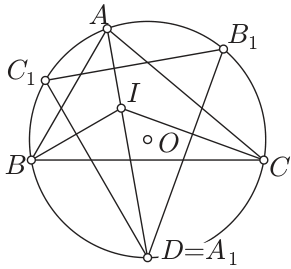
In the triangle $ABC$ we denote by $O$ and $I$ the circumcenter and the incenter, respectively. The perpendicular bisectors of the line segments $IA$, $IB$ and $IC$ pairwise intersect, thus defining the triangle $A_1B_1C_1$. Prove that
$$
\vec{OI} = \vec{OA_1} + \vec{OB_1} + \vec{OC_1}.
$$
Let $(a_n)_{n \ge 1}$ be a sequence of real numbers such that $a_1 \gt 2$ and $a_{n+1} = 1 + \frac{2}{a_n}$ for $n \ge 1$.
a) Prove that $a_{2n-1} + a_{2n} \gt 4$ for all $n \ge 1$ and $\lim_{n \to \infty} a_n = 2$.
b) Determine the largest real $a$ for which the inequality
$$
\sqrt{x^2 + a_1^2} + \sqrt{x^2 + a_2^2} + \sqrt{x^2 + a_3^2} + \dots + \sqrt{x^2 + a_n^2} \gt n\sqrt{x^2 + a^2}
$$
occurs for all $x \in \mathbb{R}$ and for any $n \in \mathbb{N}^*$.
a) Show that there exist functions $f : \mathbb{R} \to \mathbb{R}$ and $g : \mathbb{R} \to \mathbb{R}$ such that $f \circ g = g \circ f$, $f \circ f = g \circ g$ and $f(x) \ne g(x)$, for all $x \in \mathbb{R}$.
b) Prove that if $f : \mathbb{R} \to \mathbb{R}$ and $g : \mathbb{R} \to \mathbb{R}$ are continuous and have the properties $f \circ g = g \circ f$ and $f(x) \ne g(x)$, for any $x \in \mathbb{R}$, then $(f \circ f)(x) \ne (g \circ g)(x)$, for all $x \in \mathbb{R}$.