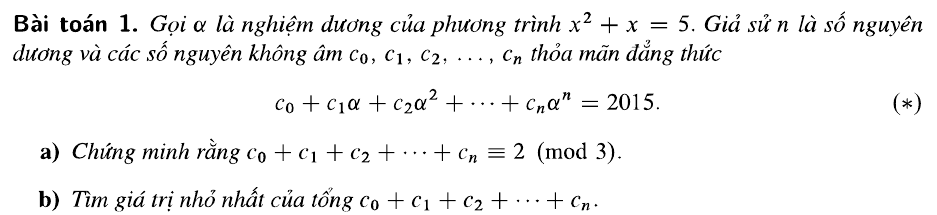
Let $\alpha$ be the positive root of $x^2+x=5$. Suppose that $n$ is a positive integer and that nonnegative integers $c_0,c_1,\ldots,c_n$ satisfy
$$c_0+c_1\alpha+c_2\alpha^2+\cdots+c_n\alpha^n=2015.$$
(a) Prove that $c_0+c_1+\cdots+c_n\equiv2\pmod3$.
(b) Find the least possible value of $c_0+c_1+\cdots+c_n$.
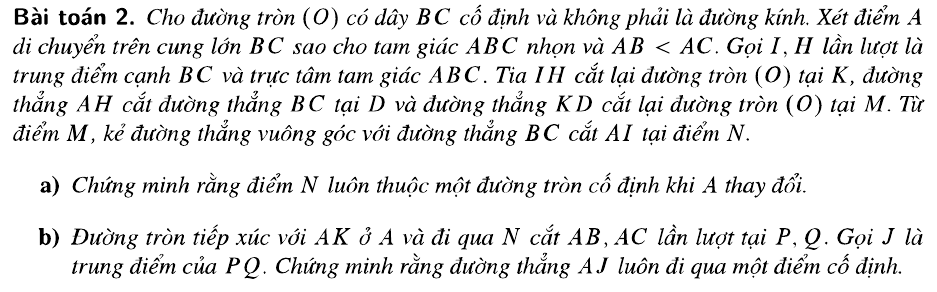
A circle $(O)$ has a fixed chord $BC$ which is not a diameter. A point $A$ moves on the major arc $BC$ so that $ABC$ is acute and $AB\lt AC$. Let $I$ be the midpoint of $BC$ and $H$ the orthocenter of $ABC$. Ray $IH$ meets $(O)$ again at $K$. Line $AH$ meets line $BC$ at $D$, and line $KD$ meets $(O)$ again at $M$. The line through $M$ perpendicular to $BC$ meets $AI$ at $N$.
(a) Prove that $N$ belongs to a fixed circle as $A$ varies.
(b) The circle tangent to $AK$ at $A$ and passing through $N$ meets $AB,AC$ again at $P,Q$, respectively. Let $J$ be the midpoint of $PQ$. Prove that $AJ$ passes through a fixed point.
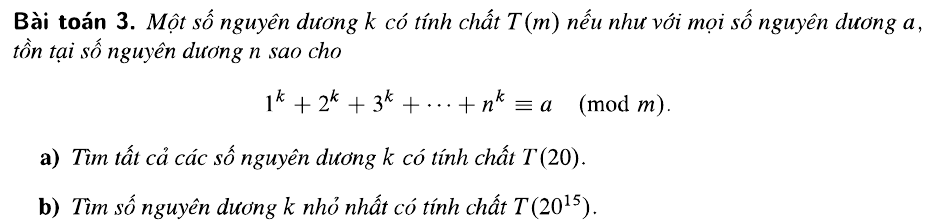
A positive integer $k$ has property $T(m)$ if, for every positive integer $a$, there is a positive integer $n$ such that
$$1^k+2^k+\cdots+n^k\equiv a\pmod m.$$
(a) Find all positive integers $k$ with property $T(20)$.
(b) Find the smallest positive integer $k$ with property $T(20^{15})$.
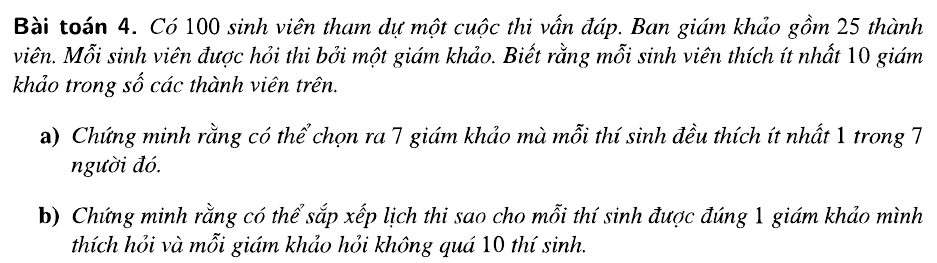
One hundred students take part in an oral examination. The panel consists of 25 examiners. Each student is questioned by one examiner. Every student likes at least 10 members of the panel.
(a) Prove that seven examiners can be selected so that every student likes at least one of them.
(b) Prove that the examination can be scheduled so that each student is questioned by exactly one examiner whom the student likes, and each examiner questions at most 10 students.
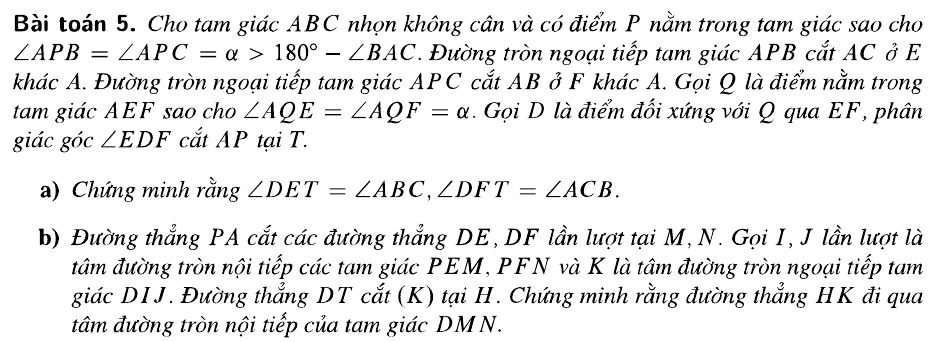
Let \(ABC\) be an acute scalene triangle and let \(P\) be an interior point such that \(\angle APB=\angle APC=\alpha>180^\circ-\angle BAC\). The circumcircle of \(APB\) meets \(AC\) again at \(E\), and the circumcircle of \(APC\) meets \(AB\) again at \(F\). Let \(Q\) lie inside \(AEF\) with \(\angle AQE=\angle AQF=\alpha\). Reflect \(Q\) in \(EF\) to obtain \(D\). The internal bisector of \(\angle EDF\) meets \(AP\) at \(T\).
(a) Prove \(\angle DET=\angle ABC\) and \(\angle DFT=\angle ACB\).
(b) The line \(PA\) meets the lines \(DE,DF\) at \(M,N\), respectively. Let \(I,J\) be the incenters of \(PEM,PFN\), and let \(K\) be the circumcenter of \(DIJ\). The line \(DT\) meets this circumcircle again at \(H\). Prove that \(HK\) passes through the incenter of \(DMN\).
Editorial warning: the source statement is retained, but part (b) is false without an additional configuration restriction. The solutions distinguish the valid part (a), the source's restricted-configuration argument, and an exact counterexample to the printed part (b). Here \(AC,AB\) must mean their supporting lines: the given angle inequality forces \(E,F\) onto the opposite extensions beyond \(A\).
Find the smallest positive integer $n$ for which there exist real numbers $a_1,a_2,\ldots,a_n$ satisfying
$$a_1+\cdots+a_n>0,\qquad a_1^3+\cdots+a_n^3\lt 0,\qquad a_1^5+\cdots+a_n^5>0.$$
Let $a$ be a nonnegative real number. Define $u_1=3$ and
$$u_{n+1}=\frac12u_n+\frac{n^2}{4n^2+a}\sqrt{u_n^2+3}\qquad(n\ge1).$$
a) For $a=0$, prove that the sequence has a finite limit and find it.
b) For every $a\in[0,1]$, prove that the sequence has a finite limit.
Let $K$ be a positive integer. Find the number of natural numbers $n\le10^K$ satisfying both:
i) $n$ is divisible by 3;
ii) every digit of its decimal representation belongs to $\{2,0,1,5\}$.
Let $(O)$ be a circle and $B,C$ fixed points on it such that $BC$ is not a diameter. A point $A$ varies on $(O)$ so that triangle $ABC$ is acute. Let $E,F$ be the feet of the altitudes from $B,C$, respectively. Let $(I)$ be a variable circle through $E,F$, with center $I$.
a) Suppose $(I)$ is tangent to $BC$ at $D$. Prove $\dfrac{DB}{DC}=\sqrt{\dfrac{\cot B}{\cot C}}$.
b) Suppose $(I)$ meets segment $BC$ at $M,N$. Let $H$ be the orthocenter of $ABC$, and $P,Q$ the intersections of $(I)$ with the circumcircle of $HBC$. A circle $(K)$ passes through $P,Q$ and is tangent to $(O)$ at $T$, where $T$ and $A$ are on the same side of $PQ$. Prove that the internal bisector of $\angle MTN$ always passes through a fixed point.
Define polynomials by
$$f_0(x)=2,\quad f_1(x)=3x,\quad f_n(x)=3xf_{n-1}(x)+(1-x-2x^2)f_{n-2}(x)\quad(n\ge2).$$
Find all positive integers $n$ for which $f_n(x)$ is divisible by $x^3-x^2+x$.
For positive integers $a,n$, consider
$$a^2x+6ay+36z=n,$$
where $x,y,z$ are natural numbers.
a) Find all $a$ such that for every $n\ge250$ the equation has a solution in natural numbers $(x,y,z)$.
b) Suppose $a\gt 1$ and $\gcd(a,6)=1$. Find, in terms of $a$, the largest $n$ for which the equation has no solution $(x,y,z)$.
There are $m$ girls and $n$ boys, $m,n\ge2$, taking part in a duet festival. Each session presents one program. A program consists of male–female duets, with each girl–boy pair singing at most one song and every student singing at least one song. Two programs are different if some girl–boy pair sings in one program but not the other. The festival ends only after every possible different program has been performed exactly once.
a) A program is called dependent on student $X$ if canceling all duets involving $X$ leaves at least one other student singing no song in that program. Prove that among all programs dependent on $X$, the number with an odd number of songs equals the number with an even number of songs.
b) Prove that the organizers can order the sessions so that any two consecutive sessions have different parities of their numbers of songs.