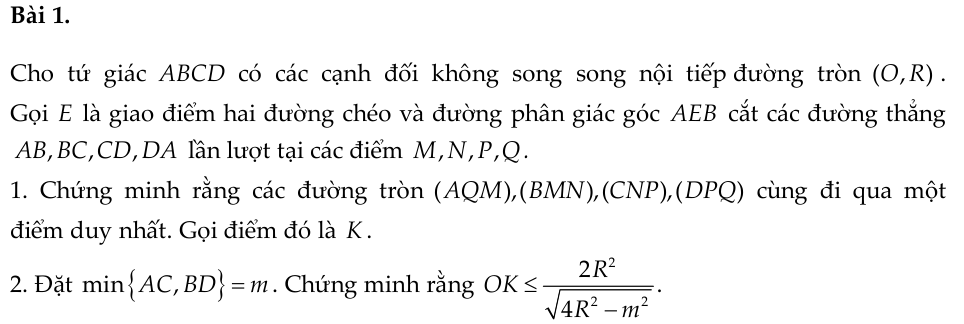
Let $ABCD$ be a convex quadrilateral inscribed in a circle with centre $O$ and radius $R$, with neither pair of opposite sides parallel. Let $E=AC\cap BD$. The internal bisector of $\angle AEB$ meets the lines $AB,BC,CD,DA$ at $M,N,P,Q$, respectively.
1. Prove that $(AQM),(BMN),(CNP),(DPQ)$ have exactly one common point $K$.
2. Put $m=\min\{AC,BD\}$. Prove
$$OK\le\frac{2R^2}{\sqrt{4R^2-m^2}}.$$
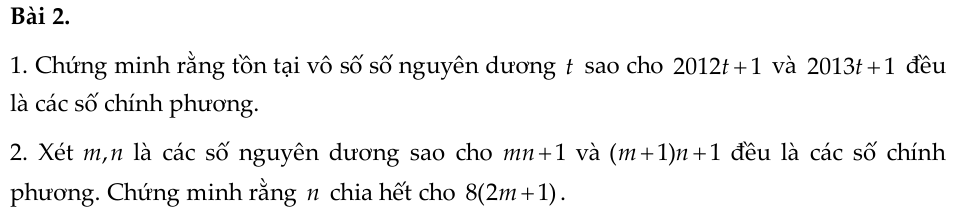
1. Prove that there are infinitely many positive integers $t$ such that $2012t+1$ and $2013t+1$ are both perfect squares.
2. Let $m,n$ be positive integers such that $mn+1$ and $(m+1)n+1$ are both perfect squares. Prove that $8(2m+1)$ divides $n$.
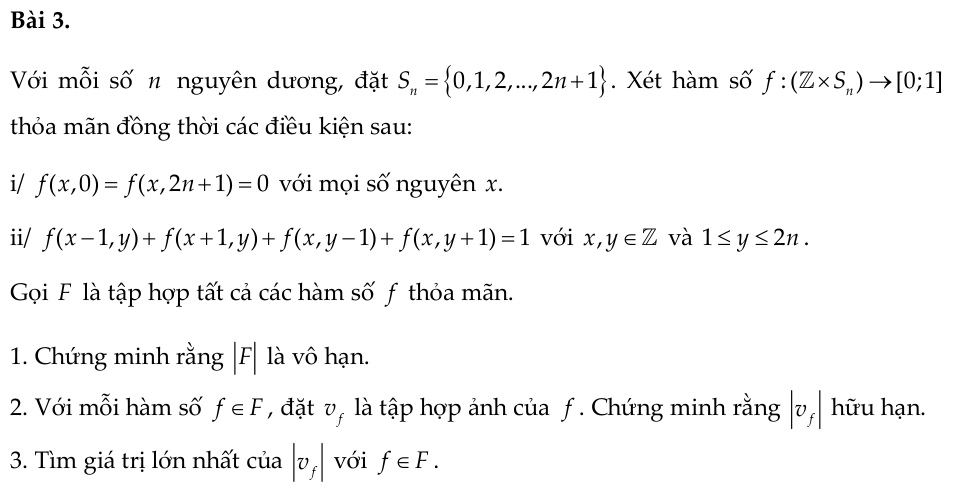
For a positive integer $n$, put $S_n=\{0,1,\ldots,2n+1\}$. Let $F$ be the set of all functions $f:\mathbb Z\times S_n\to[0,1]$ satisfying
(i) $f(x,0)=f(x,2n+1)=0$ for every integer $x$;
(ii) $f(x-1,y)+f(x+1,y)+f(x,y-1)+f(x,y+1)=1$ for integers $x$ and $1\le y\le2n$.
1. Prove that $F$ is infinite.
2. For $f\in F$, let $v_f$ be the image of $f$. Prove that $v_f$ is finite.
3. Find the largest possible value of $|v_f|$.
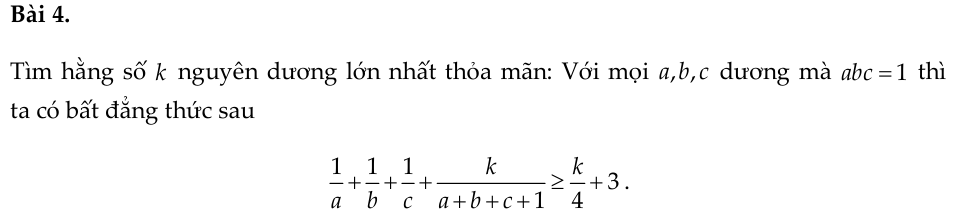
Find the largest positive integer $k$ such that, for every positive triple $a,b,c$ with $abc=1$,
$$\frac1a+\frac1b+\frac1c+\frac{k}{a+b+c+1}\ge\frac{k}{4}+3.$$
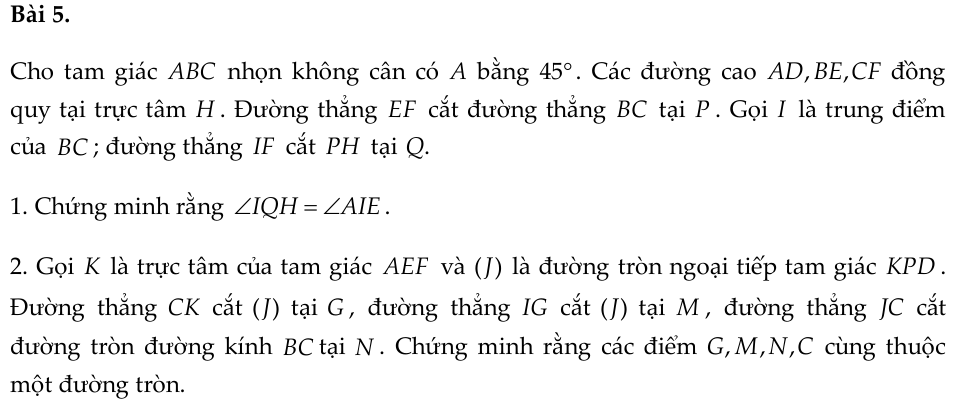
Let $ABC$ be an acute, non-isosceles triangle with $\angle A=45^\circ$. Its altitudes $AD,BE,CF$ meet at $H$. Let $P=EF\cap BC$, let $I$ be the midpoint of $BC$, and let $Q=IF\cap PH$.
1. Prove $\angle IQH=\angle AIE$.
2. Let $K$ be the orthocentre of $AEF$, and let $(J)$ be the circumcircle of $KPD$, with centre $J$. Let $G\ne K$ be the second intersection of $CK$ with $(J)$, $M\ne G$ the second intersection of $IG$ with $(J)$, and $N\ne C$ the second intersection of $JC$ with the circle of diameter $BC$. Prove that $G,M,N,C$ are concyclic.
The second-intersection qualifications make explicit the intended construction in the source.
A $10\times10\times10$ cube consists of 1000 white unit cubes. An and Bình play a game. An chooses some $1\times1\times10$ rods so that no two chosen rods have a common vertex or edge, and colours all their unit cubes black. Bình chooses some unit cubes and asks An their colours. What is the smallest number of cubes Bình must choose so that, whatever An's answers, Bình can always determine exactly which cubes are black?
Interpretation: the rods are full axis-parallel rows of the grid, and Bình chooses the whole set of queried cubes before receiving the answers, as in the source solution. “Unit squares” in the printed three-dimensional statement is read as unit cubes.
Solve, for $x,y\in\mathbb R$,
$$\begin{cases}\sqrt{\sin^2x+\dfrac1{\sin^2x}}+\sqrt{\cos^2y+\dfrac1{\cos^2y}}=\sqrt{\dfrac{20y}{x+y}},\\[4pt]\sqrt{\sin^2y+\dfrac1{\sin^2y}}+\sqrt{\cos^2x+\dfrac1{\cos^2x}}=\sqrt{\dfrac{20x}{x+y}}.\end{cases}$$
Let $ABC$ be a scalene triangle. Its incircle $(I)$ touches $BC,CA,AB$ at $D,E,F$, respectively. The line through $E$ perpendicular to $BI$ meets $(I)$ again at $K\ne E$; the line through $F$ perpendicular to $CI$ meets it again at $L\ne F$. Let $J$ be the midpoint of $KL$.
(a) Prove that $D,I,J$ are collinear.
(b) Fix $B,C$ and let $A$ vary with $AB/AC=k$ constant. Let $M\ne E,N\ne F$ be the other intersections of $IE,IF$ with $(I)$. Let $P=MN\cap IB$, $Q=MN\cap IC$. Prove that the perpendicular bisector of $PQ$ always passes through a fixed point.
Some natural numbers are initially written on a line. At each step, first identify every adjacent pair in the current left-to-right order, then insert their sum between each pair. After 2013 steps, how many occurrences of 2013 are present if initially:
(a) the numbers are $1,1000$;
(b) the numbers are $1,2,\ldots,1000$ in increasing order?
Find all functions $f:\mathbb R\to\mathbb R$ such that $f(0)=0$, $f(1)=2013$, and, for all real $x,y$,
$$(x-y)\bigl(f(f^2(x))-f(f^2(y))\bigr)$$
$$=(f(x)-f(y))\bigl(f^2(x)-f^2(y)\bigr),$$
where $f^2(x)=(f(x))^2$.
Let acute triangle $ABC$ be inscribed in $(O)$ and let $D$ be on the arc $BC$ not containing $A$. A variable line $\Delta$ through the orthocenter $H$ meets the circumcircles of $ABH$ and $ACH$ again at $M\ne H$ and $N\ne H$, respectively.
(a) Determine $\Delta$ for which the area of $AMN$ is greatest.
(b) Let $d_1$ pass through $M$ perpendicular to $DB$, and $d_2$ through $N$ perpendicular to $DC$. Prove that their intersection $P$ lies on a fixed circle.
Determine the number of ordered sextuples $(a,b,c,a',b',c')$ with all entries in $\{0,1,\ldots,14\}$ satisfying
$$\begin{cases}ab+a'b'\equiv1\pmod{15},\\ac+a'c'\equiv1\pmod{15},\\bc+b'c'\equiv1\pmod{15}.\end{cases}$$