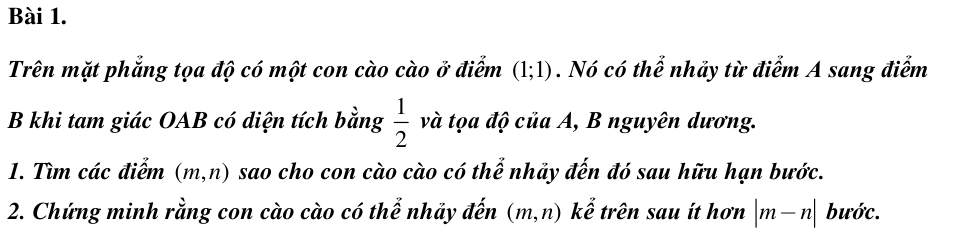
A grasshopper starts at $(1,1)$ in the coordinate plane. It may jump from $A$ to $B$ when $A,B$ have positive integer coordinates and triangle $OAB$ has area $\tfrac12$, where $O$ is the origin.
1. Determine all points $(m,n)$ it can reach in finitely many jumps.
2. Prove that each such point can be reached in fewer than $|m-n|$ jumps.
Editorial notice: Part 2 above faithfully reproduces a false strict bound in the supplied source. For example, $(2,1)$ requires one jump, not fewer than one. The valid corrected bound is **at most** $|m-n|$ jumps; $(1,1)$ requires zero. The solution proves the corrected statement.
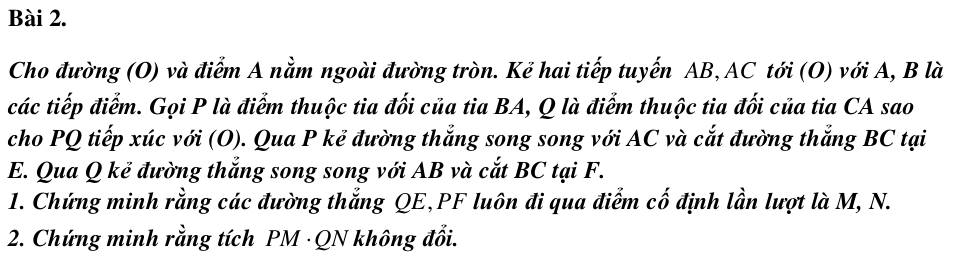
Let $(O)$ be a circle and $A$ a point outside it. Draw tangents $AB,AC$, with points of contact $B,C$. Let $P$ lie on the ray opposite to $BA$ and $Q$ on the ray opposite to $CA$, so that $PQ$ is tangent to $(O)$. The line through $P$ parallel to $AC$ meets line $BC$ at $E$; the line through $Q$ parallel to $AB$ meets line $BC$ at $F$.
1. Prove that $QE$ and $PF$ pass through fixed points $M$ and $N$, respectively.
2. Prove that $PM\cdot QN$ is constant.
Editorial correction: The source accidentally calls $A,B$ the points of contact; these must be $B,C$.
Let $n\ge3$ be an integer and let $x_1,\ldots,x_n$ be real numbers such that
$$\sum_{i=1}^n x_i=0,\qquad \sum_{i=1}^n x_i^2=n(n-1),\qquad x_1\ge x_2\ge\cdots\ge x_n.$$
Find the maximum and minimum of $f=x_1+x_2$.
The sequence $(a_n)$ is defined by $a_0=1$, $a_1=3$ and
$$a_{n+2}=1+\left\lfloor\frac{a_{n+1}^2}{a_n}\right\rfloor\quad(n\ge0).$$
Prove that $a_na_{n+2}-a_{n+1}^2=2^n$ for every integer $n\ge0$.
There are $n$ students around a round table. Each has some candies, and the total number of candies is divisible by $n$. The following transfer is allowed: if a student has more candies than the student immediately to their right, one candy is transferred from the former to the latter.
Prove that, by a suitable finite sequence of such transfers, all students can be made to have equal numbers of candies.
Editorial clarification: “one candy” is explicit in the source's solution equations but accidentally omitted from its statement.
Let $n$ be a positive integer. Prove that for every positive real number $x$,
$$\frac{x^n(x^{n+1}+1)}{x^n+1}\le\left(\frac{x+1}{2}\right)^{2n+1}.$$
When does equality hold?
The real sequence $(x_n)$ is defined by
$$x_1=1,\qquad x_n=\frac{2n}{(n-1)^2}\sum_{i=1}^{n-1}x_i\quad(n\ge2).$$
Set $y_n=x_{n+1}-x_n$ for every positive integer $n$. Prove that $(y_n)$ has a finite limit as $n\to+\infty$.
Let $(O)$ be a circle with diameter $AB$. A variable point $P\ne B$ lies on the tangent at $B$. Line $PA$ meets $(O)$ again at $C$. Let $D$ be the reflection of $C$ in $O$, and let $PD$ meet $(O)$ again at $E$.
1. Prove that $AE,BC,PO$ pass through a common point $M$.
2. Determine the positions of $P$ for which the area of triangle $AMB$ is greatest, and find that maximum in terms of the radius $R$.
A convex pentagon $ABCDE$ has all its sides and the diagonals $AC,AD$ of length at most $\sqrt3$. Choose any 2011 distinct points inside it. Prove that a closed unit disk with center on a side of the pentagon contains at least 403 of these points.
An integer sequence $(a_n)$ is defined by $a_0=1$, $a_1=-1$ and
$$a_n=6a_{n-1}+5a_{n-2}\quad(n\ge2).$$
Prove that $a_{2012}-2010$ is divisible by 2011.
Triangle $ABC$ is not isosceles at $A$, and its angles at $B,C$ are acute. A variable point $D$ lies on segment $BC$, distinct from $B,C$ and the foot of the perpendicular from $A$ to $BC$. The line $d$ perpendicular to $BC$ at $D$ meets the lines $AB,AC$ at $E,F$, respectively. Let $M,N,P$ be the incenters of triangles $AEF,BDE,CDF$, respectively. Prove that $A,M,N,P$ are concyclic if and only if $d$ passes through the incenter of triangle $ABC$.
Let $n$ be a positive integer. Prove that
$$P(x,y)=x^n+xy+y^n$$
cannot be written as $P(x,y)=G(x,y)H(x,y)$, where $G,H$ are nonconstant polynomials with real coefficients.