A figure on a computer screen shows $n$ points on a sphere, no four coplanar. Some pairs of points are joined by segments. Each segment is colored red or blue. For each point there is a key that switches the colors of all segments with that point as endpoint. For every three points there is a sequence of key presses that makes the three segments between them red. Show that it is possible to make all the segments on the screen red. Find the smallest number of key presses that can turn all the segments red, starting from the worst case.
Let $N$ be the natural numbers and $N' = N \setminus \{0\}$. Find all functions $f: N' \to N$ such that $f(xy) = f(x) + f(y)$, $f(30) = 0$ and $f(x) = 0$ for all $x \equiv 7 \pmod{10}$.
$P$ is a fixed point in the plane. $A$, $B$, $C$ are points such that $PA = 3$, $PB = 5$, $PC = 7$ and the area $ABC$ is as large as possible. Show that $P$ must be the orthocenter of $ABC$.
A house is in the shape of a triangle, perimeter $P$ metres and area $A$ square metres. The garden consists of all the land within 5 metres of the house. How much land do the garden and house together occupy?
Suppose that $S$ is a finite set of at least five points in the plane; some are coloured red, the others are coloured blue. No subset of three or more similarly coloured points is collinear. Show that there is a triangle
(i) whose vertices are all the same colour, and
(ii) at least one side of the triangle does not contain a point of the opposite colour.
Let $S=\{a_{1}, a_{2}, \ldots, a_{r}\}$ denote a sequence of integers. For each non-empty subsequence $A$ of $S$, we define $p(A)$ to be the product of all the integers in $A$. Let $m(S)$ be the arithmetic average of $p(A)$ over all non-empty subsets $A$ of $S$. If $m(S)=13$ and if $m\left(S \cup\{a_{r+1}\}\right)=49$ for some positive integer $a_{r+1}$, determine the values of $a_{1}, a_{2}, \ldots, a_{r}$ and $a_{r+1}$.
On a circumference, $n\gt 3$ points are chosen and numbered from 1 to $n$ in any order. We will say that two non-consecutive points $a$ and $b$ are related if in one of the two end arcs $a$ and $b$, all points are Marked with numbers less than the marks of $a$ and $b$. Prove that the number of pairs of related points is exactly $n-3$.
The renaissance mathematician Leonardo da Pisa (better known as Fibonacci) is attributed to the sequence defined as follows $$
\begin{aligned}
& a_{1}=1 \\
& a_{2}=1 \\
& a_{i}=a_{i-1}+a_{i-2} \quad \text{ to } i\gt 2
\end{aligned}
$$ Express $a_{2 n}$ based only on the three terms $a_{n-1}$, $a_{n}$, $a_{n+1}$.
The puzzle consisting of breaking down the Greek cross on the left of the figure into four parts with which a square can be composed is well known. A common solution is that of the figure on the right. Demonstrate that there are an infinity of different solutions. Is there a solution that gives place to four equal parts?
Let $(x_{n}),\ n \in \mathbb{N}$, a sequence of integers such that $$
\begin{aligned}
x_{1} & = 1 \\
x_{n+1} & \gt x_{n}, \text{ to } n \geq 1 \\
x_{n+1} & \leq 2n, \text{ to } n \geq 1
\end{aligned}
$$ demonstrate that for all natural integers $k$ there are two terms of the sequence $x_{r}$ and $x_{s}$ such that $x_{r} - x_{s} = k$.
Calculate, for any value of the integer parameter $t$, integer solutions $x$, $y$ of the equation $$
y^{2}=x^{4}-22 x^{3}+43 x^{2}+858 x+t^{2}+10452(t+39)
$$
Let $S$ be the collection of all sets of $n$ distinct positive integers, with no three in arithmetic progression. Show that there is a member of $S$ which has the largest sum of the inverses of its elements (you do not have to find it or to show that it is unique).
$P$ is a fixed point in the plane. Show that amongst triangles $ABC$ such that $PA = 3$, $PB = 5$, $PC = 7$, those with the largest perimeter have $P$ as incenter.
The positive integers $a$, $b$, $c$, $d$, $p$, $q$ satisfy $ad - bc = 1$ and $a / b \gt p / q \gt c / d$. Show that $q \geq b + d$ and that if $q = b + d$, then $p = a + c$.
Let $k^{3} = 2$ and let $x$, $y$, $z$ be any rational numbers such that $x + y k + z k^{2}$ is non-zero. Show that there are rational numbers $u$, $v$, $w$ such that $(x + y k + z k^{2})(u + v k + w k^{2}) = 1$.
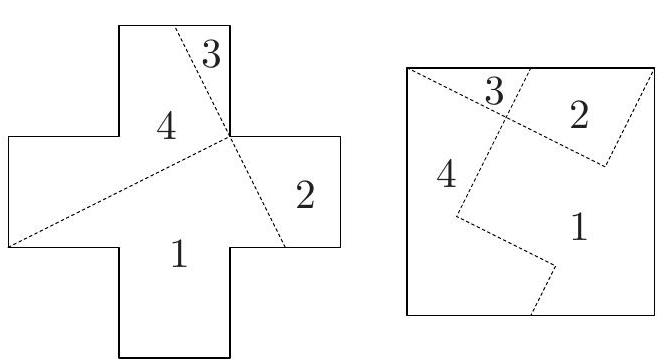 solutions. Is there a solution that gives place to four equal parts?