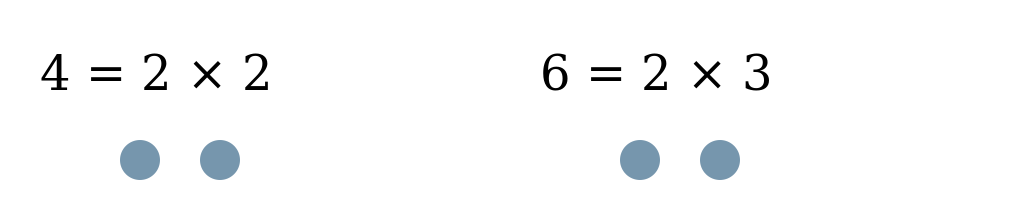
The complexity of an integer $n\gt 1$ is the number of prime factors in its factorisation, counted with multiplicity; for example 4 and 6 both have complexity 2. Find all $n$ for which every integer $m$ strictly between $n$ and $2n$ has complexity (a) no greater than that of $n$; (b) strictly less than that of $n$. Original weights:2+2.
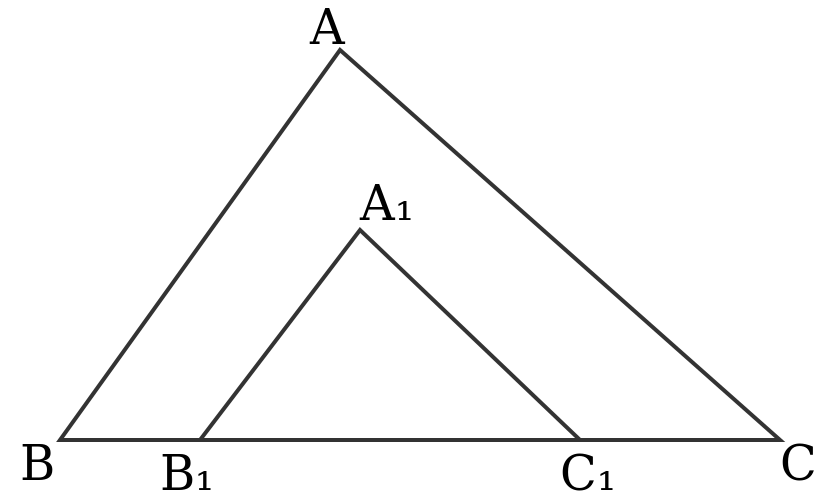
Two acute triangles $ABC,A_1B_1C_1$ satisfy $B_1,C_1\in BC$ and $A_1$ lies inside $ABC$. Their areas are $S,S_1$. Prove $\frac{S}{AB+AC}\gt \frac{S_1}{A_1B_1+A_1C_1}$.
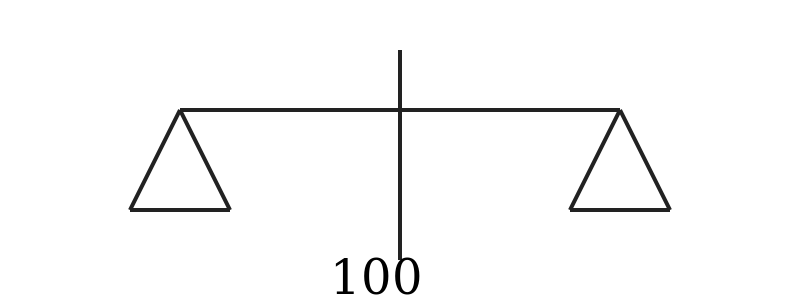
There are 100 visually identical coins, of gold, silver and bronze, at least one of each. Their weights are respectively 3,2,1 grams. Determine every coin’s type using at most 101 weighings on a balance with no weights.
Let $ABC$ have circumcentre $O$. Drop perpendiculars $OP,OQ$ onto the internal and external angle bisectors at $B$. Prove that line $PQ$ bisects the segment joining the midpoints of $CB$ and $AB$.
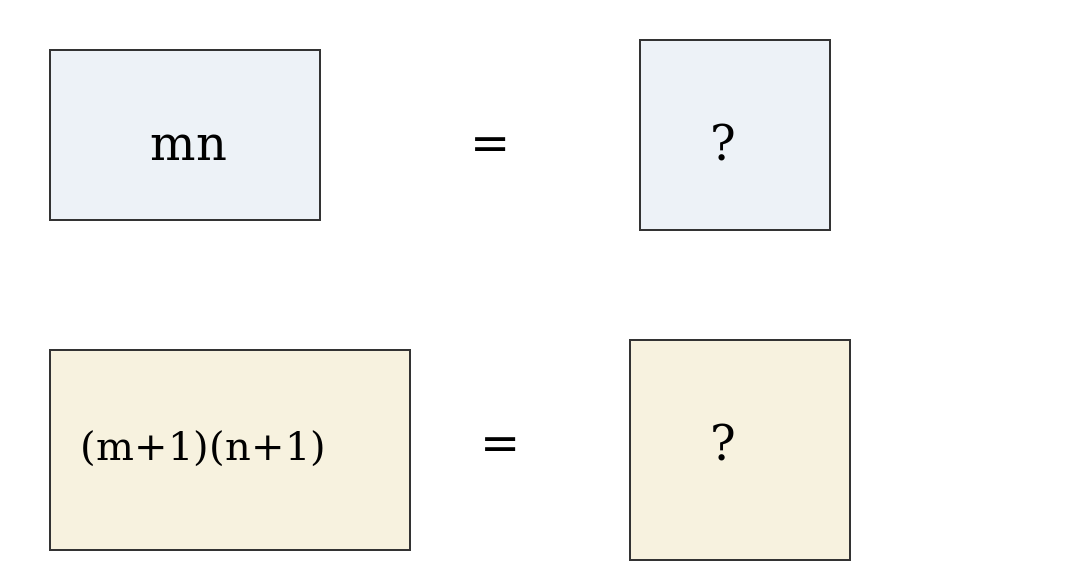
Call distinct positive integers $(m,n)$ nice if $mn$ and $(m+1)(n+1)$ are perfect squares. Prove that for every positive integer $m$ there exists $n\gt m$ making a nice pair.
Peter starts with some 100-ruble notes and no other money. Books have positive integer prices. Change is in 1-ruble coins. For an expensive book (price at least 100), he pays with the fewest 100-ruble notes needed. For a cheap book (price below 100), he pays with coins if he has enough, otherwise with one 100-ruble note. When all notes are gone, he has spent exactly half his initial money. Could he have spent at least 5000 rubles? (The official English original uses dollars; the supplied Vietnamese uses rubles. The arithmetic is unchanged.)
Peter has a wooden square stamp divided into small square cells. He inks 102 cells black and presses the stamp 100 times on white paper, each time printing exactly those 102 cells. Can the result be a101-by 101 square grid with every cell black except one corner cell?
An illusionist lays a full deck of 52 cards in a row and announces that, after 51 removals, only the Three of Clubs will remain. At each step a spectator names a valid position number. The illusionist chooses whether to count that position from the left or from the right and removes the corresponding card. For which initial positions of the Three of Clubs can the illusionist guarantee success?
Let $\omega$ be a circle with centre $O$ and distinct points $A,C$ on it. For any point $P$ on $\omega$ distinct from $A,C$, let $X,Y$ be the midpoints of $AP,CP$. Let $H$ be the orthocentre of triangle $OXY$. Prove that the position of $H$ does not depend on the choice of $P$.
A row of 100 squares contains one counter in each square. Swapping counters in adjacent squares costs 1 dollar. Swapping two counters with exactly three counters between them is free. What is the least amount of money needed to reverse their order? Give the number of dollars.
Let $a_1,\ldots,a_{1000}$ be integers and write their squares around a circle. The sum of any 41 consecutive numbers on this circle is divisible by $41^2$. Must each $a_i$ be divisible by 41?
Vasya (called Basil in the supplied Vietnamese text) has unlimited $1\times1\times3$ bricks and L-shaped bricks, each made from three unit cubes. He has completely filled an $m\times n\times k$ box with these bricks, where $m,n,k$ are integers greater than 1. Prove that the same box can be filled using only L-shaped bricks.
A polynomial $P(x,y)$ satisfies, for every integer $n\ge0$, that each of $P(n,y),P(x,n)$ is either the zero polynomial or has degree at most n. Can $P(x,x)$ have odd degree? Both the book and official original include n=0. The book says “a nonzero constant” where the official original says “the zero polynomial”; the effect of this wording is discussed below.
In an acute triangle ABC, interior side points A′∈BC,B′∈CA,C′∈AB give cevians AA′,BB′,CC′ concurrent at an interior point P. In each circle having one cevian as diameter, draw the chord through P perpendicular to that diameter. The three chords have equal length. Prove P is the orthocenter of ABC.
There are 100 visually identical coins: gold 3 g, silver 2 g and bronze 1 g, with at least one of each type. Using a balance scale with no external weights, determine every coin’s type in at most 101 weighings.
A strictly increasing positive sequence $(a_i)_{i\in\mathbb Z}$ extends infinitely in both directions. For each positive k, let b_k be the smallest integer bounding above the ratio of the sum of any k consecutive terms to the largest of those terms. Prove that either b_k=k for all k, or the sequence b_k is eventually constant.
An interior point M of a convex quadrilateral ABCD is equidistant from lines AB,CD and also equidistant from lines BC,AD. Its area equals $MA\cdot MC+MB\cdot MD$. Prove that ABCD (a) is cyclic; (b) has an incircle.
A cube of $(2N)^3$ unit cubes is pierced by axis-parallel needles, each passing through exactly 2 N unit cubes. Every unit cube is pierced by at least one needle. A set of needles is regular if no two pierce the same unit cube. (a) Prove there is a regular set of 2 N² needles using at most two directions. (b) Determine the largest guaranteed size of a regular set. The official original says “at most two directions”; the book’s phrasing is less precise.
Some integers from 1 through n are red. Whenever red a,b,c (not necessarily distinct) satisfy $n\mid a(b-c)$, one has b=c. Prove that at most $\varphi(n)$ integers are red, where $\varphi(n)$ counts positive integers at most n coprime to n. The official definition uses “at most n”; the book says “less than n”, which differs at n=1.
An illusionist lays a full deck of 52 cards in a row and announces that, after 51 removals, only the Three of Clubs will remain. At each step a spectator names a valid position number. The illusionist chooses whether to count that position from the left or from the right and removes the corresponding card. For which initial positions of the Three of Clubs can the illusionist guarantee success?