Answer all ten questions and show detailed solutions. Printed time 60 minutes; each question 4 points. Subcriterion allocations are editorial.
Sarah and her younger brother Stephen earn pocket-money by mowing lawns for neighbors. Sarah uses the lawn mower and wants to earn 5 dollars per hour for herself. Stephen removes cuttings and tidies up. They agree Stephen receives 20% of the total payment. It takes them four hours to mow a nearby large garden. How much must the owner pay for Sarah to earn exactly 5 dollars per hour?
Answer all ten questions and show detailed solutions. Printed time 60 minutes; each question 4 points. Subcriterion allocations are editorial.
John cycles to Jane’s house and back on a flat straight road, a round trip of 32 km. Throughout the journey the wind has constant speed and direction. Outward, it blows directly behind John and its speed is added to his normal bicycle speed; returning, its speed is subtracted. Total travel time is 2 hours, with the return taking twice the outward time. Find the wind speed in km/hour.
Answer all ten questions and show detailed solutions. Printed time 60 minutes; each question 4 points. Subcriterion allocations are editorial.
In the first stage of a baseball competition, teams are divided into groups of four. Each team plays each other team once. A group table records wins, draws, defeats, runs scored and runs against. A win earns 3 points, a draw 1 and a defeat 0. Here is part of a group table:
| Team | Runs scored | Runs against | Points |
|---|---:|---:|---:|
| A |2|2|4|
| B |4|4|6|
| C |2|1|4|
| D |1|2|2|
Find the result and score of all six matches: A:B; A:C; A:D; B:C; B:D; C:D. Use the source's stated draw/scoring rules.
Answer all ten questions and show detailed solutions. Printed time 60 minutes; each question 4 points. Subcriterion allocations are editorial.
The number 132 has three distinct digits and equals the sum of all different two-digit numbers made from those digits: $132=13+12+21+23+31+32$. Find all other three-digit numbers with this property.
Answer all ten questions and show detailed solutions. Printed time 60 minutes; each question 4 points. Subcriterion allocations are editorial.
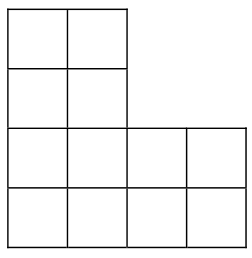
Color the twelve small squares in the L-shaped diagram using three colors, so that:
(a) Squares sharing an edge have different colors.
(b) Each color is used in exactly four squares.
(c) Every 2 × 2 block of four small squares contained in the diagram uses all three colors.
Do not mix colors or use different colors in one square. Use B,G,R for the three colors. Show your detailed solution as instructed on the cover.
Answer all ten questions and show detailed solutions. Printed time 60 minutes; each question 4 points. Subcriterion allocations are editorial.
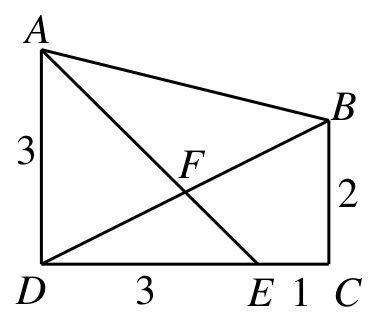
In quadrilateral $ABCD$, $AD\parallel BC$ and $AD\perp DC$. The lengths are $AD=3$, $BC=2$. Point E lies between D and C with $DE=3$ and $EC=1$. Lines AE and BD meet at F. Find the exact area of triangle ABF.
Answer all ten questions and show detailed solutions. Printed time 60 minutes; each question 4 points. Subcriterion allocations are editorial.
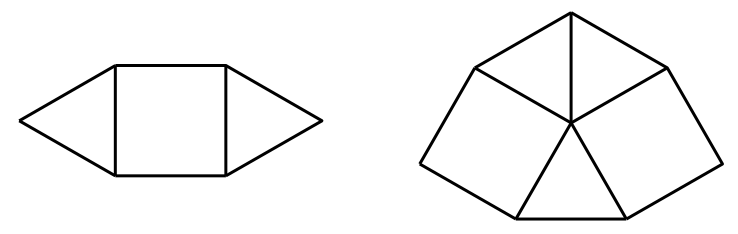
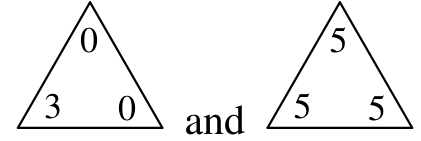
Unit equilateral triangles and unit squares can be joined to construct convex polygons, completely covering the enclosed region with no gaps or overlaps. The source examples use two triangles and one square for a hexagon, and three triangles and two squares for a 7-sided polygon. How can this process construct a convex polygon with 11 sides?
**Printed examination instructions.** Answer the following 5 questions. Write down your answer in the space provided after each question. Each question is worth 8 points. Time limit: 60 minutes.
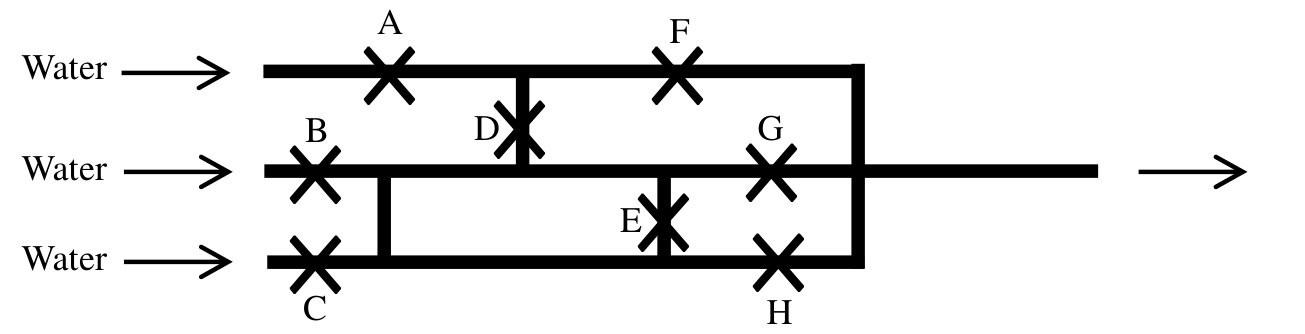
The diagram shows a network of water pipes, with eight taps, each shown by a symbol ×, at positions A, B, C, D, E, F, G and H. Water enters along three pipes at the left, indicated by →, and cannot pass a tap that is “off”. Each tap is either “on” or “off”. How many choices of taps in the “on” position result in water coming out of the pipe at the extreme right, assuming no more than three taps can be “on” at the same time?
Triominoes is played with a set of tiles, all sides of which are equal in length. Each vertex of every tile is marked with one of the digits from 0 to 5. Different vertices on the same tile may have the same digits, so the two examples below are both included.
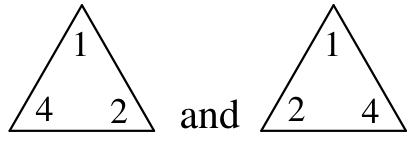
All possible tiles, including those with duplicate or triplicate digits, are in the set. How many possible tiles are there? The following mirror-image tiles are different tiles.
An n-dragon is a set of n consecutive positive integers. The first two-thirds form the tail; the remaining one-third form the head. The sum of the numbers in the tail equals the sum in the head. For example, the nine consecutive integers 2,3,4,5,6,7,8,9,10 form a 9-dragon:
- Its tail is 2,3,4,5,6,7: six numbers with sum 27.
- Its head is 8,9,10: three numbers with sum 27.
(1) Find a 21-dragon. (3 points)
(2) Find the sum of the tail of a 99999-dragon. (5 points)
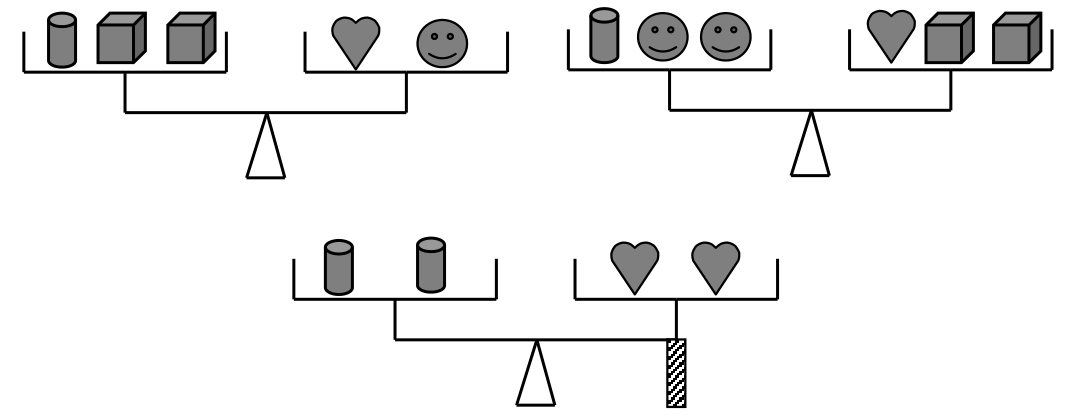
In the diagram the top two sets of scales are in perfect balance. For the third set, the right-hand side is heavier than the left-hand side and has to be supported as shown. What can be added to the left-hand side to achieve a perfect balance in this case as well?
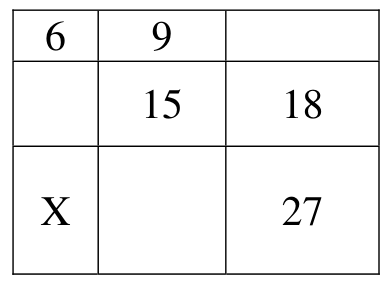
A rectangle is divided into 9 small rectangles, as shown in the diagram, which is not drawn to scale. The areas of 5 of the small rectangles (in suitable units) are given. What is $X$?
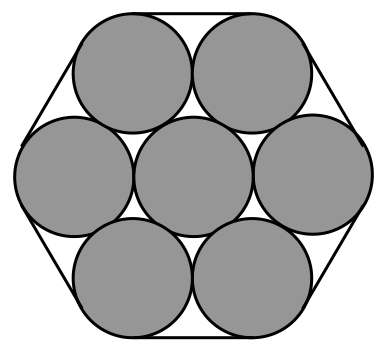
The diagram depicts seven soft-drink cans, seen from above, held tightly together by a ribbon. The circles represent the tops of the cans; the other curve, which is clearly not a circle, represents the edge of the ribbon. The ends of the ribbon meet exactly, with no overlap. All cans have diameter 6 cm. Find the exact length of the ribbon. (Take $\pi=3.14$.)
A, B, C and D are four members of the football team. No two have the same weight. A is 8 kg heavier than C. D is 4 kg heavier than B. The sum of the weights of the heaviest and the lightest is 2 kg less than the sum of the weights of the other two people. If all four weights total 402 kg, what does B weigh?
At a youth club one evening, one quarter of the members were playing pool, one sixth were playing table tennis, and five times the difference between these numbers were watching television. A further twelfth were reading, leaving 7 members wandering around undecided what to do. How many members were present that evening? Nobody was doing more than one thing at a time; for example, nobody was both playing pool and watching television.