A mathematical organization is producing a set of commemorative license plates. Each plate contains a sequence of five characters chosen from the four letters in AIME and the four digits in $2007.$ No character may appear in a sequence more times than it appears among the four letters in AIME or the four digits in $2007.$ A set of plates in which each possible sequence appears exactly once contains $N$ license plates. Find $\frac{N}{10}.$
Find the number of ordered triples $(a, b, c)$ where $a,$ $b,$ and $c$ are positive integers, $a$ is a factor of $b,$ $a$ is a factor of $c,$ and $a + b + c = 100.$
The workers in a factory produce widgets and whoosits. For each product, production time is constant and identical for all workers, but not necessarily equal for the two products. In one hour, $100$ workers can produce $300$ widgets and $200$ whoosits. In two hours, $60$ workers can produce $240$ widgets and $300$ whoosits. In three hours, $50$ workers can produce $150$ widgets and $m$ whoosits. Find $m.$
The graph of the equation $9x + 223y = 2007$ is drawn on graph paper with each square representing one unit in each direction. How many of the $1$ by $1$ graph paper squares have interiors lying entirely below the graph and entirely in the first quadrant?
An integer is called *parity-monotonic* if its decimal representation $a_1 a_2 a_3 \ldots a_k$ satisfies $a_i \lt a_{i+1}$ if $a_i$ is odd, and $a_i \gt a_{i+1}$ if $a_i$ is even. How many four-digit parity-monotonic integers are there?
Given a real number $x,$ let $\lfloor x \rfloor$ denote the greatest integer less than or equal to $x.$ For a certain integer $k,$ there are exactly $70$ positive integers $n_1,$ $n_2,$ $\ldots,$ $n_{70}$ such that $$
\begin{aligned} k &= \lfloor\sqrt[3]{n_1}\rfloor = \lfloor\sqrt[3]{n_2}\rfloor \\ &= \cdots = \lfloor\sqrt[3]{n_{70}}\rfloor \end{aligned}
$$ and $k$ divides $n_i$ for all $i$ such that $1 \le i \le 70.$ Find the maximum value of $\frac{n_i}{k}$ for $1 \le i \le 70.$
A rectangular piece of paper measures $4$ units by $5$ units. Several lines are drawn parallel to the edges of the paper. A rectangle determined by the intersections of some of these lines is called *basic* if (i) all four sides of the rectangle are segments of drawn line segments, and (ii) no segments of drawn lines lie inside the rectangle.
Given that the total length of all lines drawn is exactly $2007$ units, let $N$ be the maximum possible number of basic rectangles determined. Find the remainder when $N$ is divided by $1000.$
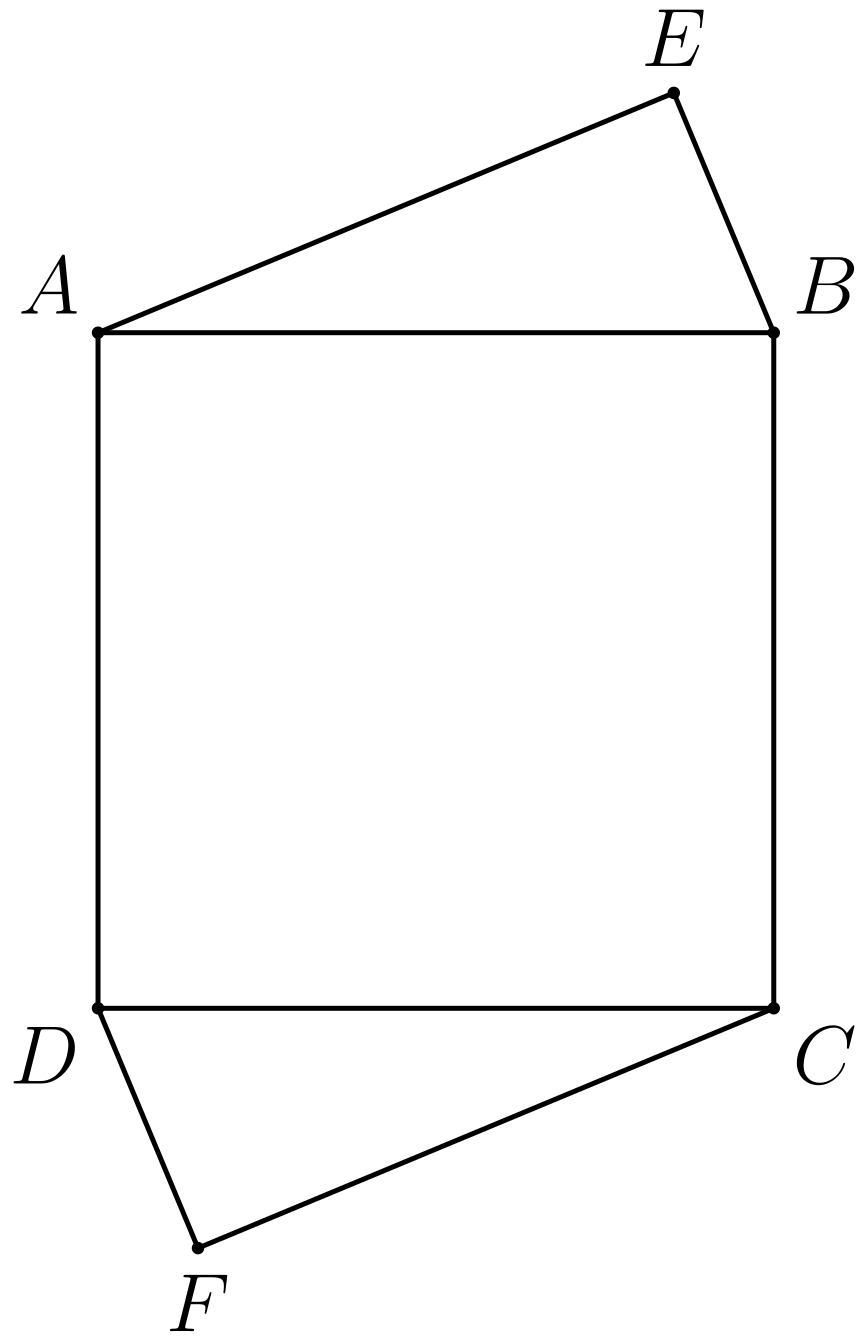
Rectangle $ABCD$ is given with $AB = 63$ and $BC = 448.$ Points $E$ and $F$ lie on $\overline{AD}$ and $\overline{BC}$ respectively, such that $AE = CF = 84.$ The inscribed circle of triangle $BEF$ is tangent to $\overline{EF}$ at point $P,$ and the inscribed circle of triangle $DEF$ is tangent to $\overline{EF}$ at point $Q.$ Find $PQ.$
Let $S$ be a set with six elements. Let $P$ be the set of all subsets of $S.$ Subsets $A$ and $B$ of $S,$ not necessarily distinct, are chosen independently and at random from $P.$ The probability that $B$ is contained in at least one of $A$ or $S - A$ is $\frac{m}{n^r},$ where $m,$ $n,$ and $r$ are positive integers, $n$ is prime, and $m$ and $n$ are relatively prime. Find $m + n + r.$ (The set $S - A$ is the set of all elements of $S$ which are not in $A.$)
Two long cylindrical tubes of the same length but different diameters lie parallel to each other on a flat surface. The larger tube has radius $72$ and rolls along the surface toward the smaller tube, which has radius $24.$ It rolls over the smaller tube and continues rolling along the flat surface until it comes to rest on the same point of its circumference as it started, having made one complete revolution. If the smaller tube never moves, and the rolling occurs with no slipping, the larger tube ends up a distance $x$ from where it starts. The distance $x$ can be expressed in the form $a\pi + b\sqrt{c},$ where $a,$ $b,$ and $c$ are integers and $c$ is not divisible by the square of any prime. Find $a + b + c.$
The increasing geometric sequence $x_0,$ $x_1,$ $x_2,$ $\ldots$ consists entirely of integral powers of $3.$ Given that $$
\sum_{n=0}^{7} \log_3(x_n) = 308
$$ and $$
56 \le \log_3\left(\sum_{n=0}^{7} x_n\right) \le 57,
$$ find $\log_3(x_{14}).$
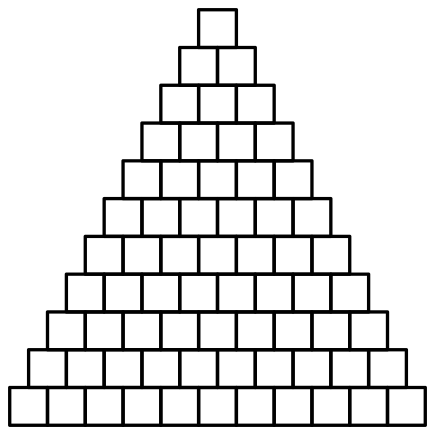
A triangular array of squares has one square in the first row, two in the second, and, in general, $k$ squares in the $k$th row for $1 \le k \le 11.$ With the exception of the bottom row, each square rests on two squares in the row immediately below, as illustrated in the figure. In each square of the eleventh row, a $0$ or a $1$ is placed. Numbers are then placed into the other squares, with the entry for each square being the sum of the entries in the two squares below it. For how many initial distributions of $0$’s and $1$’s in the bottom row is the number in the top square a multiple of $3?$
Let $f(x)$ be a polynomial with real coefficients such that $f(0) = 1,$ $f(2) + f(3) = 125,$ and for all $x,$ $f(x)f(2x^2) = f(2x^3 + x).$ Find $f(5).$
Four circles $\omega,$ $\omega_A,$ $\omega_B,$ and $\omega_C$ with the same radius are drawn in the interior of triangle $ABC$ such that $\omega_A$ is tangent to sides $AB$ and $AC,$ $\omega_B$ to $BC$ and $BA,$ $\omega_C$ to $CA$ and $CB,$ and $\omega$ is externally tangent to $\omega_A,$ $\omega_B,$ and $\omega_C.$ If the sides of triangle $ABC$ are $13,$ $14,$ and $15,$ the radius of $\omega$ can be represented in the form $\frac{m}{n},$ where $m$ and $n$ are relatively prime positive integers. Find $m + n.$
A $100$ foot long moving walkway moves at a constant rate of $6$ feet per second. Al steps onto the start of the walkway and stands. Bob steps onto the start of the walkway two seconds later and strolls forward along the walkway at a constant rate of $4$ feet per second. Two seconds after that, Cy reaches the start of the walkway and walks briskly forward beside the walkway at a constant rate of $8$ feet per second. At a certain time, one of these three persons is exactly halfway between the other two. At that time, find the distance in feet between the start of the walkway and the middle person.
The complex number $z$ is equal to $9 + bi,$ where $b$ is a positive real number and $i^2 = -1.$ Given that the imaginary parts of $z^2$ and $z^3$ are equal, find $b.$
Three planets revolve about a star in coplanar circular orbits with the star at the center. All planets revolve in the same direction, each at a constant speed, and the periods of their orbits are $60,$ $84,$ and $140$ years. The positions of the star and all three planets are currently collinear. They will next be collinear after $n$ years. Find $n.$
The formula for converting a Fahrenheit temperature $F$ to the corresponding Celsius temperature $C$ is $C = \frac{5}{9}(F - 32).$ An integer Fahrenheit temperature is converted to Celsius and rounded to the nearest integer; the resulting integer Celsius temperature is converted back to Fahrenheit and rounded to the nearest integer. For how many integer Fahrenheit temperatures $T$ with $32 \le T \le 1000$ does the original temperature equal the final temperature?