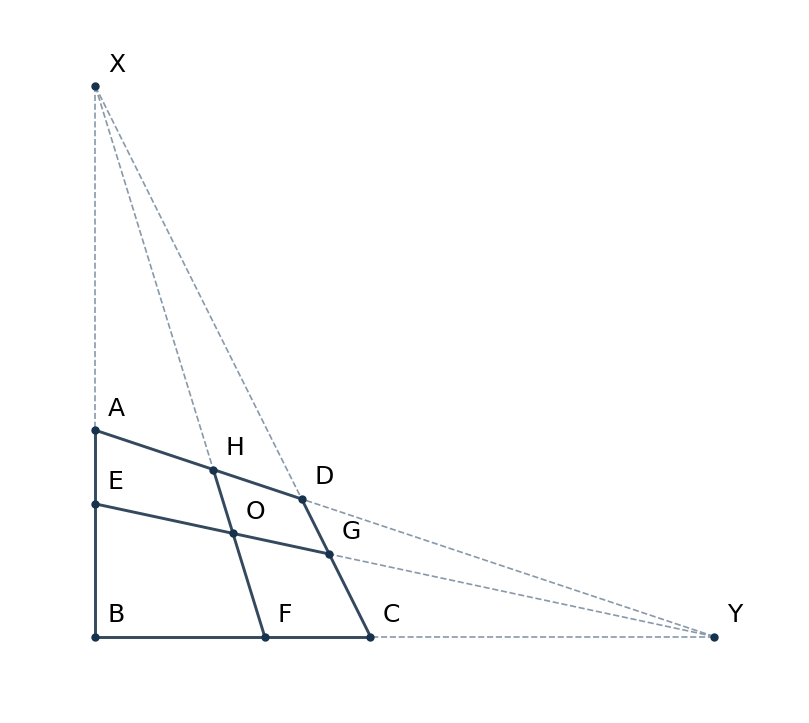
Let $ABCD$ be a convex quadrilateral. Points $E,F,G,H$ lie on $AB,BC,CD,DA$, respectively, such that lines $AB,FH,CD$ are concurrent, and lines $BC,EG,AD$ are concurrent. Put $O=EG\cap FH$. Consider $AHOE,BEOF,CFOG,DGOH$. Prove that if three of these quadrilaterals are tangential, so is the fourth. A tangential quadrilateral has a circle inside it tangent to all four sides.
Every rational number is colored white or red. Call a coloring sanferminera if, for any distinct rationals $x,y$, whenever one of $xy=1$, $x+y=0$, or $x+y=1$ holds, the numbers have different colors. How many sanferminera colorings are there?
Let $O$ be an interior point of triangle $ABC$. Extend $AO,BO,CO$ to meet $BC,CA,AB$ at $A_1,B_1,C_1$, respectively. Prove that $O$ lies inside the medial triangle of $A_1B_1C_1$ (the triangle joining the midpoints of its sides).
Olesya wrote down a natural number $N$. After this, Andriy wrote down one sixth, one fifth, one fourth, one third and a half of $N$. It turns out that the sum of all numbers that are written is integer. What is the least possible number that Olesya could write?
Find all nonnegative real quadruples $(a,b,c,d)$ satisfying
$$\begin{aligned}a^2(b+c)(b+c+d)&=\sqrt{b+c}\sqrt[3]{b+c+d},\\b^2(c+d)(c+d+a)&=\sqrt{c+d}\sqrt[3]{c+d+a},\\c^2(d+a)(d+a+b)&=\sqrt{d+a}\sqrt[3]{d+a+b},\\d^2(a+b)(a+b+c)&=\sqrt{a+b}\sqrt[3]{a+b+c}.\end{aligned}$$
Let $H$ be the point of intersection of the altitudes $AP$ and $CQ$ of an acute-angled triangle $ABC$. On the median $BM$ points $E$ and $F$ are chosen so that $\angle APE = \angle BAC$, $\angle CQF = \angle BCA$, where the point $E$ lies inside the triangle $APB$, and the point $F$ lies inside the triangle $CQB$. Prove that the lines $AE$, $CF$ and $BH$ are concurrent.
Let $n\gt 2$ be even and let real numbers $x_1,\ldots,x_n$ satisfy
$$\sum_{1\le i\lt j\le n}(x_i-x_j)^2=1.$$
Find the maximum of $\sum_{i=1}^n(x_i-x_{i+1})^2$, where $x_{n+1}=x_1$.
Let $f(x_1,\ldots,x_n)$ be an integer-coefficient polynomial of total degree less than $n$. Prove that the number of ordered tuples $(x_1,\ldots,x_n)$ with $0\le x_i\le12$ and
$$f(x_1,\ldots,x_n)\equiv0\pmod{13}$$
is divisible by13.
Consider all integer-coefficient polynomials $f(x)=(x-a_1)\cdots(x-a_{100})$, where all $a_i$ are real. Find the largest possible value of $\{a_1\}+\cdots+\{a_{100}\}$. Here $\{x\}=x-[x]$ and $[x]$ is the greatest integer not exceeding $x$.
Positive integers $K,B,W$ satisfy $B\gt W\gt 1$. Initially one pile has $B$ black balls and another has $W$ white balls. At each operation sort all piles in nonincreasing size, putting a white pile before a black pile of equal size. Select the first $K$ piles, or all piles if fewer, and split each selected pile into two whose sizes differ by at most 1.
For example, the source takes $K=4$, black piles 5,4,4,2 and white piles 8,4,2, then lists the sorted order as $(w8,b5,w4,b4,w2,b2)$. The first four split into $(4,4),(3,2),(2,2),(2,2)$, and the stated next order is $(w4,w4,b4,b3,w2,w2,w2,b2,b2,b2)$.
Repeat until a white singleton first appears at the end of an operation. Prove there is still a black pile of at least 2 balls.
An alphabet has $n$ letters. A word contains a palindrome if a consecutive substring of more than one letter reads identically forwards and backwards. For example OLIMPIADAS contains ADA. For an integer $k\gt2$, how many length-$k$ words contain no odd-length palindrome?
Let $P(x)$, $Q(x)$ be polynomials with real coefficients such that $P(0) \gt 0$ and all coefficients of the polynomial $S(x) = P(x)Q(x)$ are non-negative. Prove that for any positive $x$ the following inequality holds:
$$
S(x^2) - S^2(x) \le \frac{1}{4}(P^2(x^3) + Q(x^3)).
$$
Let $a,b,c$ be positive real numbers. Prove
$$\frac a{b+c}+\frac b{c+a}+\frac c{a+b}+\sqrt{\frac{ab+bc+ca}{a^2+b^2+c^2}}\ge\frac52.$$
When does equality hold?
Let $K_1$ have centre $O_1$, and let circle $K_2$ with centre $O_2$ pass through $O_1$. They meet at $A,B$. Circle $K_1$ meets segment $O_1O_2$ at $C$. Line $BC$ meets $K_2$ again at $D$; line $AD$ meets $K_1$ again at $E$. Let $F$ be the midpoint of $AE$. Prove that lines $O_1A,O_1D$ trisect $\angle CO_1F$.
Consider the assertion that for each positive integer $n \ge 2$, the remainder upon dividing $2^{2n}$ by $2^n - 1$ is a power of 4. Either prove the assertion or find (with proof) a counterexample.
Let $A$ be a set with $|A| = 225$, meaning that $A$ has $225$ elements. Suppose further that there are eleven subsets $A_1, \dots, A_{11}$ of $A$ such that $|A_i| = 45$ for $1 \le i \le 11$ and $|A_i \cap A_j| = 9$ for $1 \le i \lt j \le 11$. Prove that $|A_1 \cup A_2 \cup \dots \cup A_{11}| \ge 165$, and give an example for which equality holds.
Let $A,B,C,D$ be four points in space not all lying in one plane. The segments $AB,BC,CD,DA$ are tangent to the same sphere. Prove that the four points of tangency lie in one plane.