Suppose $f$ is a positive integer-valued function defined for the set of positive integers satisfying for any pair of positive integers $x, y$ the following inequality:
$$
(x + y)f(x) \leq x^2 + f(xy) + 110.
$$
Determine the minimum and the maximum value of $f(23) + f(2011)$ for this $f$.
A two-digit number $n$ is divided by the sum of its digits, giving remainder $r$.
a. Find a number $n$ such that $r=0$.
b. Show that $r$ cannot exceed $15$.
c. Show that for every remainder $r$ at most $12$, there is a number $n$ that leaves remainder $r$ when divided by its digit sum.
Let $(x_n)_{n \ge 0}$ be a sequence of integer numbers that fulfills a linear recursion of order $k$ for a fixed positive integer $k$, i.e., there exists real constant numbers $c_1, c_2, \dots, c_k$ such that $x_{n+k} = \sum_{r=1}^k c_r x_{n+k-r}$, $\forall n \ge 0$. Suppose $k$ is the minimum positive integer with this property. Prove that $c_j \in \mathbb{Z}$, for all $j$, $1 \le j \le k$.
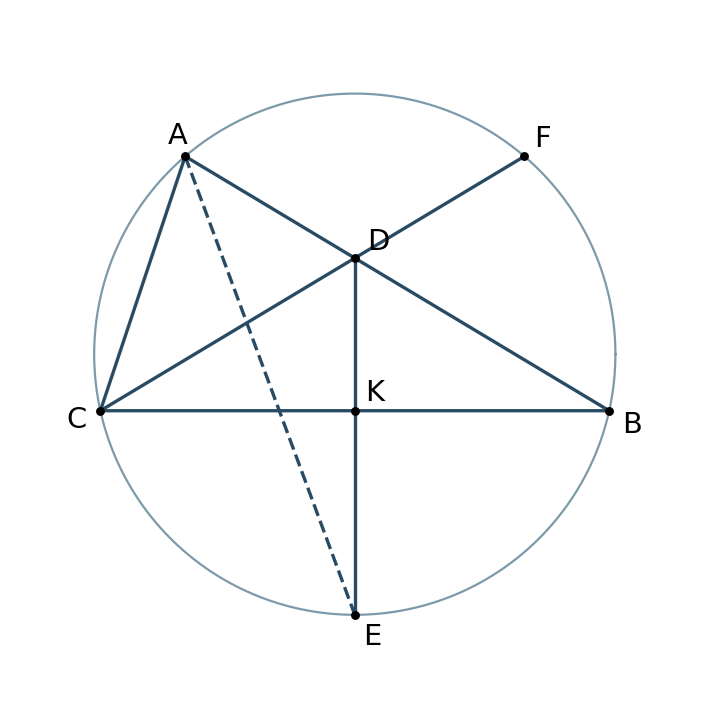
Let $ABC$ be a triangle with $AC \lt AB \lt BC$. Choose a point $D$ on the side $AB$. Suppose the circumcircle of $ABC$ meets the internal angle bisector of $\angle A$ and $CD$ at $E$ ($\neq A$) and $F$ ($\neq C$), respectively. Let $K$ be the intersection point of $BC$ and $DE$. Prove that $CK = AC$ if and only if $DK \cdot EF = AC \cdot DF$.
In a tennis tournament, a player advances to the next round only by winning. If it is not possible always to advance an even number of players, the organizers decide which rounds certain players must play. For example, at the organizers' discretion a seeded player may enter in the second round or skip from the first to the third, so that an even number of players takes part in every round.
a. In a tournament with 64 players, how many matches are played?
Emerald writes the integers from $1$ to $9$ in a $3 \times 3$ table, one number in each cell, each number appearing exactly once. Then she computes eight sums: the sums of three numbers on each row, the sums of the three numbers on each column and the sums of the three numbers on both diagonals.
a. Show a table such that exactly three of the eight sums are multiples of $3$.
b. Is it possible that none of the eight sums is a multiple of $3$?
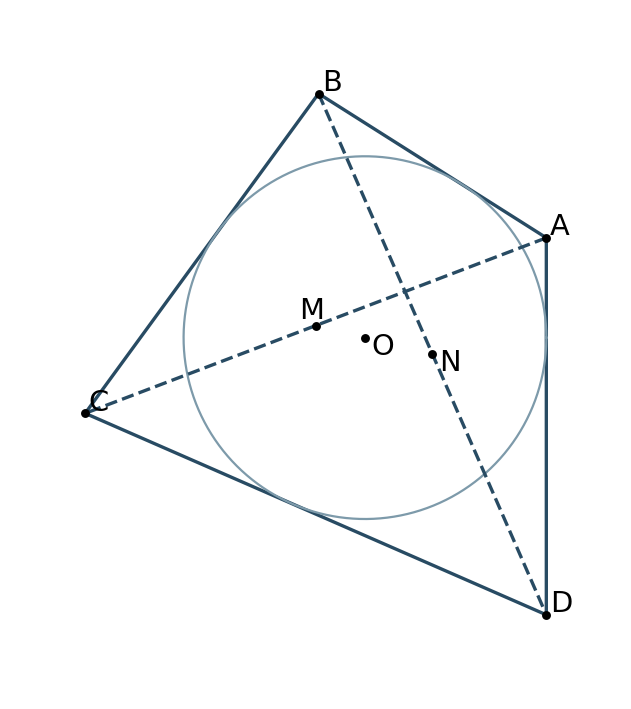
Suppose 4 sides $AB$, $BC$, $CD$, $DA$ of a quadrilateral $ABCD$ are tangent to a circle with its center $O$, and conditions
$$
OA = 5,\ OB = 6,\ OC = 7,\ OD = 8
$$
are satisfied. Let $M$, $N$ be the midpoint of the line segments $AC$, $BD$ respectively. Find the value of $OM : ON$. Here for a line segment $XY$ its length is also denoted by $XY$.
We call a number pal if it doesn't have a zero digit and the sum of the squares of the digits is a perfect square. For example, $2115522$ is pal (because $2^2 + 1^2 + 1^2 + 5^2 + 5^2 + 2^2 + 2^2 = 8^2$) but $304$ and $12$ are not pal.
Each bicycle license plate in Quixajuba contains three letters. The first is chosen from $\mathcal A=\{\mathrm G,\mathrm H,\mathrm L,\mathrm P,\mathrm R\}$, the second from $\mathcal B=\{\mathrm M,\mathrm I,\mathrm O\}$, and the third from $\mathcal C=\{\mathrm D,\mathrm U,\mathrm N,\mathrm T\}$.
Because the number of bicycles increased, the city needed more possible plates. It was decided to add two new letters to just one set, or one new letter to each of two sets.
What is the largest number of new plates that can be made when the two new letters are added?
When $a_{0}, a_{1}, \ldots, a_{1000}$ denote digits, can the sum of the 1001-digit numbers $a_{0} a_{1} \ldots a_{1000}$ and $a_{1000} a_{999} \ldots a_{0}$ have odd digits only?
On a $123\times123$ board, each cell is colored purple or blue subject to these conditions:
- Every purple cell not on the border has exactly 5 blue cells among its 8 neighbors.
- Every blue cell not on the border has exactly 4 purple cells among its 8 neighbors.
Note: Two cells are neighbors if they share a side or a vertex.
a) Consider a $3\times3$ subboard within the $123\times123$ board. How many cells of each color can it contain?
b) Calculate the number of purple cells on the $123\times123$ board.
There are 4 cards and on each one a positive 1-digit integer is written. By choosing 2 different cards from the 4 and writing down the sum of the 2 numbers written on the chosen cards, we can get 4 distinct integers. Also by choosing 2 distinct cards and writing down the product of the 2 numbers written on the chosen cards, we can get 3 distinct integers. Determine all possible combinations of the numbers written on the 4 given cards.
Four cars $A,B,C,D$ race from São Paulo to Fortaleza, starting in the order $A$, then $B$, then $C$, then $D$. During the race, $A$ and $B$ exchanged positions (overtook each other) 9 times, and $B$ and $C$ exchanged positions 8 times.
To determine the finishing order in Fortaleza, you may only ask questions of the form:
“How many times did cars $X$ and $Y$ exchange positions?”
Before asking the next question, you know the answer to the previous one. Formulate three questions that determine the finishing order of all four cars.
We are given a rectangular $m \times n$ chessboard with $m$ unit squares in each row and $n$ unit squares in each column. We are going to assign an integer to each unit square. A rectangle $R$ consisting of one or more unit squares is called a shelf if there is an integer $h$ satisfying the following two conditions:
1. The number in each unit square in $R$ is larger than $h$.
2. The number in a unit square out of $R$ sharing an edge or a point with $R$ is at most $h$.
(We assume that a shelf $R$ contains all interior unit squares in the rectangle.) What is the number of shelves if we assign integers to maximize the number of shelves?