We are given an infinite deck of cards, each with a real number on it. For every real number $x$, there is exactly one card in the deck that has $x$ written on it. Now two players draw disjoint sets $A$ and $B$ of $100$ cards each from this deck. We would like to define a rule that declares one of them a winner. This rule should satisfy the following conditions:
1. The winner only depends on the relative order of the $200$ cards: if the cards are laid down in increasing order face down and we are told which card belongs to which player, but not what numbers are written on them, we can still decide the winner.
2. If we write the elements of both sets in increasing order as $A=\{a_{1}, a_{2}, \ldots, a_{100}\}$ and $B=\{b_{1}, b_{2}, \ldots, b_{100}\}$, and $a_{i}\gt b_{i}$ for all $i$, then $A$ beats $B$.
3. If three players draw three disjoint sets $A, B, C$ from the deck, $A$ beats $B$ and $B$ beats $C$, then $A$ also beats $C$.
How many ways are there to define such a rule? Here, we consider two rules as different if there exist two sets $A$ and $B$ such that $A$ beats $B$ according to one rule, but $B$ beats $A$ according to the other.
Let $AB\Gamma\Delta$ be a quadrilateral inscribed into the circle. With centers $A, B, \Gamma, \Delta$ we draw circles $C_A, C_B, C_\Gamma, C_\Delta$ respectively, not having common points. The circle $C_A$ intersects the sides of the quadrilateral at the points $A_1, A_2$, the circle $C_B$ at the points $B_1, B_2$, the circle $C_\Gamma$ at the points $\Gamma_1, \Gamma_2$ and the circle $C_\Delta$ at the points $\Delta_1, \Delta_2$. Prove that the quadrilateral created by the lines $A_1A_2, B_1B_2, \Gamma_1\Gamma_2$ and $\Delta_1\Delta_2$ is cyclic. (E. Psychas)
A card deck consists of 1024 cards. On each card, a set of distinct decimal digits is written in such a way that no two of these sets coincide (thus, one of the cards is empty). Two players alternately take cards from the deck, one card per turn. After the deck is empty, each player checks if he can throw out one of his cards so that each of the ten digits occurs on an even number of his remaining cards. If one player can do this but the other one cannot, the one who can is the winner; otherwise a draw is declared.
Determine all possible first moves of the first player after which he has a winning strategy.
Let $n$ be a positive integer not exceeding $2014$ with the property that $x^2 + x + 1$ is a factor of $x^{2n} + x^n + 1$. Find the sum of all possible values of $n$.
For every real number $x$, let $\|x\|$ denote the distance between $x$ and the nearest integer. Prove that for every pair $(a, b)$ of positive integers there exist an odd prime $p$ and a positive integer $k$ satisfying
$$
\left\|\frac{a}{p^{k}}\right\|+\left\|\frac{b}{p^{k}}\right\|+\left\|\frac{a+b}{p^{k}}\right\|=1 .
$$
Find the smallest positive integer $n$ for which a polynomial
$$P(X)=a_{2n}X^{2n}+a_{2n-1}X^{2n-1}+\ldots+a_1X+a_0$$
with real coefficients has both properties:
- $2014\le a_i\le2015$ for $i=0,1,\ldots,2n$;
- there is a real number $\xi$ such that $P(\xi)=0$.
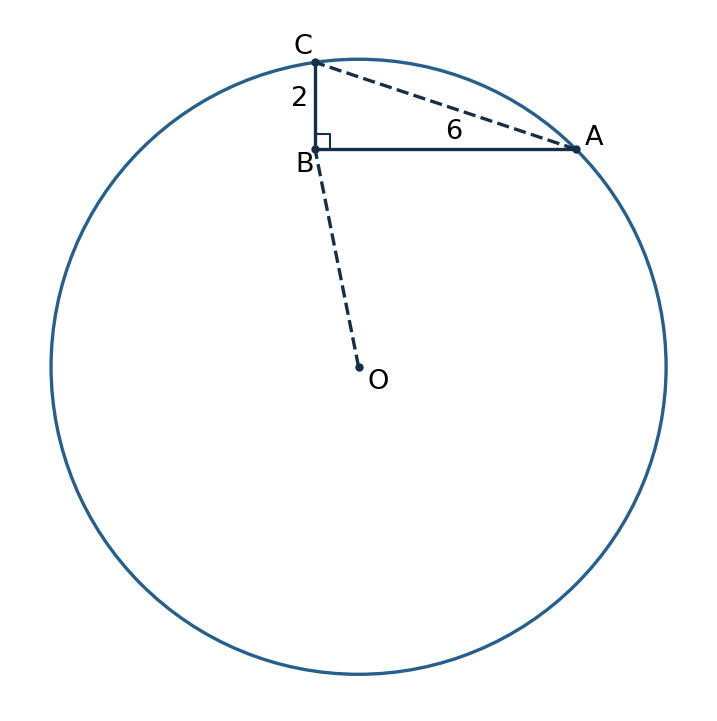
Points $A$ and $C$ lie on the circumference of a circle with radius $\sqrt{50}$. $B$ is a point inside the circle such that $\angle ABC = 90^\circ$. If $AB = 6$ and $BC = 2$, find the distance from $B$ to the centre of the circle.
Let $\lfloor x \rfloor$ denote the greatest integer not exceeding $x$. Find the last two digits of
$$
\left\lfloor \frac{1}{3} \right\rfloor + \left\lfloor \frac{2}{3} \right\rfloor + \left\lfloor \frac{2^2}{3} \right\rfloor + \cdots + \left\lfloor \frac{2^{2^{2^{14}}}}{3} \right\rfloor
$$
Let $\Sigma = \{1,2,3,\ldots,n\}$. We want to make a partition of the set $\Sigma$ into three subsets $A$, $B$ and $\Gamma$ mutually disjoint with $A \cup B \cup \Gamma = \Sigma$ and such that the sums of their elements $S_A$, $S_B$ and $S_\Gamma$, respectively, are equal. Examine if that is possible, in the following cases
(α) $n = 2014$; (β) $n = 2015$; (γ) $n = 2018$. (A. Fellouris)
A positive integer $n$ is called playful if it can be written as $n=a^b+b$ for integers $a,b\ge2$. Decide whether there are $102$ consecutive positive integers of which exactly $100$ are playful.
Let $ABC$ be a triangle. The points $K$, $L$, and $M$ lie on the segments $BC$, $CA$, and $AB$, respectively, such that the lines $AK$, $BL$, and $CM$ intersect in a common point. Prove that it is possible to choose two of the triangles $ALM$, $BMK$, and $CKL$ whose inradii sum up to at least the inradius of the triangle $ABC$.
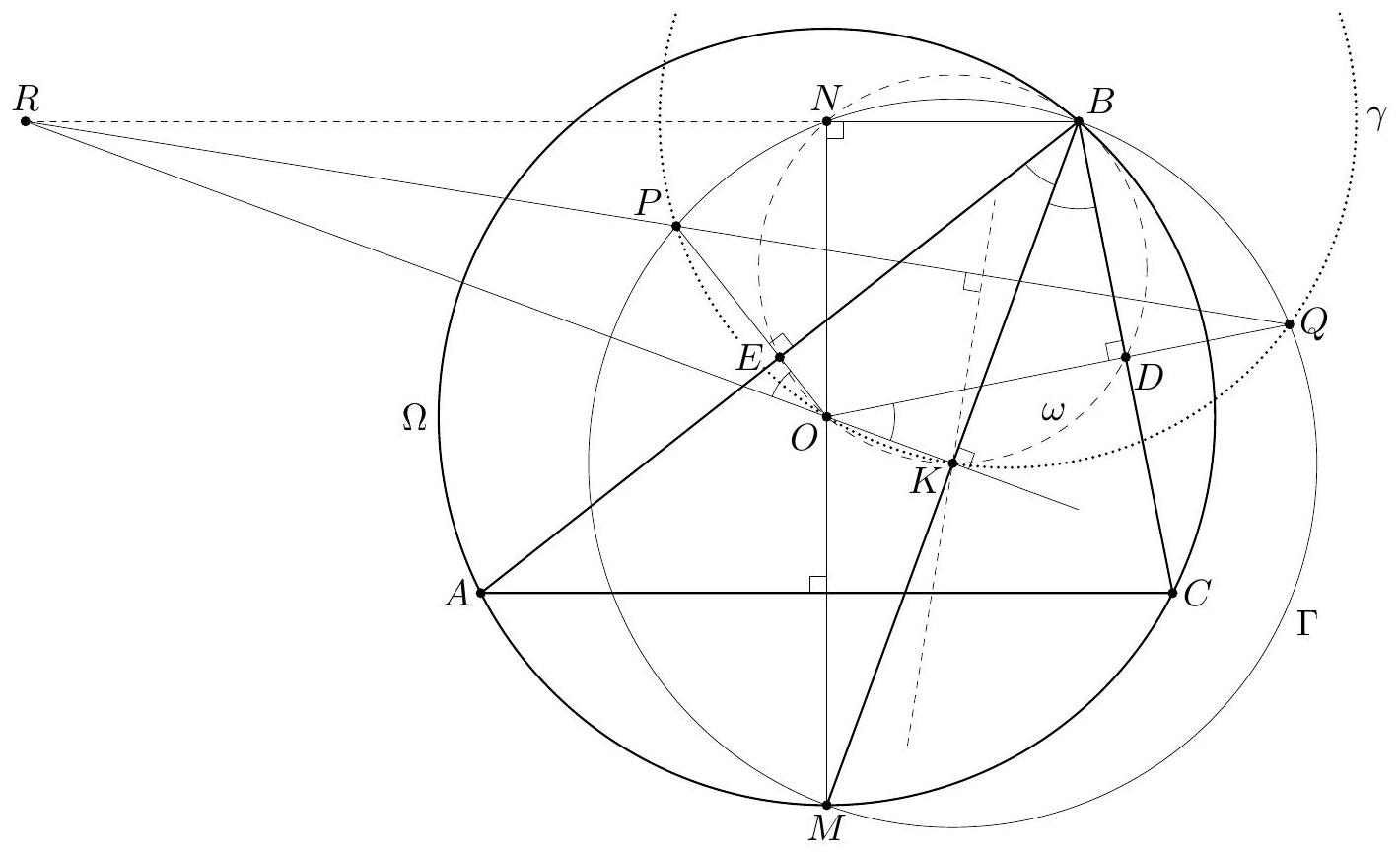
Let $\Omega$ and $O$ be the circumcircle and the circumcentre of an acute-angled triangle $A B C$ with $A B \gt B C$. The angle bisector of $\angle A B C$ intersects $\Omega$ at $M \neq B$. Let $\Gamma$ be the circle with diameter $B M$. The angle bisectors of $\angle A O B$ and $\angle B O C$ intersect $\Gamma$ at points $P$ and $Q$, respectively. The point $R$ is chosen on the line $P Q$ so that $B R = M R$. Prove that $B R \parallel A C$. (Here we always assume that an angle bisector is a ray.)
(Russia)
Find the greatest positive integer $k$ for which the following holds: For all positive real numbers $a$, $b$ and $c$ with $abc = 1$, we have the inequality
$$
\frac{1}{a} + \frac{1}{b} + \frac{1}{c} + \frac{k}{a+b+c+1} \ge \frac{k}{4} + 3.
$$
Let $a$, $b$, $c$ be distinct nonzero real numbers. If the equations $ax^3 + bx + c = 0$, $bx^3 + cx + a = 0$ and $cx^3 + ax + b = 0$ have a common root, prove that at least one of these equations has three real roots (not necessarily distinct).
Let $ABC$ be an acute triangle and $H$ be the perpendicular foot at the side $BC$ from $A$. Let $D$ and $E$ be points on the segments $AB$ and $AC$, $F$ and $G$ be the perpendicular feet at $BC$ from $D$ and $E$ respectively. Let $P$ be the perpendicular foot at the segment $DH$ from $E$. Suppose that $DG, EF, AH$ are concurrent. Show that $\angle APE = \angle CPE$.
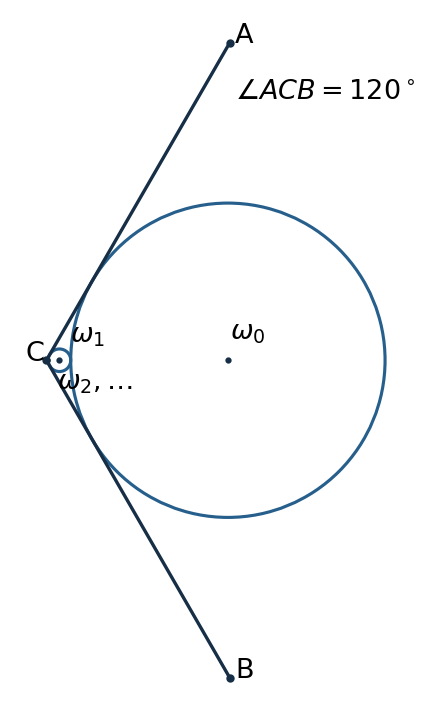
Let $A$, $B$, $C$ be points on the same plane with $\angle ACB = 120^\circ$. There is a sequence of circles $\omega_0, \omega_1, \omega_2, \ldots$ on the same plane (with corresponding radii $r_0, r_1, r_2, \ldots$, where $r_0 \gt r_1 \gt r_2 \gt \ldots$) such that each circle is tangent to both segments $CA$ and $CB$. Furthermore, $\omega_i$ is tangent to $\omega_{i-1}$ for all $i \ge 1$. If $r_0 = 3$, find the value of $r_0 + r_1 + r_2 + \ldots$.