Let $a,b,c$ be nonnegative real numbers with $a+b+c=3$. Prove
$$\begin{aligned}&\left(a^2b+\frac23\right)\left(b^2c+\frac23\right)+\left(b^2c+\frac23\right)\left(c^2a+\frac23\right)\\&\quad+\left(c^2a+\frac23\right)\left(a^2b+\frac23\right)\le\frac{75}{4}.\end{aligned}$$
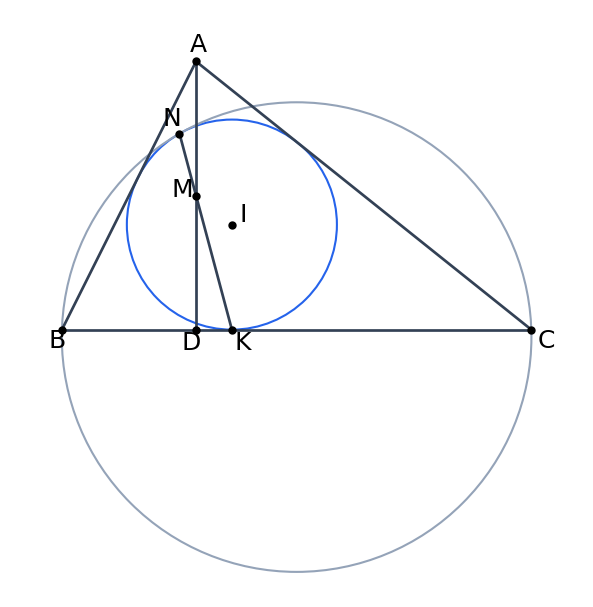
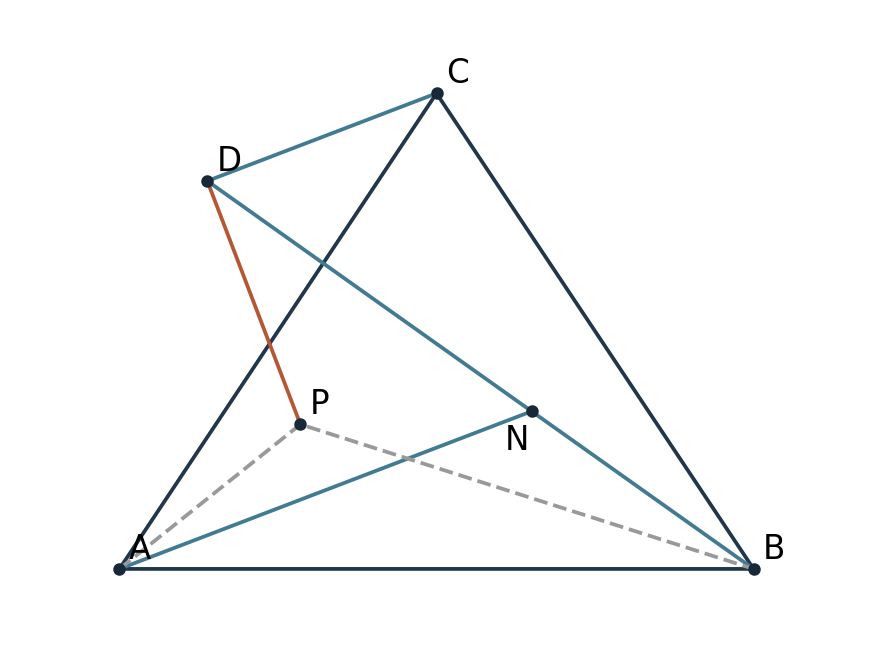
In acute triangle $ABC$, the incircle $\omega$ touches line $BC$ at $K$. Let $AD$ be the altitude and $M$ the midpoint of $AD$. If $N$ is the second intersection of $\omega$ and $KM$, prove that the circumcircle of triangle $BCN$ and $\omega$ are tangent at $N$.
A flea at point $A$ on a line jumps exactly $1\,\mathrm m$ each time, never leaving the line.
a) In how many ways can it reach point $B$, $5\,\mathrm m$ to the right of $A$, in exactly 7 jumps?
b) In how many ways can it reach point $C$, $5\,\mathrm m$ to the right of $A$, in exactly 9 jumps?
c) Can it reach point $D$ on the line at distance $2013\,\mathrm m$ from $A$ in exactly 2028 jumps? Justify.
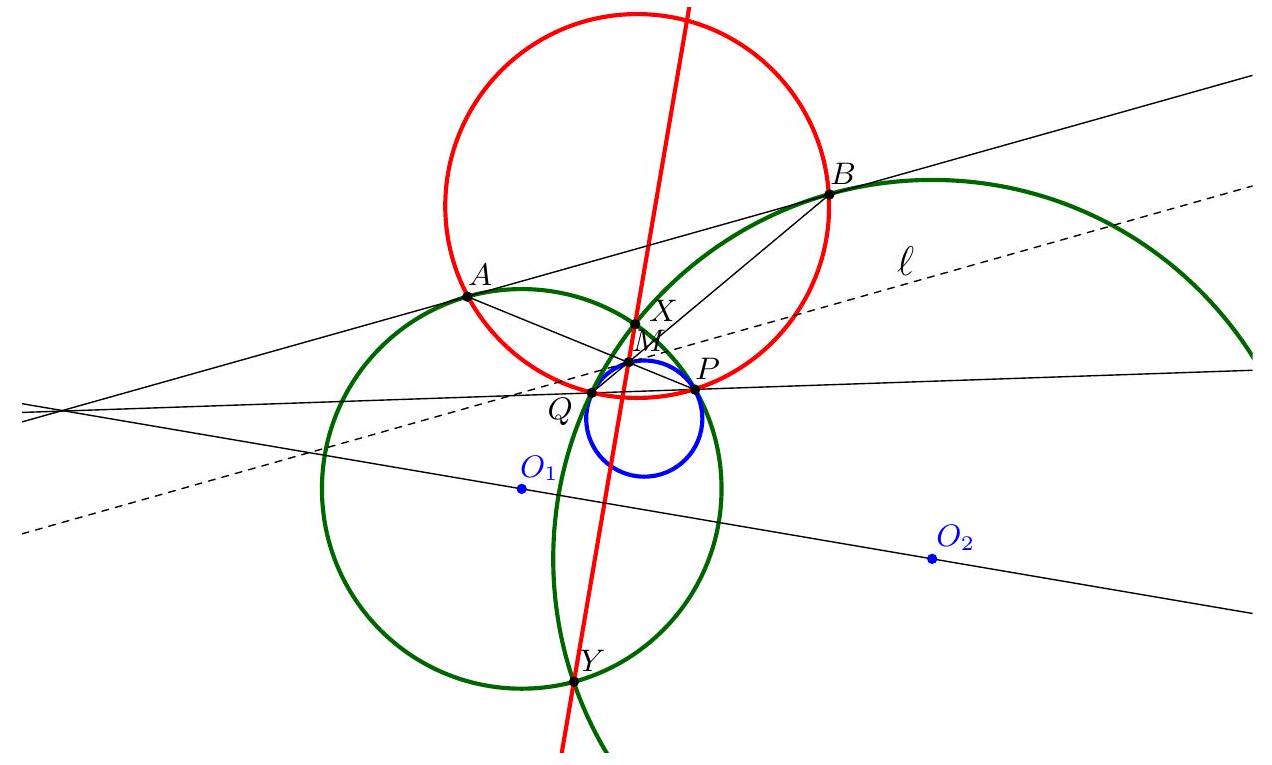
Let two circles ω₁,ω₂ intersect at X,Y. A circle ω is internally tangent to ω₁ and ω₂ at P and Q respectively. Segment XY meets ω at M,N. Rays PM and PN meet ω₁ at A,D; rays QM and QN meet ω₂ at B,C. Prove AB=CD.
Eight children sit around a round table. For each child, the total number of candies held by that child and the two neighbors is odd. Must every child have an odd number of candies?
Let $\{a_n\}_{n\ge1}$ be a sequence of natural numbers such that $0\lt a_{n+1}-a_n\le m$ for every $n\ge1$, where $m\in\mathbb N$ is fixed. Prove that there are terms $a_r,a_s$ with $a_r\mid a_s$ and $1\le r\lt s$.
Let $a$ be a positive integer such that exactly $10$ perfect squares are greater than $a$ and less than $2a$.
(a) Find the smallest possible value of $a$.
(b) Find the greatest possible value of $a$.
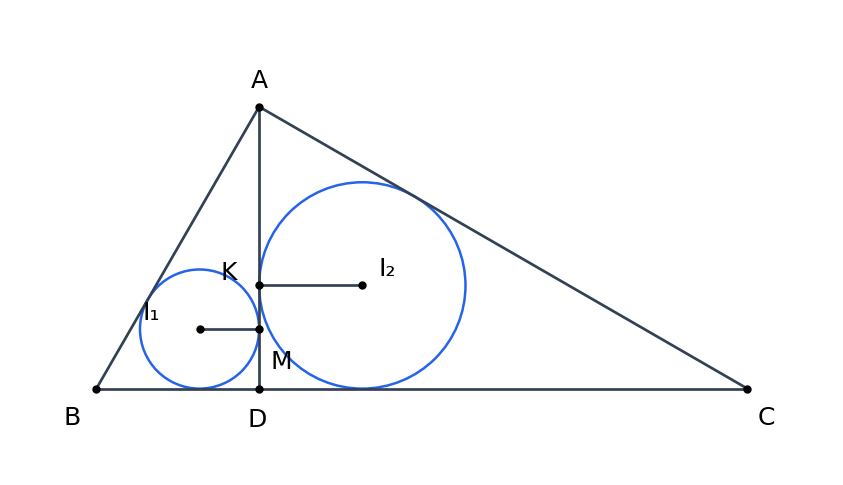
Triangle $ABC$ has $\angle BAC=90^\circ$. Let $D$ be the foot of the altitude from $A$ to $BC$, and let $I_1,I_2$ be the incenters of triangles $ABD,ACD$, respectively. Let $M,K$ be the perpendicular feet from $I_1,I_2$ to segment $AD$, respectively. If $I_1M+I_2K=BC/4$, find the angles of triangle $ABC$.
Consider the sequence $a_1,a_2,\ldots$, where
$$a_n=\underbrace{111111\ldots1}_{3^n\text{ digits}},$$
that is, $a_1=\underbrace{111}_{\text{three ones}}$, $a_2=\underbrace{111111111}_{\text{nine ones}}$, $a_3=\underbrace{111\ldots1}_{\text{twenty-seven ones}}$, and so on.
(a) Show that $a_1$ is a multiple of $3$ but not of $9$.
(b) Show that $a_2$ is a multiple of $9$ but not of $27$.
(c) Show that $a_3$ is a multiple of $27$ but not of $81$.
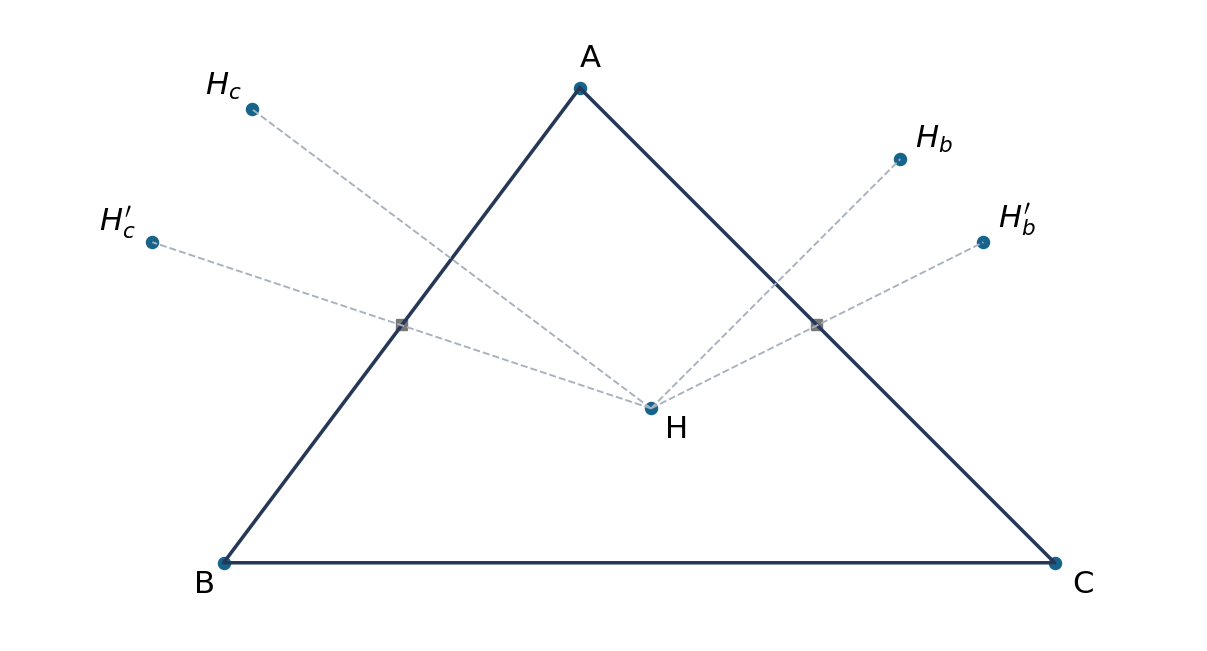
Let $ABC$ be an acute angled triangle, and $H$ a point in its interior. Let the reflections of $H$ through the sides $AB$ and $AC$ be called $H_{c}$ and $H_{b}$, respectively, and let the reflections of $H$ through the midpoints of these same sides be called $H_{c}^{\prime}$ and $H_{b}^{\prime}$, respectively. Show that the four points $H_{b}, H_{b}^{\prime}, H_{c}$, and $H_{c}^{\prime}$ are concyclic if and only if at least two of them coincide or $H$ lies on the altitude from $A$ in triangle $ABC$.
Do there exist two real monic polynomials $P(x)$ and $Q(x)$ of degree 3, such that the roots of $P(Q(x))$ are nine pairwise distinct nonnegative integers that add up to 72? (In a monic polynomial of degree 3, the coefficient of $x^3$ is 1.)
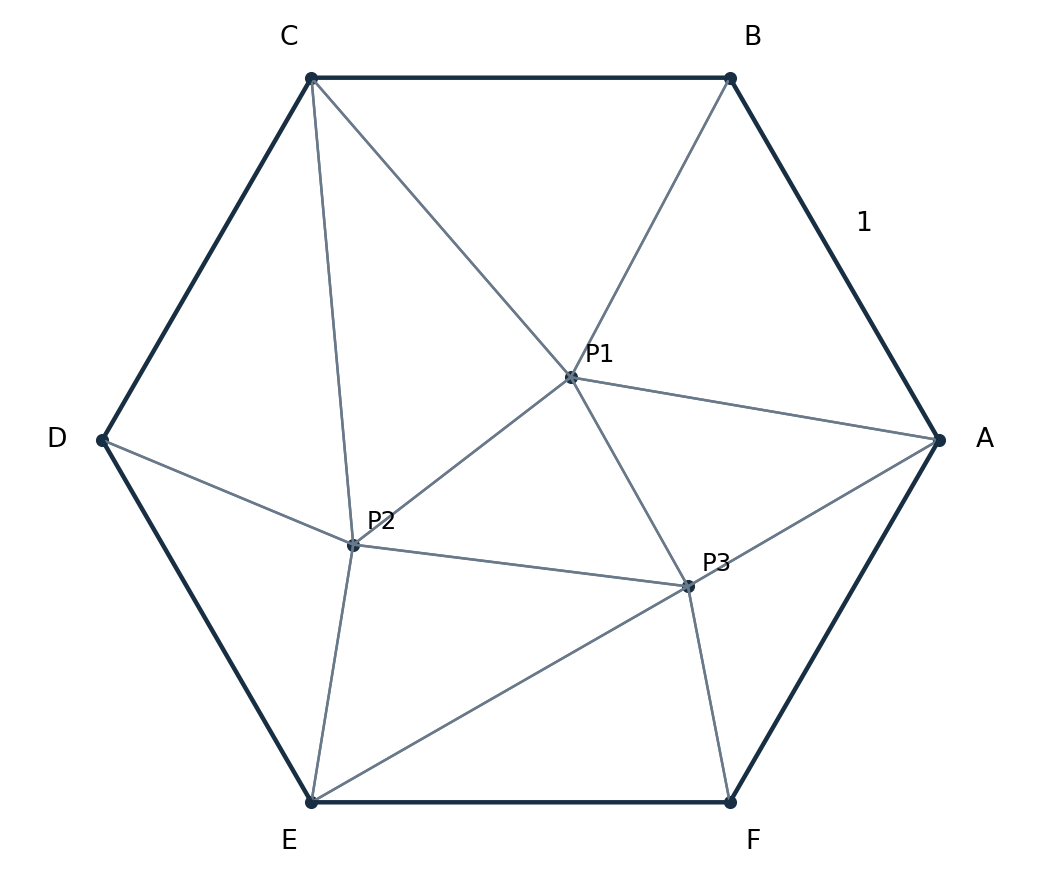
A regular hexagon with side-length $1$ is given. Inside the hexagon $m$ points are given so that no three of them are collinear. The hexagon is split into triangles, so that each of the given $m$ points and each vertex of the hexagon is a vertex of one such triangle. The triangles into which the hexagon is split have no common interior point. Prove that, among them, there exists one triangle whose area is not greater than $\frac{3\sqrt{3}}{4(m+2)}$.
Professor Guilherme creates three strange machines. Machine $A$ turns a cat into a dog with probability $1/3$; machine $B$ does so with probability $2/5$; and machine $C$ with probability $1/4$. If the animal is a dog, none of the machines changes it.
He puts a cat into $A$, then the resulting animal into $B$, and finally the animal from $B$ into $C$. What is the probability that a dog comes out of $C$?
**ДБ-А2** Prove that the number of partitions of $n$ in which only odd summands may be repeated equals the number of partitions of $n$ in which each summand occurs at most three times.
Let $ABC$ be an isosceles triangle with $AC = BC$. Let $N$ be a point inside the triangle such that $2 \angle ANB = 180^{\circ} + \angle ACB$. Let $D$ be the intersection of the line $BN$ and the line parallel to $AN$ that passes through $C$. Let $P$ be the intersection of the angle bisectors of the angles $CAN$ and $ABN$.
Show that the lines $DP$ and $AN$ are perpendicular.
A natural number $N$ greater than $10$ is called a “supersquare” if the number formed by every two consecutive digits of $N$ (in the same order) is always a perfect square. For example, $8164$ is a supersquare because $81$, $16$, and $64$ are perfect squares. Other examples are $25$ and $649$.
(a) How many supersquares are there?
(b) What is the largest supersquare?
Five friends, Arnaldo, Bernaldo, Cernaldo, Dernaldo, and Ernaldo, competed in five races. In each race first place earned $5$ points, second $4$, and so on down to last place with $1$. Final scores were the sums over five races. Arnaldo finished first overall with $19$ points, followed by Bernaldo with $16$. Cernaldo, Dernaldo, and Ernaldo were third, fourth, and fifth overall. There were no ties in any race or in the final standings. Curiously, neither Arnaldo nor Bernaldo won even one race.
(a) Show that in every race Arnaldo and Bernaldo occupied second and third places in some order.
(b) How many points did Cernaldo score?
(c) How many races did each runner win?
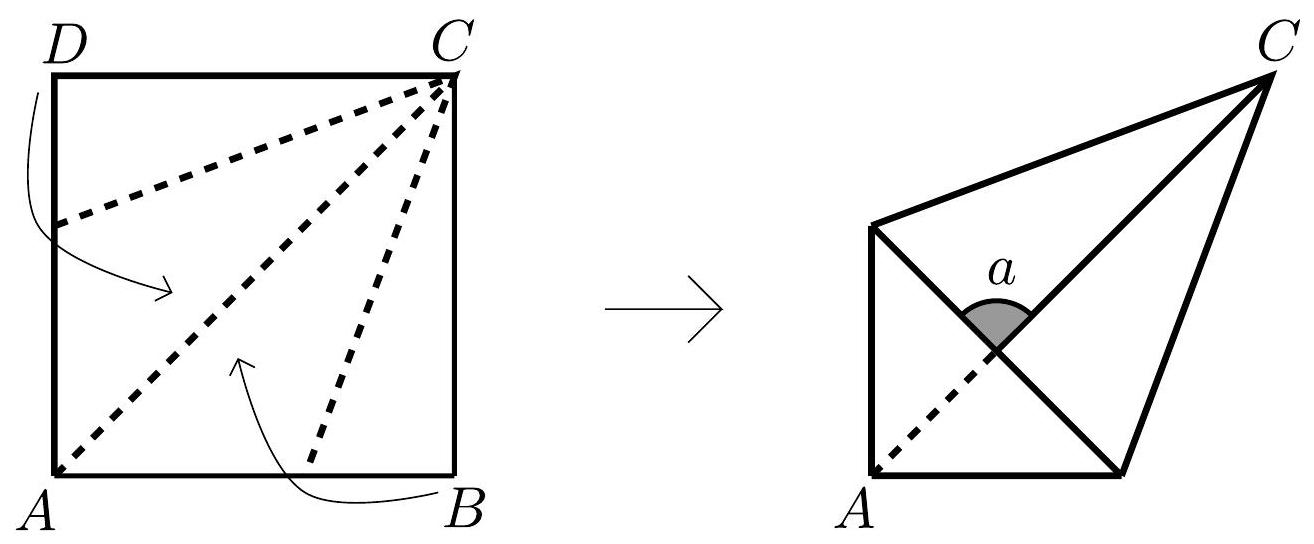
Júlio Daniel has a square sheet of paper with vertices $A,B,C,D$. He first folds it by bringing vertices $B,D$ to the diagonal as shown:
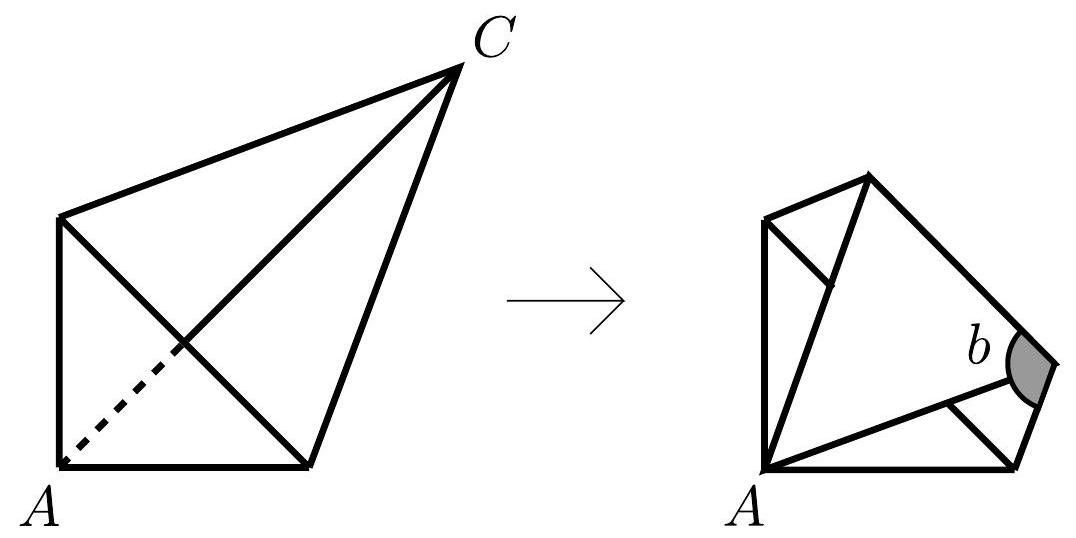
He then brings vertex $C$ to $A$, obtaining a pentagon as shown:
a) Prove that angle $a$ measures $90^\circ$.
b) Determine angle $b$.
A racing turtle travels along a straight line as follows. On the first stretch, of length $\frac12\,\mathrm m$, it runs at $3\,\mathrm{m/s}$. On the second stretch, of length $\frac13\,\mathrm m$, it runs at $4\,\mathrm{m/s}$. On the third stretch, of length $\frac14\,\mathrm m$, it runs at $5\,\mathrm{m/s}$, and so on.
a) How long does it take to cover the first stretch? Write the result as the difference of two unit fractions, that is, fractions with numerator 1.
b) Do the same for the second stretch.
c) Calculate the time needed to cover the first 2013 stretches.