Let $S=\{a_1,\ldots,a_{2004}\}$ consist of 2004 distinct positive integers. For each $i=1,1,\ldots,2004$ (as printed), let $f(a_i)$ be the number of elements of $S$ coprime to $a_i$. The source then requires $d(a_i)<2003$ and $f(a_i)=f(a_j)$ for all $i,j\in\{1,\ldots,2004\}$.
Find the smallest positive integer $k$ such that every $k$-element subset of every such $S$ contains two distinct elements whose greatest common divisor is not 1.
Editorial notice: the symbol $d$ is not defined in the source. The conditional reference proof below interprets $d=f$; it is not a resolution of the literal undefined statement.
The supplied source has no question point values. Each problem uses 1 editorial point for import compatibility; this is not an official scoring scale.
The supplied PDF does not state a time limit. This edition uses the user-approved 240 minutes per session, 480 minutes total for both sessions; this is an editorial convention.
The source prints May 7–8, 2004. Assigning Questions 1–3 and 4–6 to the two days is an editorial convention, not printed day headings. Importer scoring multipliers are correct 1, incorrect 0, blank 0; these essays require manual grading.
Determine all real numbers $\alpha$ for which there is exactly one function $f:\mathbb R\to\mathbb R$ satisfying
$$f(x^2+y+f(y))=f(x)^2+\alpha y\qquad(x,y\in\mathbb R).$$
Two circles $(O_1),(O_2)$ intersect at $A,B$. Their tangents to $(O_1)$ at $A,B$ meet at $K$. A point $M\ne A,B$ lies on $(O_1)$. Let $P$ be the second intersection of $MA$ with $(O_2)$, $C$ the second intersection of $MK$ with $(O_1)$, and $Q$ the second intersection of $CA$ with $(O_2)$. Prove:
1. The midpoint of $PQ$ lies on $MC$.
2. The line $PQ$ passes through a fixed point as $M$ varies.
As usual, a construction is considered only where the named second intersections and the lines in the claim are defined and nondegenerate.
Let $x_1=603$, $x_2=102$ and
$$x_{n+2}=x_{n+1}+x_n+2\sqrt{x_{n+1}x_n-2}\qquad(n\ge1).$$
Prove: (1) every term is a positive integer; (2) infinitely many terms end in the four decimal digits 2003; (3) no term ends in the four digits 2004.
Let $ABCDEF$ be a convex hexagon, and let $A_1,B_1,C_1,D_1,E_1,F_1$ be the midpoints of $AB,BC,CD,DE,EF,FA$, respectively. Their perimeters are $p$ and $p_1$. Suppose all interior angles of $A_1B_1C_1D_1E_1F_1$ are equal. Prove
$$p\ge\frac{2\sqrt3}{3}p_1,$$
and determine exactly when equality holds.
Let $S$ be a nonempty set of positive integers whose smallest and largest elements are coprime. For each natural number $n$, let $S_n$ be the set of all natural numbers expressible as a sum of at most $n$ elements of $S$, with repetitions allowed. The sum of zero elements is 0. If $a=\max S$, prove that there are a positive integer $k$ and an integer $b$ such that
$$|S_n|=an+b\qquad\text{for every }n>k.$$
Here $|X|$ denotes the number of elements of $X$, and natural numbers in the definition of $S_n$ include 0.
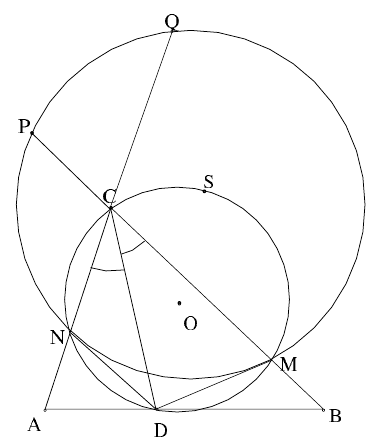
Let $ABC$ be a triangle in the plane, and let $D$ be the intersection of segment $AB$ with the internal bisector of $\angle ACB$. A variable circle $(O)$ always passes through $C,D$ and is not tangent to either line $BC$ or $CA$. It meets $BC,CA$ again at $M,N$, respectively.
(a) Prove that there exists a circle $(S)$ tangent to lines $DM,DN$ at $M,N$, respectively.
(b) Circle $(S)$ meets lines $BC,AC$ at $P,Q$, respectively. Prove that the lengths $MP,NQ$ are constant as $(O)$ varies.
Let $A$ be the set of the first 16 positive integers, $A=\{1,2,\ldots,16\}$. Determine the smallest positive integer $k$ such that every $k$-element subset of $A$ contains two elements $a,b$ for which $a^2+b^2$ is prime.
Consider the real sequence $\{x_n\}_{n=1}^{+\infty}$ defined by
$$x_1=1,\qquad x_{n+1}=\frac{(2+2\cos2\alpha)x_n+\cos^2\alpha}{(2-2\cos2\alpha)x_n+2-\cos2\alpha}\quad(n=1,2,\ldots),$$
where $\alpha$ is a real parameter. Determine all possible values of $\alpha$ such that the sequence $\{y_n\}_{n=1}^{+\infty}$ with
$$y_n=\sum_{k=1}^{n}\frac1{1+2x_n}$$
has a finite limit as $n$ tends to infinity, and determine those limits.
For each positive integer $n$, let $S(n)$ be the sum of all its decimal digits. Among all positive integers $m$ divisible by $2003$, find the smallest possible value of $S(m)$.