Skip to content / Đến nội dung
ThichHocToan.com

Question bank SMO 2011

Exam papers

110 questions

Question 1

Calculate the following sum: $$\frac12+\frac24+\frac38+\frac4{16}+\cdots+\frac{10}{2^{10}}.$$
  1. $\frac{503}{256}$
  2. $\frac{505}{256}$
  3. $\frac{507}{256}$
  4. $\frac{509}{256}$
  5. None of the above.

Question 2

It is known that the roots of the equation $$x^5+3x^4-4044118x^3-12132362x^2-12132363x-2011^2=0$$ are all integers. How many distinct roots does the equation have?
  1. $1$
  2. $2$
  3. $3$
  4. $4$
  5. $5$

Question 3

A fair dice is thrown three times. The results of the first, second and third throw are recorded as $x,y,z$, respectively. Suppose $x+y=z$. What is the probability that at least one of $x,y,z$ is $2$?
  1. $\frac1{12}$
  2. $\frac38$
  3. $\frac8{15}$
  4. $\frac13$
  5. $\frac7{13}$

Question 4

Let $$x=1\underbrace{00\cdots0}_{2011}\,1\underbrace{00\cdots0}_{2012}\,50.$$
The two indicated blocks contain $2011$ and $2012$ zeros, respectively. Which of the following is a perfect square?
  1. $x-75$
  2. $x-25$
  3. $x$
  4. $x+25$
  5. $x+75$

Question 5

Suppose $N_1,N_2,\ldots,N_{2011}$ are positive integers. Let
$$X=(N_1+N_2+\cdots+N_{2010})(N_2+N_3+\cdots+N_{2011}),$$
$$Y=(N_1+N_2+\cdots+N_{2011})(N_2+N_3+\cdots+N_{2010}).$$
Which one of the following relationships always holds?
  1. $X=Y$
  2. $X>Y$
  3. $X\lt Y$
  4. $X-N_1\lt Y-N_{2011}$
  5. None of the above.

Question 6

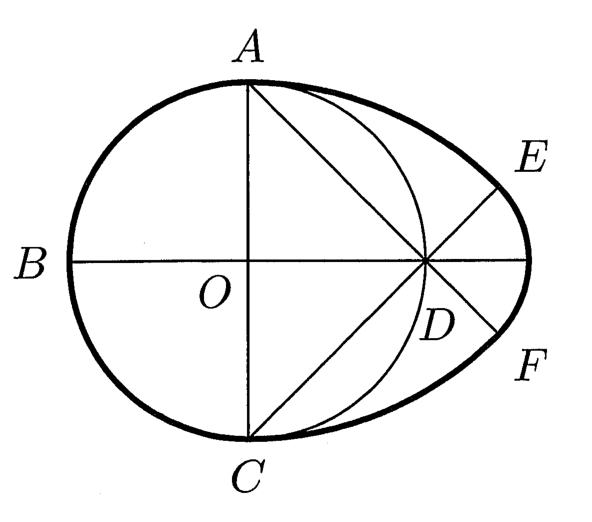
Consider the following egg shaped curve. $ABCD$ is a circle of radius 1 centred at $O$. The arc $\widehat{AE}$ is centred at $C$, $\widehat{CF}$ is centred at $A$ and $\widehat{EF}$ is centred at $D$.

Question illustration

What is the area of the region enclosed by the egg shaped curve?
  1. $(3-\sqrt2)\pi-1$
  2. $(3-\sqrt2)\pi$
  3. $(3+\sqrt2)\pi+1$
  4. $(3-2\sqrt2)\pi$
  5. $(3-2\sqrt2)\pi+1$

Question 7

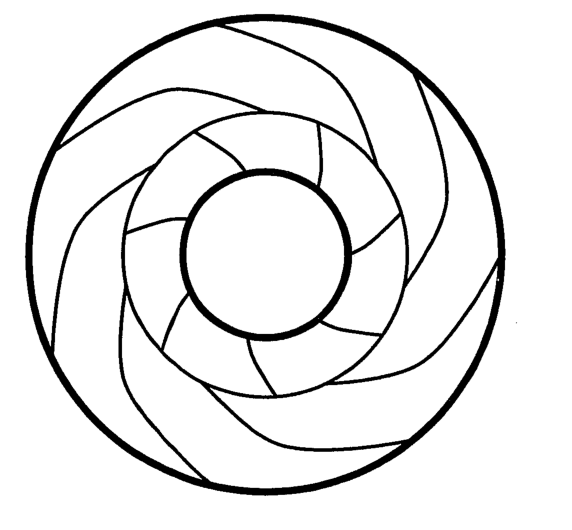
The following annulus is cut into 14 regions. Each region is painted with one colour. What is the minimum number of colours needed to paint the annulus so that no two adjacent regions share the same colour?

Question illustration
  1. $3$
  2. $4$
  3. $5$
  4. $6$
  5. $7$

Question 8

Let $n=(2^4-1)(3^6-1)(5^{10}-1)(7^{12}-1)$. Which of the following statements is true?
  1. $n$ is divisible by 5, 7 and 11 but not 13.
  2. $n$ is divisible by 5, 7 and 13 but not 11.
  3. $n$ is divisible by 5, 11 and 13 but not 7.
  4. $n$ is divisible by 7, 11 and 13 but not 5.
  5. None of the above.

Question 9

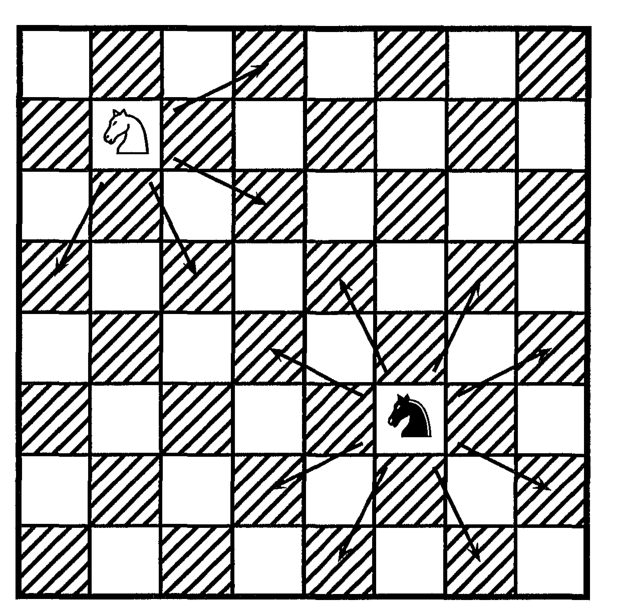
How many ways can you place a White Knight and a Black Knight on an $8\times8$ chessboard such that they do not attack each other?

Question illustration
  1. $1680$
  2. $1712$
  3. $3696$
  4. $3760$
  5. None of the above.

Question 10

In the set $\{1,6,7,9\}$, which of the numbers appear as the last digit of $n^n$ for infinitely many positive integers $n$?
  1. $1,6,7$ only.
  2. $1,6,9$ only.
  3. $1,7,9$ only.
  4. $6,7,9$ only.
  5. $1,6,7,9$.

Question 11

Suppose $\dfrac xa+\dfrac yb+\dfrac zc=\sqrt2$ and $\dfrac ax+\dfrac by+\dfrac cz=0$. Find $$\frac{x^2}{a^2}+\frac{y^2}{b^2}+\frac{z^2}{c^2}.$$

Question 12

Suppose $x=\dfrac{13}{\sqrt{19+8\sqrt3}}$. Find the exact value of $$\frac{x^4-6x^3-2x^2+18x+23}{x^2-8x+15}.$$

Question 13

Let $a_1=3$, and define $a_{n+1}=\dfrac{\sqrt3a_n-1}{a_n+\sqrt3}$ for all positive integers $n$. Find $a_{2011}$.

Question 14

Let $a,b,c$ be positive real numbers such that
$$\begin{cases}a^2+ab+b^2=25,\\b^2+bc+c^2=49,\\c^2+ca+a^2=64.\end{cases}$$
Find $(a+b+c)^2$.

Question 15

Let $P(x)$ be a polynomial of degree 2010. Suppose $P(n)=\dfrac n{1+n}$ for all $n=0,1,2,\ldots,2010$. Find $P(2012)$.

Question 16

Let $\lfloor x\rfloor$ be the greatest integer smaller than or equal to $x$. How many solutions are there to the equation $$x^3-\lfloor x^3\rfloor=(x-\lfloor x\rfloor)^3$$ on the interval $[1,20]$?

Question 17

Let $n$ be the smallest positive integer such that the sum of its digits is 2011. How many digits does $n$ have?

Question 18

Find the largest positive integer $n$ such that $n+10$ is a divisor of $n^3+2011$.

Question 19

Let $a,b,c,d$ be real numbers such that
$$\begin{cases}a^2+b^2+2a-4b+4=0,\\c^2+d^2-4c+4d+4=0.\end{cases}$$
Let $m$ and $M$ be the minimum and the maximum values of $(a-c)^2+(b-d)^2$, respectively. What is $m\times M$?

Question 20

Suppose $x_1,x_2,\ldots,x_{2011}$ are positive integers satisfying
$$x_1+x_2+\cdots+x_{2011}=x_1x_2\cdots x_{2011}.$$
Find the maximum value of $x_1+x_2+\cdots+x_{2011}$.