Points $A,$ $B,$ and $C$ lie in that order along a straight path where the distance from $A$ to $C$ is $1800$ meters. Ina runs twice as fast as Eve, and Paul runs twice as fast as Ina. The three runners start running at the same time with Ina starting at $A$ and running toward $C,$ Paul starting at $B$ and running toward $C,$ and Eve starting at $C$ and running toward $A.$ When Paul meets Eve, he turns around and runs toward $A.$ Paul and Ina both arrive at $B$ at the same time. Find the number of meters from $A$ to $B.$
Let $a_0 = 2,$ $a_1 = 5,$ and $a_2 = 8,$ and for $n \gt 2$ define $a_n$ recursively to be the remainder when $4(a_{n-1} + a_{n-2} + a_{n-3})$ is divided by $11.$ Find $a_{2018} \cdot a_{2020} \cdot a_{2022}.$
Find the sum of all positive integers $b \lt 1000$ such that the base-$b$ integer $36_{b}$ is a perfect square and the base-$b$ integer $27_{b}$ is a perfect cube.
In equiangular octagon $CAROLINE,$ $CA = RO = LI = NE = \sqrt{2}$ and $AR = OL = IN = EC = 1.$ The self-intersecting octagon $CORNELIA$ encloses six non-overlapping triangular regions. Let $K$ be the area enclosed by $CORNELIA,$ that is, the total area of the six triangular regions. Then $K = \frac{a}{b},$ where $a$ and $b$ are relatively prime positive integers. Find $a + b.$
Suppose that $x,$ $y,$ and $z$ are complex numbers such that $xy = -80 - 320i,$ $yz = 60,$ and $zx = -96 + 24i,$ where $i = \sqrt{-1}.$ Then there are real numbers $a$ and $b$ such that $x + y + z = a + bi.$ Find $a^2 + b^2.$
A real number $a$ is chosen randomly and uniformly from the interval $[-20, 18].$ The probability that the roots of the polynomial $$
\begin{aligned} &x^4 + 2ax^3 + (2a - 2)x^2 \\ &\quad {}+ (-4a + 3)x - 2 \end{aligned}
$$ are all real can be written in the form $\frac{m}{n},$ where $m$ and $n$ are relatively prime positive integers. Find $m + n.$
Triangle $ABC$ has side lengths $AB = 9,$ $BC = 5\sqrt{3},$ and $AC = 12.$ Points $A = P_0,$ $P_1,$ $P_2,$ $\ldots,$ $P_{2450} = B$ are on segment $\overline{AB}$ with $P_k$ between $P_{k-1}$ and $P_{k+1}$ for $k = 1,$ $2,$ $\ldots,$ $2449,$ and points $A = Q_0,$ $Q_1,$ $Q_2,$ $\ldots,$ $Q_{2450} = C$ are on segment $\overline{AC}$ with $Q_k$ between $Q_{k-1}$ and $Q_{k+1}$ for $k = 1,$ $2,$ $\ldots,$ $2449.$ Furthermore, each segment $\overline{P_kQ_k},$ $k = 1,$ $2,$ $\ldots,$ $2449,$ is parallel to $\overline{BC}.$ The segments cut the triangle into $2450$ regions, consisting of $2449$ trapezoids and $1$ triangle. Each of the $2450$ regions has the same area. Find the number of segments $\overline{P_kQ_k},$ $k = 1,$ $2,$ $\ldots,$ $2450,$ that have rational length.
A frog is positioned at the origin in the coordinate plane. From the point $(x, y),$ the frog can jump to any of the points $(x + 1, y),$ $(x + 2, y),$ $(x, y + 1),$ or $(x, y + 2).$ Find the number of distinct sequences of jumps in which the frog begins at $(0, 0)$ and ends at $(4, 4).$
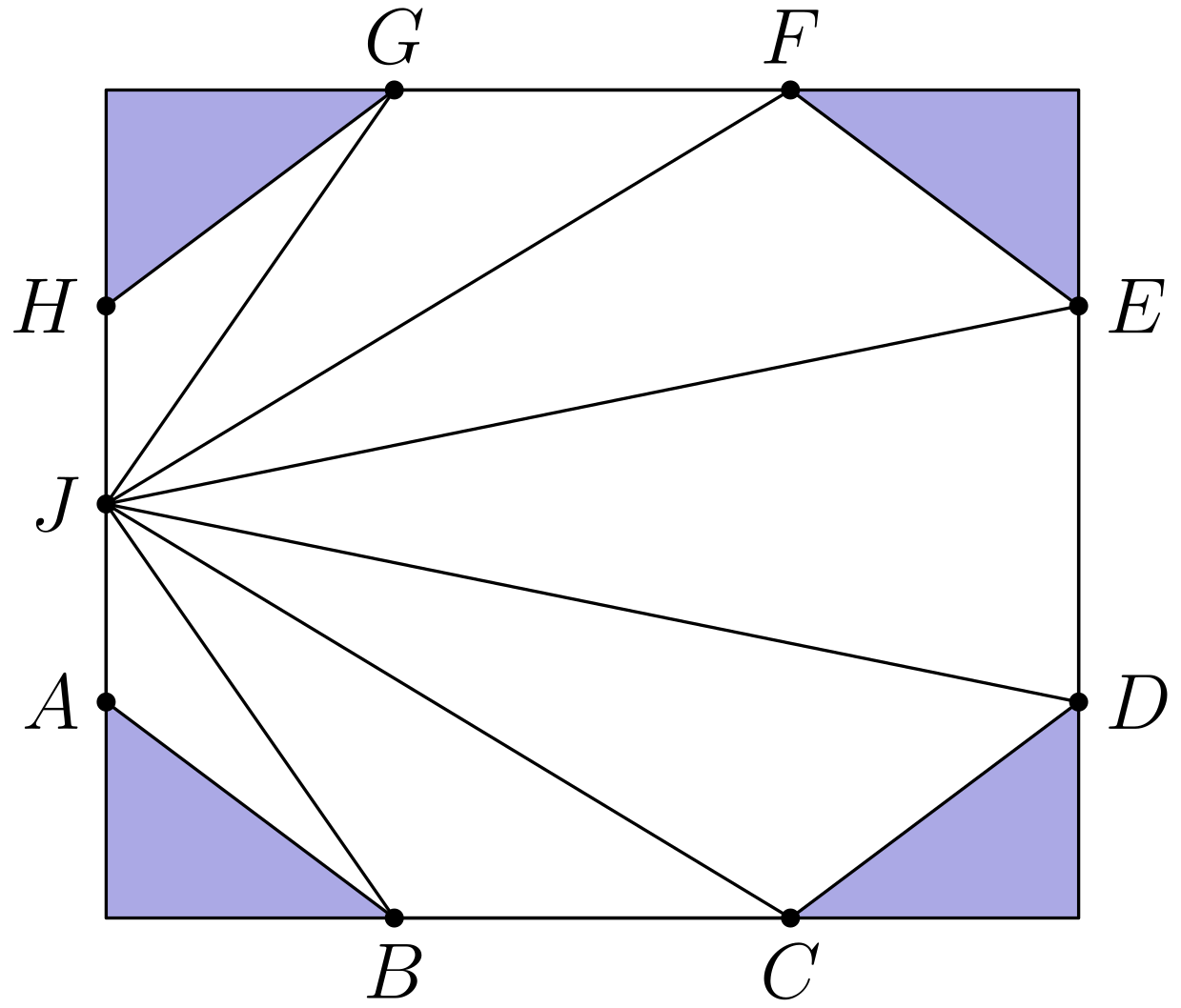
Octagon $ABCDEFGH$ with side lengths $AB = CD = EF = GH = 10$ and $BC = DE = FG = HA = 11$ is formed by removing four $6$-$8$-$10$ triangles from the corners of a $23 \times 27$ rectangle with side $\overline{AH}$ on a short side of the rectangle, as shown. Let $J$ be the midpoint of $\overline{AH},$ and partition the octagon into $7$ triangles by drawing segments $\overline{JB},$ $\overline{JC},$ $\overline{JD},$ $\overline{JE},$ $\overline{JF},$ and $\overline{JG}.$ Find the area of the convex polygon whose vertices are the centroids of these $7$ triangles.
Find the number of functions $f(x)$ from $\{1, 2, 3, 4, 5\}$ to $\{1, 2, 3, 4, 5\}$ that satisfy $f(f(x)) = f(f(f(x)))$ for all $x$ in $\{1, 2, 3, 4, 5\}.$
Find the number of permutations of $1,$ $2,$ $3,$ $4,$ $5,$ $6$ such that for each $k$ with $1 \le k \le 5,$ at least one of the first $k$ terms of the permutation is greater than $k.$
Let $ABCD$ be a convex quadrilateral with $AB = CD = 10,$ $BC = 14,$ and $AD = 2\sqrt{65}.$ Assume that the diagonals of $ABCD$ intersect at point $P,$ and that the sum of the areas of triangles $APB$ and $CPD$ equals the sum of the areas of triangles $BPC$ and $APD.$ Find the area of quadrilateral $ABCD.$
Misha rolls a standard, fair six-sided die until she rolls $1$-$2$-$3$ in that order on three consecutive rolls. The probability that she will roll the die an odd number of times is $\frac{m}{n},$ where $m$ and $n$ are relatively prime positive integers. Find $m + n.$
The incircle $\omega$ of triangle $ABC$ is tangent to $\overline{BC}$ at $X.$ Let $Y \neq X$ be the other intersection of $\overline{AX}$ with $\omega.$ Points $P$ and $Q$ lie on $\overline{AB}$ and $\overline{AC},$ respectively, so that $\overline{PQ}$ is tangent to $\omega$ at $Y.$ Assume that $AP = 3,$ $PB = 4,$ $AC = 8,$ and $AQ = \frac{m}{n},$ where $m$ and $n$ are relatively prime positive integers. Find $m + n.$
Find the number of functions $f$ from $\{0, 1, 2, 3, 4, 5, 6\}$ to the integers such that $f(0) = 0,$ $f(6) = 12,$ and $$
\begin{aligned} |x - y| &\le |f(x) - f(y)| \\ &\le 3|x - y| \end{aligned}
$$ for all $x$ and $y$ in $\{0, 1, 2, 3, 4, 5, 6\}.$
Let $S$ be the number of ordered pairs of integers $(a, b),$ with $1 \le a \le 100$ and $b \ge 0,$ such that the polynomial $x^2 + ax + b$ can be factored into the product of two (not necessarily distinct) linear factors with integer coefficients. Find the remainder when $S$ is divided by $1000.$
The number $n$ can be written in base $14$ as $\underline{a}\,\underline{b}\,\underline{c},$ can be written in base $15$ as $\underline{a}\,\underline{c}\,\underline{b},$ and can be written in base $6$ as $\underline{a}\,\underline{c}\,\underline{a}\,\underline{c},$ where $a \gt 0.$ Find the base-$10$ representation of $n.$
Kathy has $5$ red cards and $5$ green cards. She shuffles the $10$ cards and lays out $5$ of the cards in a row in a random order. She will be happy if and only if all the red cards laid out are adjacent and all the green cards laid out are adjacent. For example, card orders RRGGG, GGGGR, or RRRRR will make Kathy happy, but RRRGR will not. The probability that Kathy will be happy is $\frac{m}{n},$ where $m$ and $n$ are relatively prime positive integers. Find $m + n.$
In $\triangle ABC,$ $AB = AC = 10$ and $BC = 12.$ Point $D$ lies strictly between $A$ and $B$ on $\overline{AB}$ and point $E$ lies strictly between $A$ and $C$ on $\overline{AC}$ so that $AD = DE = EC.$ Then $AD$ can be expressed in the form $\frac{p}{q},$ where $p$ and $q$ are relatively prime positive integers. Find $p + q.$
For each ordered pair of real numbers $(x, y)$ satisfying $$
\begin{aligned} &\log_2(2x + y) \\ &= \log_4(x^2 + xy + 7y^2), \end{aligned}
$$ there is a real number $K$ such that $$
\begin{aligned} &\log_3(3x + y) \\ &= \log_9(3x^2 + 4xy + Ky^2). \end{aligned}
$$ Find the product of all possible values of $K.$