Suppose that the measurement of time during the day is converted to the metric system so that each day has $10$ metric hours, and each metric hour has $100$ metric minutes. Digital clocks would then be produced that would read $9{:}99$ just before midnight, $0{:}00$ at midnight, $1{:}25$ at the former $3{:}00$ AM, and $7{:}50$ at the former $6{:}00$ PM. After the conversion, a person who wanted to wake up at the equivalent of the former $6{:}36$ AM would set his new digital alarm clock for $A{:}BC,$ where $A,$ $B,$ and $C$ are digits. Find $100A + 10B + C.$
Positive integers $a$ and $b$ satisfy the condition $$
\log_2(\log_{2^a}(\log_{2^b}(2^{1000}))) = 0.
$$ Find the sum of all possible values of $a + b.$
A large candle is $119$ centimeters tall. It is designed to burn down more quickly when it is first lit and more slowly as it approaches its bottom. Specifically, the candle takes $10$ seconds to burn down the first centimeter from the top, $20$ seconds to burn down the second centimeter, and $10k$ seconds to burn down the $k$-th centimeter. Suppose it takes $T$ seconds for the candle to burn down completely. Then $\frac{T}{2}$ seconds after it is lit, the candle’s height in centimeters will be $h.$ Find $10h.$
In the Cartesian plane let $A = (1, 0)$ and $B = (2, 2\sqrt{3}).$ Equilateral triangle $ABC$ is constructed so that $C$ lies in the first quadrant. Let $P = (x, y)$ be the center of $\triangle ABC.$ Then $x \cdot y$ can be written as $\frac{p\sqrt{q}}{r},$ where $p$ and $r$ are relatively prime positive integers and $q$ is an integer that is not divisible by the square of any prime. Find $p + q + r.$
In equilateral $\triangle ABC$ let points $D$ and $E$ trisect $\overline{BC}.$ Then $\sin(\angle DAE)$ can be expressed in the form $\frac{a\sqrt{b}}{c},$ where $a$ and $c$ are relatively prime positive integers, and $b$ is an integer that is not divisible by the square of any prime. Find $a + b + c.$
A group of clerks is assigned the task of sorting $1775$ files. Each clerk sorts at a constant rate of $30$ files per hour. At the end of the first hour, some of the clerks are reassigned to another task; at the end of the second hour, the same number of the remaining clerks are also reassigned to another task, and a similar reassignment occurs at the end of the third hour. The group finishes the sorting in $3$ hours and $10$ minutes. Find the number of files sorted during the first one and a half hours of sorting.
A hexagon that is inscribed in a circle has side lengths $22,$ $22,$ $20,$ $22,$ $22,$ and $20$ in that order. The radius of the circle can be written as $p + \sqrt{q},$ where $p$ and $q$ are positive integers. Find $p + q.$
A $7 \times 1$ board is completely covered by $m \times 1$ tiles without overlap; each tile may cover any number of consecutive squares, and each tile lies completely on the board. Each tile is either red, blue, or green. Let $N$ be the number of tilings of the $7 \times 1$ board in which all three colors are used at least once. For example, a $1 \times 1$ red tile followed by a $2 \times 1$ green tile, a $1 \times 1$ green tile, a $2 \times 1$ blue tile, and a $1 \times 1$ green tile is a valid tiling. Note that if the $2 \times 1$ blue tile is replaced by two $1 \times 1$ blue tiles, this results in a different tiling. Find the remainder when $N$ is divided by $1000.$
Given a circle of radius $\sqrt{13},$ let $A$ be a point at a distance $4 + \sqrt{13}$ from the center $O$ of the circle. Let $B$ be the point on the circle nearest to point $A.$ A line passing through the point $A$ intersects the circle at points $K$ and $L.$ The maximum possible area for $\triangle BKL$ can be written in the form $\frac{a - b\sqrt{c}}{d},$ where $a,$ $b,$ $c,$ and $d$ are positive integers, $a$ and $d$ are relatively prime, and $c$ is not divisible by the square of any prime. Find $a + b + c + d.$
Let $A = \{1, 2, 3, 4, 5, 6, 7\},$ and let $N$ be the number of functions $f$ from set $A$ to set $A$ such that $f(f(x))$ is a constant function. Find the remainder when $N$ is divided by $1000.$
Let $S$ be the set of all polynomials of the form $z^3 + az^2 + bz + c,$ where $a,$ $b,$ and $c$ are integers. Find the number of polynomials in $S$ such that each of its roots $z$ satisfies either $|z| = 20$ or $|z| = 13.$
In $\triangle ABC,$ $AC = BC,$ and point $D$ is on $\overline{BC}$ so that $CD = 3 \cdot BD.$ Let $E$ be the midpoint of $\overline{AD}.$ Given that $CE = \sqrt{7}$ and $BE = 3,$ the area of $\triangle ABC$ can be expressed in the form $m\sqrt{n},$ where $m$ and $n$ are positive integers and $n$ is not divisible by the square of any prime. Find $m + n.$
For positive integers $n$ and $k,$ let $f(n, k)$ be the remainder when $n$ is divided by $k,$ and for $n \gt 1$ let $$
F(n) = \max_{1 \le k \le \frac{n}{2}} f(n, k).
$$ Find the remainder when $\sum_{n = 20}^{100} F(n)$ is divided by $1000.$
Let $A,$ $B,$ $C$ be angles of a triangle with $A$ and $C$ acute and $B$ greater than a right angle satisfying $$
\begin{aligned} &\cos^2 A + \cos^2 B \\ &\quad {}+ 2 \sin A \sin B \cos C = \frac{15}{8} \end{aligned}
$$ and $$
\begin{aligned} &\cos^2 B + \cos^2 C \\ &\quad {}+ 2 \sin B \sin C \cos A = \frac{14}{9}. \end{aligned}
$$ There are positive integers $p,$ $q,$ $r,$ and $s$ for which $$
\begin{aligned} &\cos^2 C + \cos^2 A \\ &\quad {}+ 2 \sin C \sin A \cos B \\ &= \frac{p - q\sqrt{r}}{s}, \end{aligned}
$$ where $p + q$ and $s$ are relatively prime and $r$ is not divisible by the square of any prime. Find $p + q + r + s.$
The AIME Triathlon consists of a half-mile swim, a $30$-mile bicycle ride, and an eight-mile run. Tom swims, bicycles, and runs at constant rates. He runs five times as fast as he swims, and he bicycles twice as fast as he runs. Tom completes the AIME Triathlon in four and a quarter hours. How many minutes does he spend bicycling?
Let $ABCD$ be a square, and let $E$ and $F$ be points on $\overline{AB}$ and $\overline{BC},$ respectively. The line through $E$ parallel to $\overline{BC}$ and the line through $F$ parallel to $\overline{AB}$ divide $ABCD$ into two squares and two nonsquare rectangles. The sum of the areas of the two squares is $\frac{9}{10}$ of the area of square $ABCD.$ Find $\frac{AE}{EB} + \frac{EB}{AE}.$
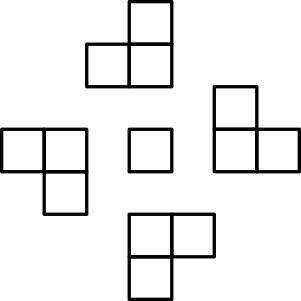
In the array of $13$ squares shown below, $8$ squares are colored red, and the remaining $5$ squares are colored blue. If one of all possible such colorings is chosen at random, the probability that the chosen colored array appears the same when rotated $90^\circ$ around the central square is $\frac{1}{n},$ where $n$ is a positive integer. Find $n.$
The real root of the equation $8x^3 - 3x^2 - 3x - 1 = 0$ can be written in the form $\frac{\sqrt[3]{a} + \sqrt[3]{b} + 1}{c},$ where $a,$ $b,$ and $c$ are positive integers. Find $a + b + c.$