It is given that $\log_{6} a + \log_{6} b + \log_{6} c = 6,$ where $a,$ $b,$ and $c$ are positive integers that form an increasing geometric sequence and $b - a$ is the square of an integer. Find $a + b + c.$
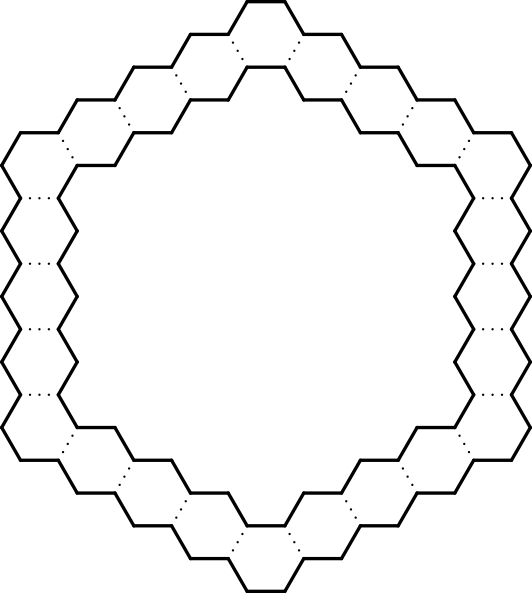
Patio blocks that are regular hexagons $1$ unit on a side are used to outline a garden by placing the blocks edge to edge with $n$ on each side. The diagram indicates the path of blocks around the garden when $n = 5.$
If $n = 202,$ then the area of the garden enclosed by the path, not including the path itself, is $m\left(\frac{\sqrt{3}}{2}\right)$ square units, where $m$ is a positive integer. Find the remainder when $m$ is divided by $1000.$
It is known that, for all positive integers $k,$ $$
\begin{aligned} &1^2 + 2^2 + 3^2 + \cdots + k^2 \\ &= \frac{k(k+1)(2k+1)}{6}. \end{aligned}
$$ Find the smallest positive integer $k$ such that $1^2 + 2^2 + 3^2 + \cdots + k^2$ is a multiple of $200.$
Find the least positive integer $k$ for which the equation $\left\lfloor \frac{2002}{n} \right\rfloor = k$ has no integer solutions for $n.$ (The notation $\lfloor x \rfloor$ means the greatest integer less than or equal to $x.$)
Let $S$ be the set $\{1, 2, 3, \ldots, 10\}.$ Let $n$ be the number of sets of two non-empty disjoint subsets of $S.$ (*Disjoint sets* are defined as sets that have no common elements.) Find the remainder obtained when $n$ is divided by $1000.$
While finding the sine of a certain angle, an absent-minded professor failed to notice that his calculator was not in the correct angular mode. He was lucky to get the right answer. The two least positive real values of $x$ for which the sine of $x$ degrees is the same as the sine of $x$ radians are $\frac{m\pi}{n - \pi}$ and $\frac{p\pi}{q + \pi},$ where $m,$ $n,$ $p,$ and $q$ are positive integers. Find $m + n + p + q.$
Two distinct, real, infinite geometric series each have a sum of $1$ and have the same second term. The third term of one of the series is $\frac{1}{8},$ and the second term of both series can be written in the form $\frac{\sqrt{m} - n}{p},$ where $m,$ $n,$ and $p$ are positive integers and $m$ is not divisible by the square of any prime. Find $100m + 10n + p.$
A basketball player has a constant probability of $0.4$ of making any given shot, independent of previous shots. Let $a_n$ be the ratio of shots made to shots attempted after $n$ shots. The probability that $a_{10} = 0.4$ and $a_n \le 0.4$ for all $n$ such that $1 \le n \le 9$ is given to be $\frac{p^a q^b r}{\left(s^c\right)},$ where $p,$ $q,$ $r,$ and $s$ are primes, and $a,$ $b,$ and $c$ are positive integers. Find $(p + q + r + s)(a + b + c).$
In triangle $ABC,$ point $D$ is on $\overline{BC}$ with $CD = 2$ and $DB = 5,$ point $E$ is on $\overline{AC}$ with $CE = 1$ and $EA = 3,$ $AB = 8,$ and $\overline{AD}$ and $\overline{BE}$ intersect at $P.$ Points $Q$ and $R$ lie on $\overline{AB}$ so that $\overline{PQ}$ is parallel to $\overline{CA}$ and $\overline{PR}$ is parallel to $\overline{CB}.$ It is given that the ratio of the area of triangle $PQR$ to the area of triangle $ABC$ is $\frac{m}{n},$ where $m$ and $n$ are relatively prime positive integers. Find $m + n.$
The perimeter of triangle $APM$ is $152,$ and angle $PAM$ is a right angle. A circle of radius $19$ with center $O$ on $\overline{AP}$ is drawn so that it is tangent to $\overline{AM}$ and $\overline{PM}.$ Given that $OP = \frac{m}{n},$ where $m$ and $n$ are relatively prime positive integers, find $m + n.$
Circles $C_1$ and $C_2$ intersect at two points, one of which is $(9, 6),$ and the product of their radii is $68.$ The $x$-axis and the line $y = mx,$ where $m \gt 0,$ are tangent to both circles. It is given that $m$ can be written in the form $\frac{a\sqrt{b}}{c},$ where $a,$ $b,$ and $c$ are positive integers, $b$ is not divisible by the square of any prime, and $a$ and $c$ are relatively prime. Find $a + b + c.$
Many states use a sequence of three letters followed by a sequence of three digits as their standard license-plate pattern. Given that each three-letter three-digit arrangement is equally likely, the probability that such a license plate will contain at least one palindrome (a three-letter arrangement or a three-digit arrangement that reads the same left-to-right as it does right-to-left) is $\frac{m}{n},$ where $m$ and $n$ are relatively prime positive integers. Find $m + n.$
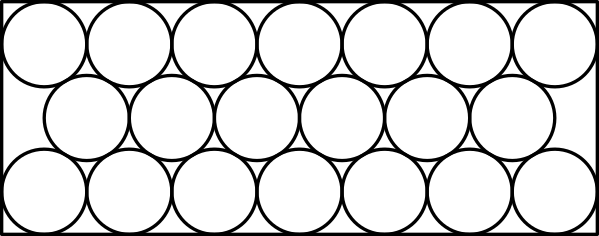
The diagram shows twenty congruent circles arranged in three rows and enclosed in a rectangle. The circles are tangent to one another and to the sides of the rectangle as shown in the diagram. The ratio of the longer dimension of the rectangle to the shorter dimension can be written as $\frac{1}{2}\left(\sqrt{p} - q\right),$ where $p$ and $q$ are positive integers. Find $p + q.$
Jane is $25$ years old. Dick is older than Jane. In $n$ years, where $n$ is a positive integer, Dick’s age and Jane’s age will both be two-digit numbers and will have the property that Jane’s age is obtained by interchanging the digits of Dick’s age. Let $d$ be Dick’s present age. How many ordered pairs of positive integers $(d, n)$ are possible?
Consider the sequence defined by $a_k = \frac{1}{k^2 + k}$ for $k \ge 1.$ Given that $a_m + a_{m+1} + \cdots + a_{n-1} = \frac{1}{29},$ for positive integers $m$ and $n$ with $m \lt n,$ find $m + n.$
Let $A_1,$ $A_2,$ $A_3,$ $\ldots,$ $A_{12}$ be the vertices of a regular dodecagon. How many distinct squares in the plane of the dodecagon have at least two vertices in the set $\{A_1, A_2, A_3, \ldots, A_{12}\}?$