Two evenly matched teams are engaged in a series of games, which ends as soon as a team wins four games. Is it more likely for the series to end in exactly six games or in exactly seven games?
Prove that there exists a finite sequence of distinct positive integers $n_1, n_2, \dots, n_k$, such that
$$
2012 \lt \sum_{i=1}^{k} \frac{1}{n_i} \lt 2012 + \left(\frac{1}{2012}\right)^{2012}.
$$
A school has $n$ students and there are some extra classes provided for them so that each student can participate in any number of them. We know that there are at least two participants in any class. We also know that if two different classes have two common students, then the numbers of their participants are different. Prove that the total number of classes is not greater than $(n - 1)^2$.
Let $p$ be a prime. At any vertex of a regular polygon with $p$ sides it is written an integer. For any vertex of the polygon we compute the difference between the sum of the integers written at his neighbors and his number. After that we delete all the initial integers and replace them by the new obtained integers. Prove that the integers obtained after $p$ such steps are the same modulo $p$ with the initial integers.
Let $n \ge 3$ be a positive integer. Suppose we have a circle with $n$ positions labeled $1, 2, \dots, n$ in clockwise order. $n$ counters, each with one side white and the other side black, are placed on the circle with one counter in each of the numbered positions. Initially all counters have the white side facing up, except the counter at position $1$ which shows black. We are allowed to perform the following operation:
(i) Choose a counter $X$ whose black side is facing up, and let $Y, Z$ be the next two counters in clockwise order.
(ii) Flip counter $Y$ so that it is showing the other color.
(iii) Move $X$ two spaces clockwise, and move $Y, Z$ one space counterclockwise. (So after the operation we still have one counter in each position.)
Let $S$ be any nonempty subset of $\{1, 2, \dots, n\}$. Show that we can perform a finite sequence of moves after which the numbers in $S$ correspond exactly to the positions of the black counters.
A subset of $\{1, 2, 3, \dots, 30\}$ is called *delicious* if it does not contain elements $a$ and $b$ satisfying $a = 3b$. A delicious subset is called *super delicious* if it is delicious and no delicious set has more elements than it has. Determine the number of super delicious subsets.
Find all the finite sets $A$ of real positive numbers having at least two elements, with the property that $a^2 + b^2 \in A$ for every $a, b \in A$ with $a \neq b$.
Let $ABC$ be a triangle, $I_a$ the excenter opposite to $A$, and $M$ its reflection across $BC$. Prove that $AM$ is parallel to the Euler line of triangle $BCI_a$.
Let $(a_n)_{n \ge 1}$ be a sequence with the property that for every prime $p$ and for every positive integer $k$ the following relation holds:
$$
a_{kp+1} = pa_k - 3a_p + 13.
$$
A sequence $a_1, a_2, \dots$ is defined in the following way: $a_1 = 1$, $a_2 = 143$, and $a_{n+1} = 5 \cdot \frac{a_1 + a_2 + \dots + a_n}{n}$ for $n \ge 2$. Prove that $a_n$ is an integer for every $n \ge 1$.
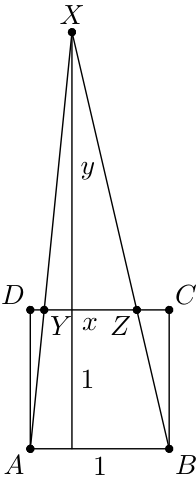
Let $ABCD$ be a square and $X$ a point such that $A$ and $X$ are on opposite sides of $CD$. The lines $AX$ and $BX$ intersect $CD$ in $Y$ and $Z$ respectively. If the area of $ABCD$ is $1$ and the area of $XYZ$ is $\frac{2}{3}$, determine the length of $YZ$.
Let $S$ be the set of positive integers. Determine all functions $f: S \to S$ such that $x^2 + f(y)$ divides $f(x)^2 + y$ for every pair of positive integers $x$ and $y$.
Let circles $\Gamma_1$ and $\Gamma_2$ intersect at $D$ and $P$. The common tangent of the two circles closest to the point $D$ touches $\Gamma_1$ at $A$ and $\Gamma_2$ at $B$. The line $AD$ intersects $\Gamma_2$ for the second time in $C$. Let $M$ be the middle of the line segment $BC$. Prove that $\angle DPM = \angle BDC$.
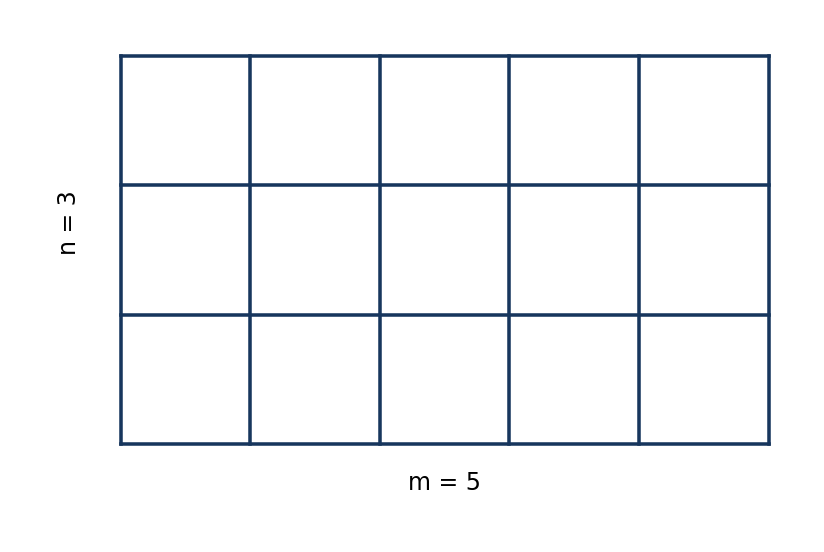
Divide a rectangle of dimension $m \times n$ by lines parallel to the sides into $mn$ congruent squares. Find the number of squares in this configuration.
Let $a$, $b$, $c$, $d$ be integers with $a$, $c$ both nonzero, and define $x_n = \gcd(an + b, cn + d)$ for all positive integers $n$. Show that the sequence $x_1, x_2, x_3, \dots$ is unbounded if and only if $ad = bc$.