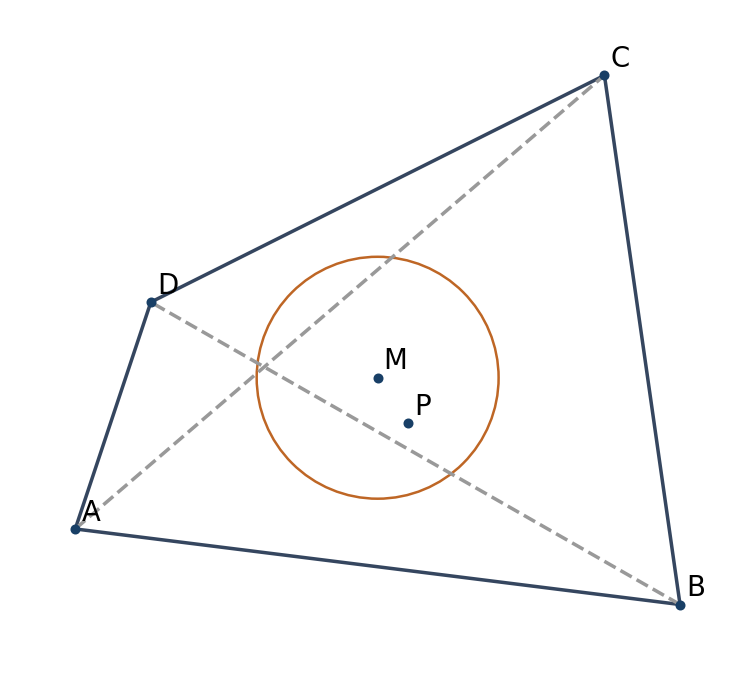
Denote $M$ the midpoint of a segment whose ends are the midpoints of the diagonals of quadrilateral $ABCD$. A circle $C$ with center $M$ and radius $r$ is drawn so that the vertices of the quadrilateral are outside $C$.
Prove that $PA + PB + PC + PD \gt 4r$ for all points $P$ which are inside $C$.
Supplemental coordinate illustration (AI); perspective is not to scale.
Let $p \ge 2$ be a prime, $(K, +, \cdot)$ be a field with $p^2$ elements and
$$
L = \{0, 1, \dots, \underbrace{1+1+\cdots+1}_{p-1 \text{ times}}\}.
$$
Prove that for every $x \in K \setminus L$ there exists $a, b \in L$ so that $x^{2013} + ax + b = 0$.
Find all increasing functions $f: \mathbb{N}^* \to \mathbb{N}^*$ with the property: for every $n \in \mathbb{N}^*$, the number $\frac{1}{n} \sum_{k=1}^{n} k f(k)$ is a perfect square not larger than $(n+1)^2$.
Let $a,b\in\mathbb R^*$ and define $f:\mathbb R\to\mathbb R$ by
$$f(x)=\begin{cases}ax,&x\in\mathbb Q,\\bx,&x\in\mathbb R\setminus\mathbb Q.\end{cases}$$
Prove that $f$ is injective if and only if it is surjective.
A group $(G,\cdot)$ has property $(P)$ if, for every automorphism $f$ of $G$, there exist automorphisms $g,h$ of $G$ such that $f(x)=g(x)\cdot h(x)$ for every $x\in G$. Prove:
a) Every group with $(P)$ is commutative.
b) Every finite commutative group of odd order has $(P)$.
c) No finite group of order $4n+2$, $n\in\mathbb N$, has $(P)$.
The order of a finite group is its number of elements.
Let $p$ and $q$ be positive integers such that $p q = 2^{3} \cdot 5^{5} \cdot 7^{2} \cdot 11$ and $\frac{p}{q} = 2 \cdot 5 \cdot 7^{2} \cdot 11$. Find the number of positive integer divisors of $p$.
Let $A$ be a set of 7 integers and denote $S = \{x + y \mid x, y \in A\}$. Prove that if $S$ has 13 elements, then the sum of $A$'s elements is divisible by 7.
Two couples and a single person are seated at random in a row of five chairs. What is the probability that at least one person is not beside his/her partner?
Triangle $ABC$ is inscribed in the circle $C$ and $AA'$, $BB'$, $CC'$ are diameters of this circle. Denote $H_1, H_2, H_3$ the orthocenters of the triangles $A'BC$, $AB'C$, $ABC'$ respectively.
a) Prove that there exists a triangle $PQR$ with sides equal to $[AH_1]$, $[BH_2]$, $[CH_3]$ and compute the ratio $S_{PQR}/S_{ABC}$.
b) Prove that the straight lines $AH_1$, $BH_2$ and $CH_3$ are concurrent.
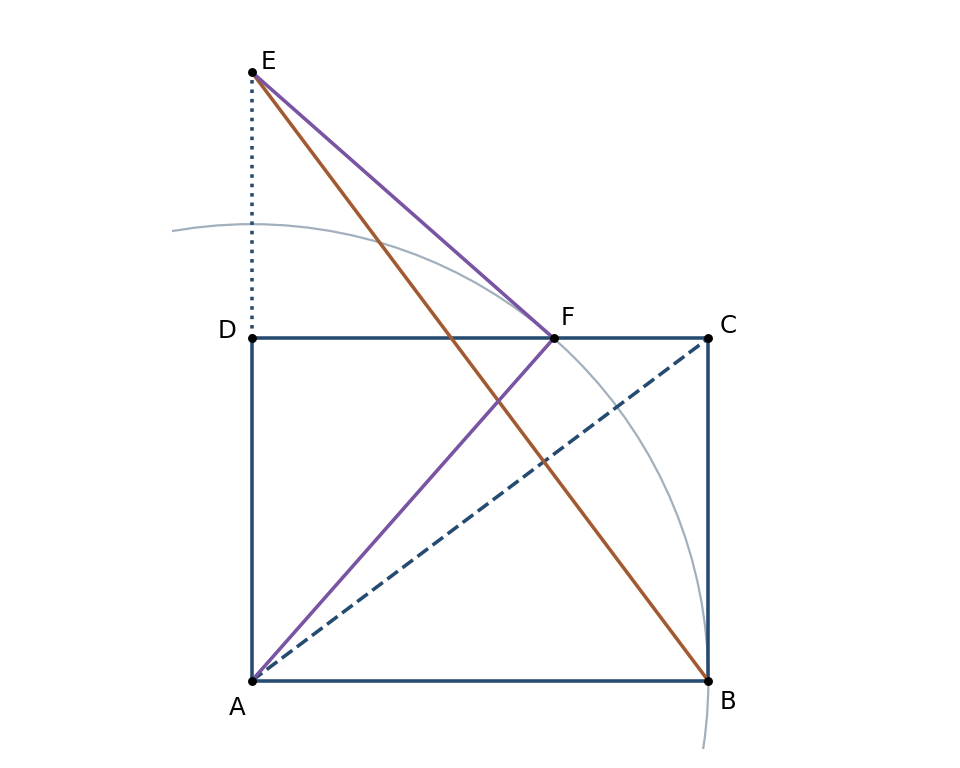
The segment $\overline{AB}$ is the longer side of the rectangle $ABCD$. Let $E$ be the intersection of the perpendicular from $B$ to $\overline{AC}$ and the line $AD$, and let $F$ be the intersection of the circle with centre $A$ which passes through $B$ and $\overline{CD}$. Prove that the lines $AF$ and $EF$ are perpendicular.
Let $n$ be a positive integer. Two players, Alice and Bob, are playing the following game:
* Alice chooses $n$ real numbers, not necessarily distinct
* Alice writes all pairwise sums on a sheet of paper and gives it to Bob (there are $\frac{n(n-1)}{2}$ such sums, not necessarily distinct)
* Bob wins if he finds correctly the initial $n$ numbers chosen by Alice with only one guess.
Can Bob be sure to win for the following cases?
a. $n=5$
b. $n=6$
c. $n=8$
Justify your answer(s).
The excircle opposite $A$ in triangle $ABC$ is tangent to side $BC$ at $A_1$. Define $B_1$ on $CA$ and $C_1$ on $AB$ analogously. Suppose the circumcenter of triangle $A_1B_1C_1$ lies on the circumcircle of triangle $ABC$. Prove that $ABC$ is right-angled.
The excircle opposite $A$ is the circle tangent to side $BC$ and to the lines $AB,AC$, but not to the segments $AB,AC$. The excircles opposite $B,C$ are defined analogously.