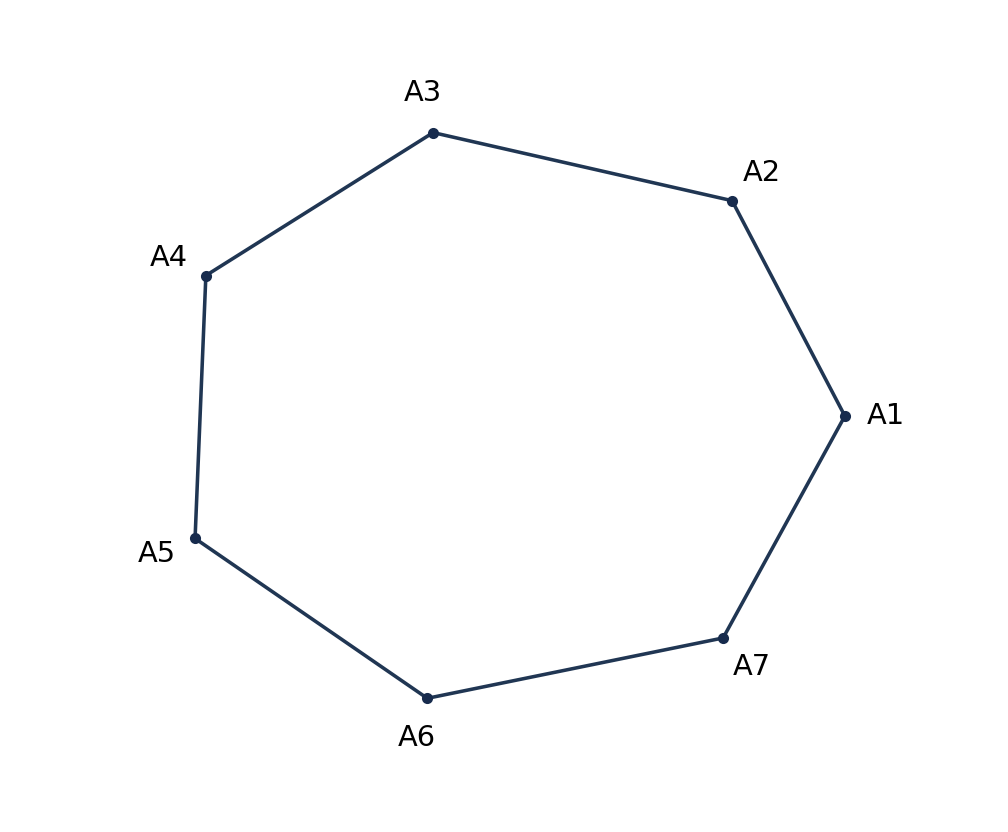
A convex heptagon is given. One calculates the cosines of four arbitrary its angles, the sines of three remaining angles, and then finds the sum of these 7 numbers. It happens that this sum is independent of the choice of the four angles. Prove that this heptagon has four equal angles.
Schematic convex heptagon (the sum condition is specified in the text):
Pete has put several tokens into some squares of a checkered $50 \times 50$ board (at most one token per square). Prove that Bazil can put at most $99$ tokens into empty squares so that each row and each column contains an even number of tokens.
Let $ABCD$ be an inscribed quadrilateral for which the rays $AB$ and $DC$ meet at $K$. It happened that the points $B$, $D$, and the midpoints of the segments $AC$ and $KC$ are concyclic. Find all possible values the angle $ADC$ may get.
The sphere $\omega$ passes through vertex $S$ of the pyramid $SABC$ and meets edges $SA$, $SB$ and $SC$ a second time at $A_1$, $B_1$ and $C_1$, respectively. The sphere $\Omega$ circumscribed about $SABC$ intersects $\omega$ in a circle whose plane is parallel to $(ABC)$. Points $A_2$, $B_2$ and $C_2$ are the reflections of $A_1$, $B_1$ and $C_1$ in the midpoints of $SA$, $SB$ and $SC$, respectively. Prove that $A,B,C,A_2,B_2,C_2$ lie on one sphere. (I. Bogdanov)
$10^{1000}$ positive integers are arranged in a circle. One has calculated the least common multiple of every two neighboring numbers. May it happen that these calculated numbers are $10^{1000}$ consecutive positive integers (in some order)? (S. Berlov)
The equation $x^3+*x^2+*x+*=0$ is written on a board. Petya and Vasya take turns replacing stars by rational numbers: first Petya replaces any star, then Vasya replaces either of the two remaining stars, and finally Petya replaces the last star. Is it true that, whatever Vasya does, Petya can obtain an equation for which the difference between two roots is $2014$?
A teacher writes four distinct positive integers in Petya's notebook. Petya finds the greatest common divisor of each pair. The six results are $1,2,3,4,5,N$, where $N\gt5$. What is the least possible value of $N$?
Point $M$ is the midpoint of side $AC$ of triangle $ABC$. Points $P$ and $Q$ are chosen on segments $AM$ and $CM$, respectively, so that $PQ=AC/2$. The circumcircle of triangle $ABQ$ meets side $BC$ at $X\ne B$, and the circumcircle of triangle $BCP$ meets side $AB$ at $Y\ne B$. Prove that quadrilateral $BYMX$ is cyclic. (F. Ivlev, F. Nilov)
The numbers $1, 2, \dots, n^2$ are put in some order into the squares of a checkered $n \times n$ board, one number per square. Pete performs several moves according to the following rules. On the first move, he puts a token into some square. By any subsequent move, he may either put a new token into an arbitrary square, or to move a token horizontally or vertically from a square containing some number $a$ to any square containing a number greater than $a$. Every time a token is put onto a square, this square is marked; it is prohibited to put a token into a marked square.
Find the least number $k$ such that for every arrangement of the numbers, Pete can mark all the squares of the board using at most $k$ tokens.
There are $99$ positive integers arranged in a circle. Any two neighboring numbers differ by $1$, by $2$, or by a factor of $2$. Prove that at least one of them is divisible by $3$. (S. Berlov)
All cells of an $n\times n$ square table are numbered in some order from $1$ to $n^2$. Petya makes moves according to the following rules. On his first move he places a token in any cell. On each subsequent move he may either place a new token in a cell or move a token horizontally or vertically from a cell numbered $a$ to a cell with a larger number. Whenever a token enters a cell, that cell is immediately colored; placing a token on a colored cell is forbidden. What is the smallest number of tokens Petya needs to be able, regardless of the initial numbering, to color all cells in finitely many moves?
(D. Khramtsov)
Petya and Vasya play on an $n\times n$ board, where $n\gt1$. Initially the board is white except for one corner cell, which is black and contains a rook. The players alternate moves. On each move a player moves the rook horizontally or vertically, and all cells through which it moves, including its destination, are recolored black. The rook may neither pass through black cells nor stop on them. A player unable to move loses; Petya moves first. Who wins with optimal play?
The teacher gave to Pete four distinct positive integers. Pete has calculated the greatest common divisor of every two of these numbers. He obtained six numbers: $1$, $2$, $3$, $4$, $5$, and $N$, where $N\gt5$. Find the least possible value of $N$.
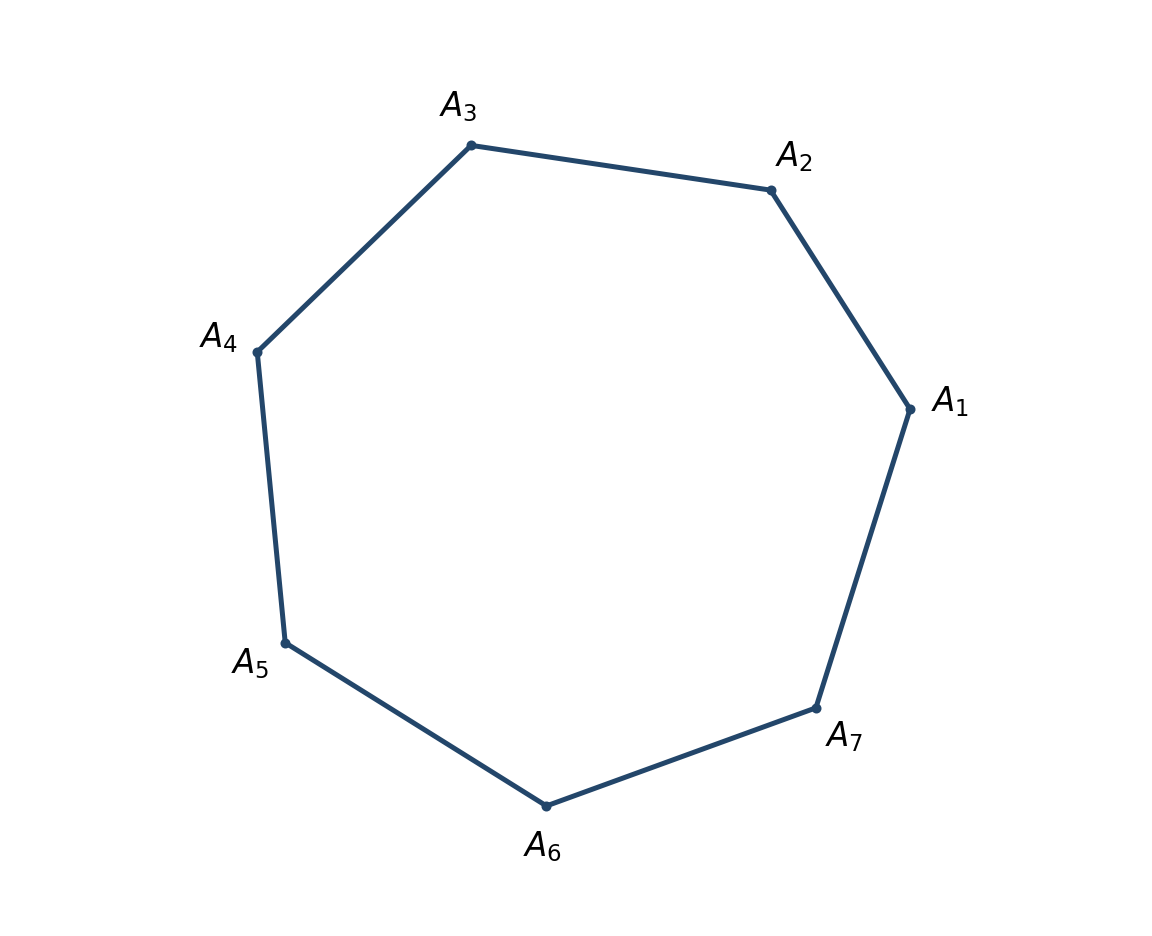
A convex heptagon is given. Choose any four of its angles and take their sines; take the cosines of the remaining three angles. The sum of these seven numbers does not depend on the original choice of four angles. Prove that four angles of the heptagon are equal.
Schematic convex heptagon (the equal-sum hypothesis is not encoded by the drawing).
Seryozha chose two distinct positive integers $a$ and $b$. He wrote four numbers in his notebook: $a,a+2,b,b+2$. He then wrote on the blackboard all six pairwise products of the notebook numbers. What is the largest possible number of perfect squares among the numbers on the board?
Triangle $ABC$ is inscribed in a circle $\Omega$ with center $O$. The circle with diameter $AO$ meets the circumcircle of triangle $OBC$ at $S\ne O$. The tangents to $\Omega$ at $B$ and $C$ meet at $P$. Prove that $A,S,P$ are collinear.