Let $n \ge 2$ be a positive integer. Determine all possible values of the sum
$$
S = \lfloor x_2 - x_1 \rfloor + \lfloor x_3 - x_2 \rfloor + \dots + \lfloor x_n - x_{n-1} \rfloor,
$$
where $x_1, x_2, \dots, x_n$ are real numbers whose integer parts are $1, 2, \dots, n$, respectively.
Let $\triangle ABC$ be a triangle and $D, E, F$ be the second intersection of its medians with its circumcircle. Prove that if the triangles $BDC, CEA, AFB$ have the same area, then triangle $ABC$ is equilateral.
Marian Ionescu
Denote $M$ the midpoint of the edge $[AD]$ of the cube $ABCD'A'B'C'D'$. Denote $\alpha$ the plane perpendicular in $B$ on the straight line $BM$. Find the tangent of the angle between the planes $\alpha$ and $(ACB')$.
For every positive integer $n$, let $\sigma(n)$ denote the sum of all positive divisors of $n$ (1 and $n$, inclusive). Show that a positive integer $n$, which has at most two distinct prime factors, satisfies the condition $\sigma(n) = 2n - 2$ if and only if $n = 2^k(2^{k+1} + 1)$, where $k$ is a non-negative integer and $2^{k+1} + 1$ is prime.
Let $P$ and $Q$ be the midpoints of the diagonals $BD$ and $AC$ of the quadrilateral $ABCD$. Consider the points $M \in (BC)$, $N \in (CD)$, $R \in (PQ)$ and $S \in (AC)$ such that $\frac{BM}{MC} = \frac{DN}{NC} = \frac{PR}{RQ} = \frac{AS}{SC} = k$. Prove that the centroid of the triangle $AMN$ lies on the segment $[RS]$.
Let $A$ be an invertible matrix in $M_4(\mathbb{R})$, such that $\operatorname{tr} A = \operatorname{tr} A^* \neq 0$, where $A^*$ is the adjugate of $A$. Prove that the matrix $A^2 + I_4$ is singular if and only if there exists a nonzero matrix $B$ in $M_4(\mathbb{R})$, so that $AB = -BA$.
Let $n$ be an integer greater than $1$ and let $S$ be a finite set containing more than $n+1$ elements. Consider the collection of all sets $\mathcal{A}$ of subsets of $S$ satisfying the following two conditions:
(a) Each member of $\mathcal{A}$ contains at least $n$ elements of $S$; and
(b) Each element of $S$ is contained in at least $n$ members of $\mathcal{A}$.
Determine $\max_{\mathcal{A}} \min_{\mathcal{B}} |\mathcal{B}|$, as $\mathcal{B}$ runs through all subsets of $\mathcal{A}$ whose members cover $S$, and $\mathcal{A}$ runs through the above collection.
Let $M$ be the set of palindromic numbers of the form $5n + 4$, where $n \ge 0$ is an integer. (A positive integer is a *palindromic number* if it remains the same when its digits are reversed. For instance, the numbers 7, 191, 23532, 3770773 are palindromic numbers.)
a) If we write the elements of $M$ in increasing order, which is the 50th number?
b) Among all numbers in $M$, written with nonzero digits who sum up to 2014, which is the greatest one and which the smallest one?
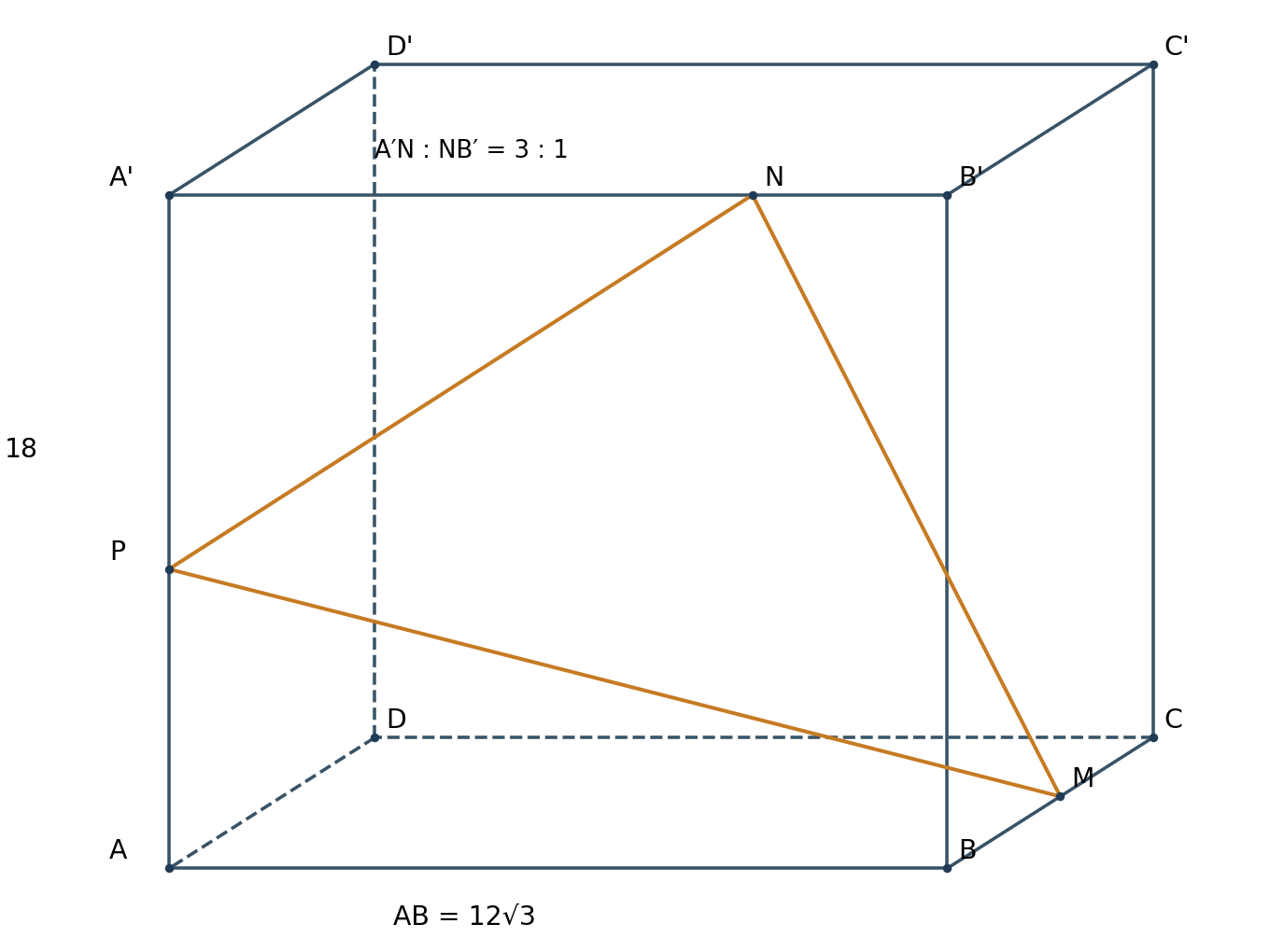
In the right parallelepiped $ABCD'A'B'C'D'$, with $AB = 12\sqrt{3}$ cm and $AA' = 18$ cm, we consider the points $P \in [AA']$ and $N \in [A'B']$ such that $A'N = 3B'N$. Determine the length of the line segment $[AP]$ such that for any position of the point $M \in [BC]$, the triangle $MNP$ is right angled at $N$.
Damian Marinescu
Supplemental illustration of the intended rectangular-base case; this extra assumption is discussed separately in the editorial.
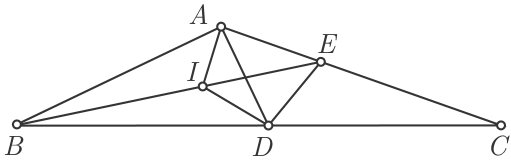
Let $ABC$ be a triangle in which $m(\hat{A}) = 135^\circ$. The perpendicular to the line $AB$ erected at $A$ intersects the side $[BC]$ at $D$, and the angle bisector of $\angle B$ intersects the side $[AC]$ at $E$. Find the measure of $\widehat{BED}$.
Determine all real numbers $x, y, z \in (0,1)$ that satisfy simultaneously the conditions:
$$
\begin{cases}
(x^2 + y^2)\sqrt{1-z^2} \geq z \\
(y^2 + z^2)\sqrt{1-x^2} \geq x \\
(z^2 + x^2)\sqrt{1-y^2} \geq y
\end{cases}
$$
Given an integer $n \ge 2$, show that there exist $n+1$ pairwise distinct numbers $x_1, x_2, \dots, x_n, x_{n+1}$ in $\mathbb{Q} \setminus \mathbb{Z}$ such that $\{x_1^3\} + \{x_2^3\} + \dots + \{x_n^3\} = \{x_{n+1}^3\}$, where $\{x\}$ is the fractional part of the real number $x$.
Suppose $(G, \cdot)$ is a finite group with unity $e$, $a$ is an element in $G \setminus \{e\}$ and $p$ is a prime number such that $x^{p+1} = a^{-1} x a$, for all $x \in G$.
a) Show that there is $k \in \mathbb{N}^*$ such that $\text{ord}(G) = p^k$.
b) Prove that $H = \{x \in G \mid x^p = e\}$ is a subgroup of $G$ and
$$
(\text{ord}(H))^2 \gt \text{ord}(G).
$$
Let $f: [0, 1] \to [0, 1]$ be a continuous function and $x_0, y_0$ be two points in $[0, 1]$. Define sequences $(x_n)_{n \in \mathbb{N}}$ and $(y_n)_{n \in \mathbb{N}}$ of points in $[0, 1]$ by
$$
x_{n+1} = \frac{f(x_0) + \cdots + f(x_n)}{n+1} \quad \text{and} \quad y_{n+1} = f\left(\frac{y_0 + \cdots + y_n}{n+1}\right);
$$
Clearly, the definition is correct. Prove that the sequences $(x_n)_{n \in \mathbb{N}}$ and $(y_n)_{n \in \mathbb{N}}$ are convergent.