Let $m$ be a positive integer. Prove that if Mari writes at least $m+3$ numbers on the board, then Jüri can choose 4 of those such that the sum of some two of those and the sum of the other two give the same remainder when divided by $m$.
Let a finite decimal fraction be given. Juku starts appending digits to this fraction in such a way that each new digit equals the remainder of the sum of all digits existing so far in division by $10$. (For instance, if the initial fraction is $27.35$ then the digits added to the end are $7$, $4$, $8$ etc.)
Prove that the infinite decimal fraction obtained this way represents a rational number.
Show that, for every integer $r \ge 2$, there exists an $r$-chromatic simple graph (no loops, nor multiple edges) which has no cycle of less than 6 edges.
A convex quadrilateral $ABCD$ where $\angle DAB + \angle ABC \lt 180^\circ$ is given on a plane. Let $E$ be a point different from the vertices of the quadrilateral on the line interval $AB$ such that the circumcircles of triangles $AED$ and $BEC$ intersect inside the quadrilateral $ABCD$ at point $F$. Point $G$ is defined so that $\angle DCG = \angle DAB$, $\angle CDG = \angle ABC$ and triangle $CDG$ is located outside quadrilateral $ABCD$. Prove that the points $E$, $F$, $G$ are collinear.
In a plane with cartesian coordinates, let $P$ and $Q$ be two regions of convex polygon (including boundary and interior) whose vertices are all integer points (i.e., their coordinates are all integers) and $T = P \cap Q$. Prove that if $T$ is not empty and does not contain integer point, then $T$ is a non-degenerate convex quadrilateral. (posed by Qu Zhenhua)
Depending on the positive integer $k$, determine the smallest real number $D_k$ such that
$$
(abc)^2 + (bcd)^2 + (cda)^2 + (dab)^2 \le D_k
$$
for all nonnegative real numbers $a, b, c, d$ such that $a^k + b^k + c^k + d^k = 4$.
Let $ABC$ be an isosceles triangle with a base $\overline{AB}$. A point $P$ is chosen on the segment $\overline{AC}$ and a point $Q$ is chosen on the segment $\overline{BC}$ such that $|AP| + |BQ| = |PQ|$. The line parallel with the line $BC$ which passes through the midpoint of the segment $\overline{PQ}$ intersects the segment $\overline{AB}$ in the point $N$. Circumcircle of the triangle $PNQ$ intersects the line $AC$ in the points $P$ and $K$, and the line $BC$ in the points $Q$ and $L$. If the point $R$ is the intersection of the lines $PL$ and $QK$, prove that the line $PQ$ is perpendicular to the line $CR$. (Stipe Vidak)
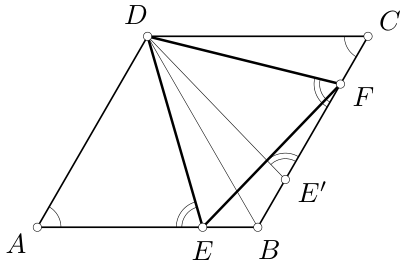
Malle drew a rhombus $ABCD$ and chose points $E$ and $F$ on sides $AB$ and $BC$, respectively, such that the triangle $DEF$ is equilateral. Malle was very surprised when she discovered that there is another possibility to choose points $E$ and $F$ on sides $AB$ and $BC$, respectively, such that $DEF$ is equilateral. What can be the measures of the angles of this rhombus?
The side $BC$ of the triangle $ABC$ is extended beyond $C$ to $D$ so that $CD = BC$. The side $CA$ is extended beyond $A$ to $E$ so that $AE = 2CA$.
Prove that if $AD = BE$, then the triangle $ABC$ is right-angled.
Let $a_1,a_2,\ldots,a_n$ be positive real numbers such that $a_1+a_2+\cdots+a_n=1$. Prove that the following inequality holds:
$$\begin{aligned}&\frac{a_1^3}{a_1^2+a_2a_3}+\frac{a_2^3}{a_2^2+a_3a_4}+\cdots\\&\quad+\frac{a_{n-1}^3}{a_{n-1}^2+a_na_1}+\frac{a_n^3}{a_n^2+a_1a_2}\ge\frac12.\end{aligned}$$
In the real numbers, solve the following system of equations:
$$
\begin{aligned}
\sin^2 x + \cos^2 y &= \tan^2 z, \\
\sin^2 y + \cos^2 z &= \tan^2 x, \\
\sin^2 z + \cos^2 x &= \tan^2 y.
\end{aligned}
$$
In the product
$$
\left(1 + \frac{1}{1}\right) \cdot \left(1 + \frac{1}{3}\right) \cdot \left(1 + \frac{1}{5}\right) \cdots \left(1 + \frac{1}{2n-1}\right)
$$
the denominators of the fractions are all odd numbers from $1$ to $(2n - 1)$. Is it possible to choose a natural number $n \gt 1$ such that this product would evaluate to an integer?
A $(2k+1) \times (2k+1)$ table, where $k$ is a positive integer, contains one real number in each entry, where these numbers are pairwise different. After each row, one writes the median of the row, i.e., the number occurring in this row such that the row contains the same amount of numbers less than it and greater than it. Let $m$ be the median of the column of medians. Prove that more than a quarter of the numbers initially in the table are less than $m$.
Suppose there are 101 persons sitting around a round table in an arbitrary order. The $k$th person possesses $k$ pieces of cards, $k = 1, \dots, 101$. We call it a *transition* if one transits one of his cards to one of his adjacent persons. Find the minimum positive number $k$, such that whatever the order of the seating, there is a way of no more than $k$ transitions so that each person possesses 51 cards.
Find all positive integers $a$ and $b$ for which there are three consecutive integers at which the polynomial
$$
P(n)=\frac{n^{5}+a}{b}
$$
takes integer values.
A non-empty set $A \subseteq \{1, 2, 3, \dots, n\}$ is called a *good set* of degree $n$ if $|A| \le \min_{x \in A} x$. Denote by $a_n$ the number of good sets of degree $n$. Prove that $a_{n+2} = a_{n+1} + a_n + 1$ for any positive integer $n$. (posed by Li Weigu)
Determine all integers $m$ for which the $m \times m$ square can be dissected into five rectangles, the side lengths of which are the integers $1,2,3, \ldots, 10$ in some order.
We are given a triangle $ABC$. Find the locus of points $X$ in the plane $ABC$ whose reflections through the lines $AB$, $BC$, $CA$ are vertices of an equilateral triangle.