Let $S(k)$ denote the sum of the digits of an integer $k$. We say that an integer $a$ is of order $n$ if there exists a sequence of integers $a_{0}, a_{1}, \ldots, a_{n}$ such that $a_{n}=a$ and $a_{i+1}=a_{i}-S\left(a_{i}\right)$ for all $i=0,1, \ldots, n-1$. Show that for every integer $n \geqslant 1$ there exists an integer $b$ that is of order $n$ but not of order $n+1$.
Let $n \in \mathbb{N}^{*}$. We place $1 \times n$ and $n \times 1$ rectangles on a $2 n \times 2 n$ chessboard in such a way that two rectangles never intersect and each rectangle covers exactly $n$ squares. A set of such rectangles is called saturated if it is impossible to add a rectangle without intersecting a rectangle already in place.
Find the smallest $k$ such that there exists a saturated set of $k$ rectangles.
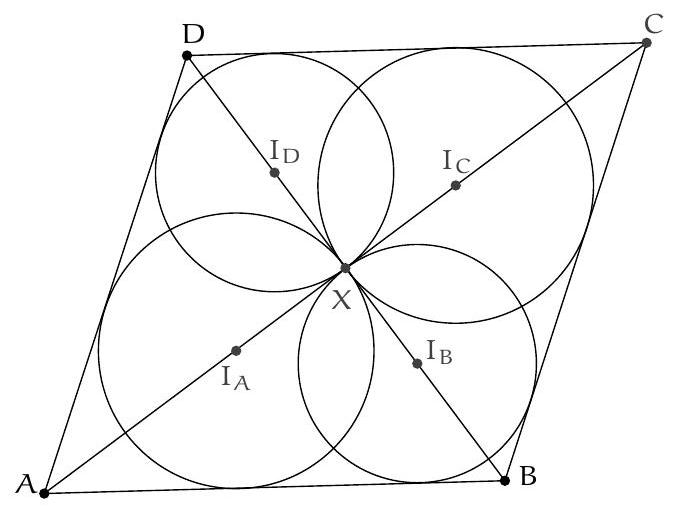
Let $ABCD$ be a convex quadrilateral. Suppose that the incircles of the triangles $ABC$, $BCD$, $CDA$ and $DAB$ have a common point. Show that $ABCD$ is a rhombus.
Let $n \geqslant 2$ and let $a_{1}, \ldots, a_{n}, b_{1}, \ldots, b_{n}$ be strictly positive real numbers. The $a_{i}$ are assumed to be pairwise distinct, and so are the $b_{i}$. Assume that it is possible to split the $a_{i}$ into two subsets with the same sum, and likewise for the $b_{i}$.
Show that there exists a simple $2n$-gon with exactly $n$ horizontal sides and $n$ vertical sides, such that the lengths of the horizontal sides are exactly the $a_{i}$ and the lengths of the vertical sides are exactly the $b_{i}$.
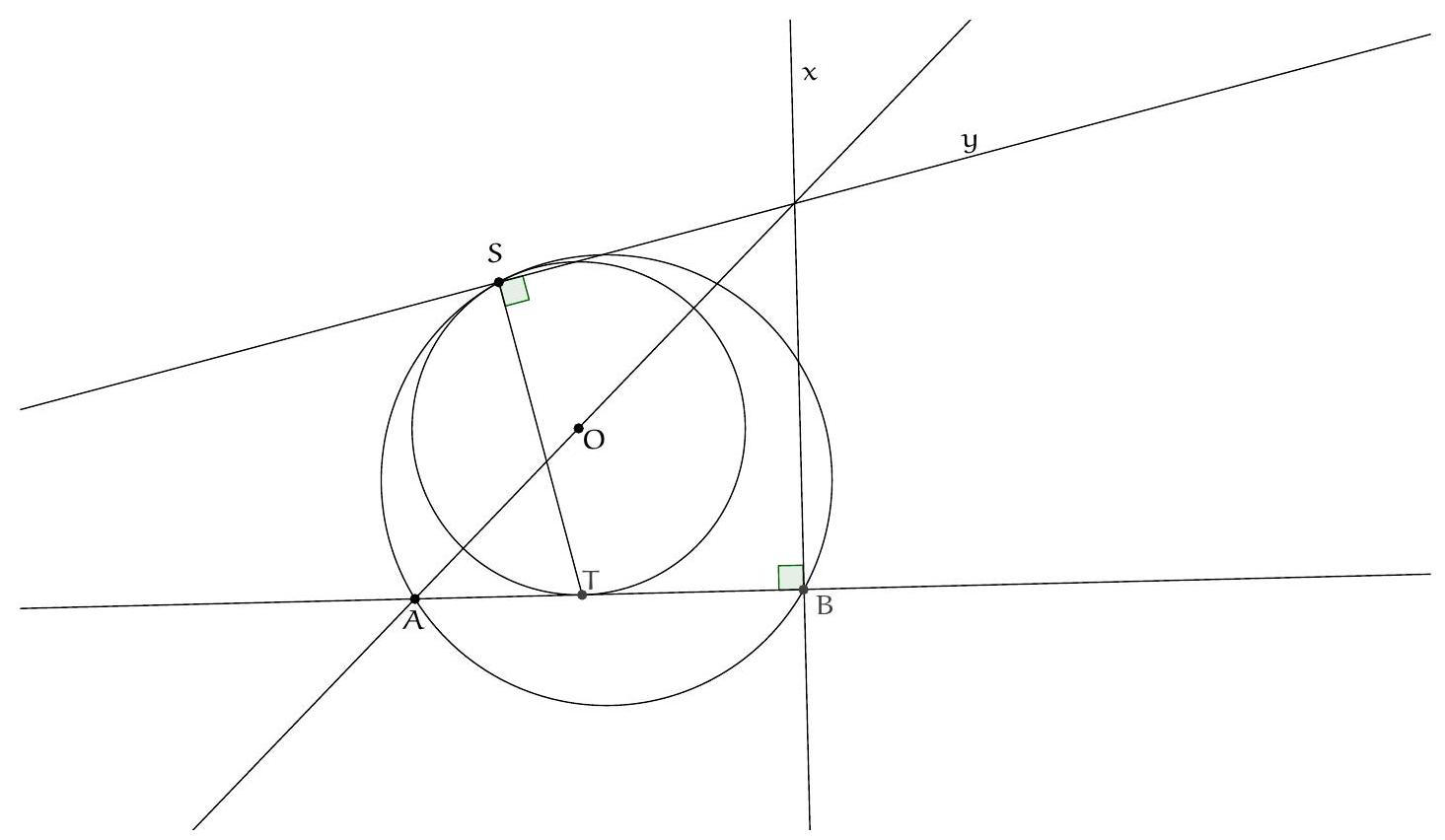
Two circles $\omega_{1}$ and $\omega_{2}$ are tangent at $S$, with $\omega_{1}$ inside $\omega_{2}$. Let $O$ be the center of $\omega_{1}$. A chord $[AB]$ of $\omega_{2}$ is tangent to $\omega_{1}$ at $T$. Show that $(AO)$, the perpendicular to $(AB)$ through $B$, and the perpendicular to $(ST)$ through $S$ are concurrent.
Let $\Gamma$ be a circle with center $O$, and $(d)$ a line that does not intersect $\Gamma$. Let $P$ be the orthogonal projection of $O$ onto $(d)$. Let $Q$ be a variable point on the line $(d)$, and let $\left(t_{1}\right)$ and $\left(t_{2}\right)$ be the tangents to $\Gamma$ through $Q$. Let $A$ and $B$ be the orthogonal projections of $P$ onto $\left(t_{1}\right)$ and $\left(t_{2}\right)$. Show that the intersection point of $(AB)$ and $(OP)$ remains fixed as $Q$ varies.
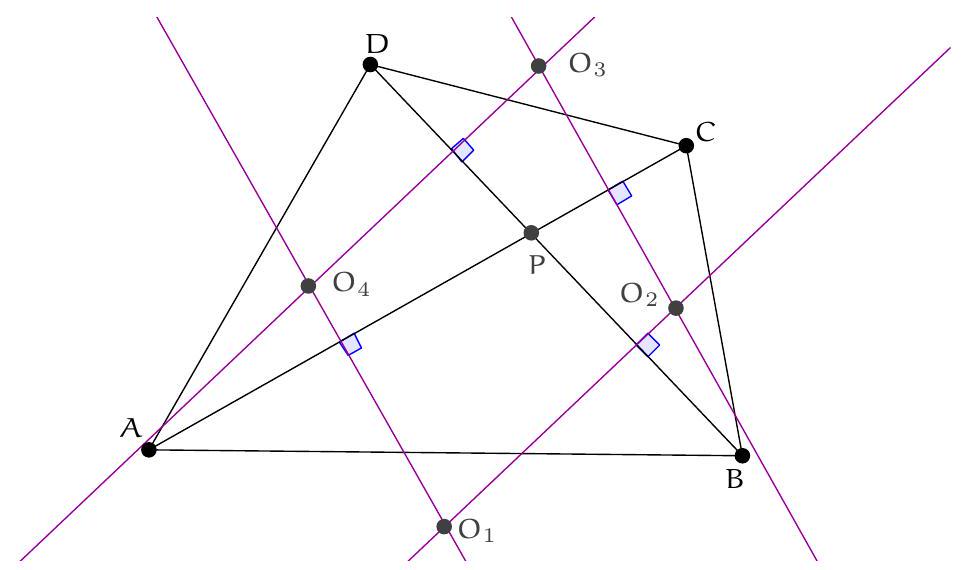
Let $ABCD$ be a convex quadrilateral (that is, its diagonals lie inside $ABCD$), and let $P$ be the intersection of its diagonals $[AC]$ and $[BD]$. Let $O_1, O_2, O_3$ and $O_4$ be the centers of the circumcircles of $ABP$, $BCP$, $CDP$ and $DAP$.
Show that $O_1O_2O_3O_4$ is a parallelogram.
Let $n \geqslant 2$. A piece is placed on each square of an $n \times n$ chessboard. A move consists in moving each piece to a square that touches its starting square at exactly one corner (several pieces may end up on the same square).
What is the smallest integer $k$ such that it is possible that, after some number of moves, only $k$ squares contain at least one piece?
Let $n \geqslant 3$ be an integer and let $a_{1}, a_{2}, \ldots, a_{n}$ be real numbers.
a. Suppose that $a_{i} \lt \max \left(a_{i-1}, a_{i+1}\right)$ for every $i \in\{2,3, \ldots, n-1\}$. Show that $a_{i} \lt \max \left(a_{1}, a_{n}\right)$ for every $i \in\{2,3, \ldots, n-1\}$.
b. Suppose that $a_{i} \leqslant \max \left(a_{i-1}, a_{i+1}\right)$ for every $i \in\{2,3, \ldots, n-1\}$. Is it true that $a_{i} \leqslant \max \left(a_{1}, a_{n}\right)$ for every $i \in\{2,3, \ldots, n-1\}$?
N.B. If $x$ and $y$ are two real numbers, $\max (x, y)$ denotes the larger of the two.
Let $A$ be a set of 13 integers between 1 and 37. Show that there exist four pairwise distinct numbers in $A$ such that the sum of two of them is equal to the sum of the other two.
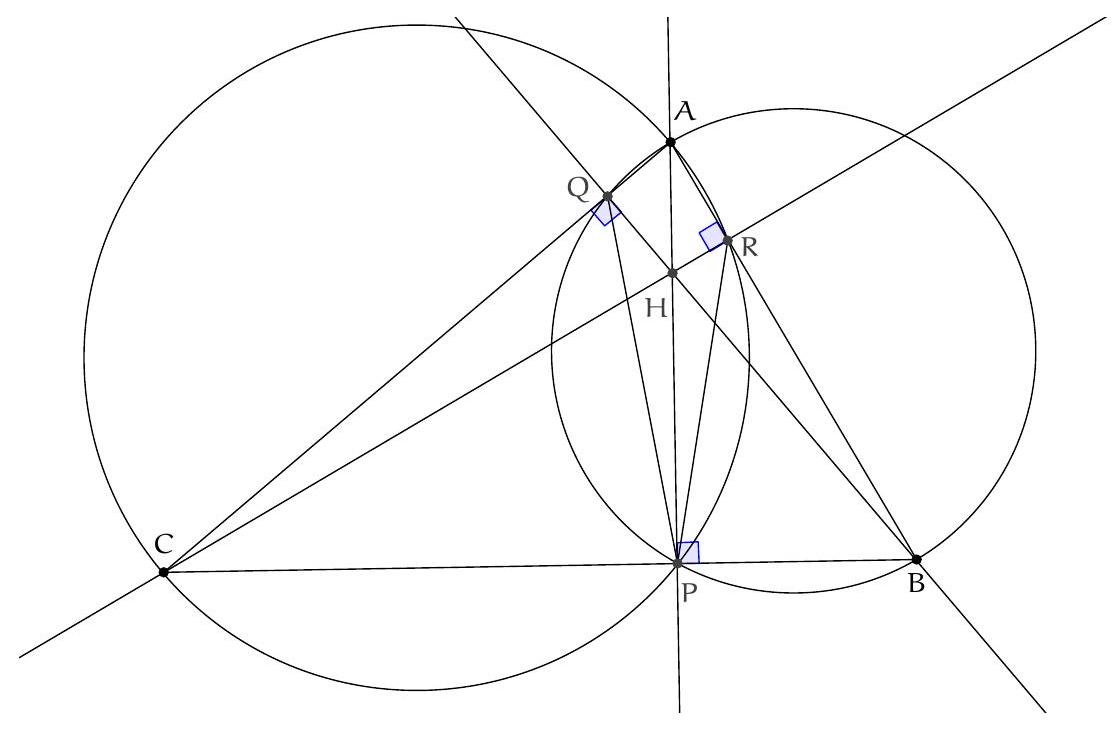
Let $ABC$ be a triangle, $H$ its orthocenter, and $P$, $Q$ and $R$ the feet of the altitudes from $A$, $B$ and $C$.
Show that $H$ is the center of the incircle of $PQR$.
The seven dwarfs have pairwise distinct heights. They go to the mine in a column in some order, in such a way that the dwarf at the head is taller than the second one, who is shorter than the third one, who is taller than the fourth one, and so on...
How many such ways of arranging the dwarfs are there?
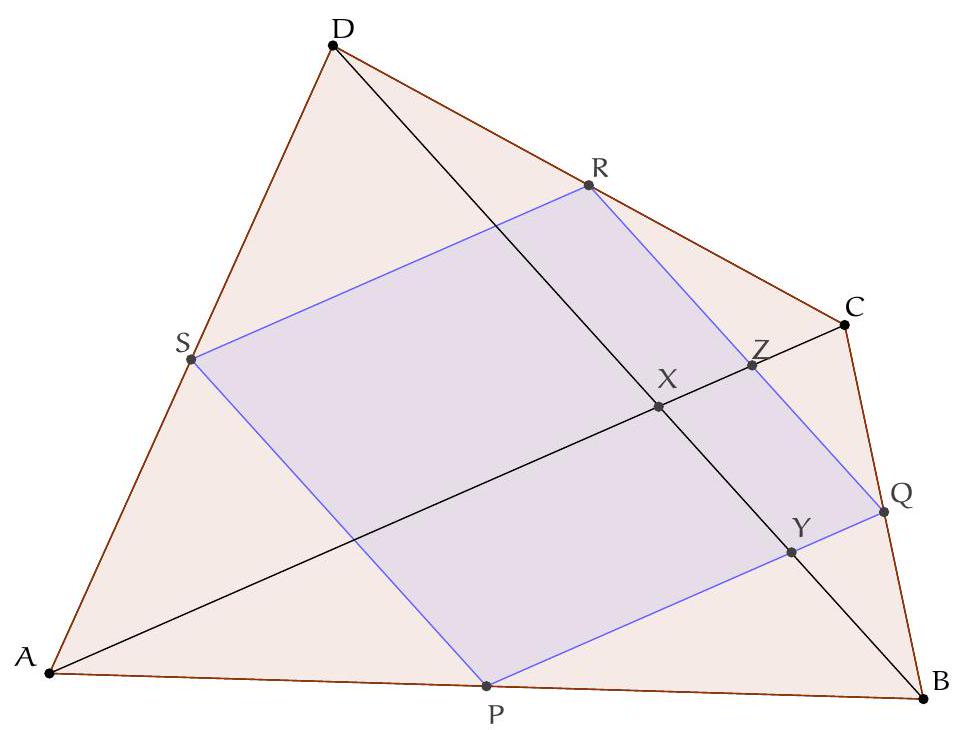
Let $A B C D$ be a convex quadrilateral. Let $P, Q, R$ and $S$ be the midpoints of the sides $[A B],[B C],[C D]$ and $[D A]$. Show that the area of $PQRS$ is equal to half the area of $A B C D$.
Let $n$ and $k$ be strictly positive integers. There are $n k$ objects (of the same size) and $k$ boxes, each of which can hold $n$ objects. Each object is colored with one of $k$ possible colors. Show that it is possible to put the objects in the boxes so that each box contains objects of at most 2 different colors.
A strictly positive integer $n$ is called fun if for every strictly positive divisor $d$ of $n$, the integer $d+2$ is prime. Determine all fun integers whose number of divisors is maximal.
Let $ABC$ be a non-isosceles triangle. Let $\omega$ be its incircle and $I$ its center. Let $M, N, P$ be the points of tangency of $\omega$ with the sides $[BC], [CA], [AB]$. Let $J$ be the intersection point of $(MN)$ and $(IC)$. The line $(PJ)$ meets $\omega$ again at $K$. Show that