The circles $\omega_1$ and $\omega_2$ centered at $O_1$ and $O_2$, respectively, intersect at the point $X$. The line $XO_1$ intersects $\omega_1$ at the points $X$ and $A$. The line $XO_2$ intersects $\omega_2$ at the points $X$ and $B$. Let $M$ be the midpoint of the segment $AB$. The ray $MO_1$ intersects $\omega_1$ at the point $D$, and the ray $MO_2$ intersects $\omega_2$ at the point $C$.
The circles $\omega_1$ and $\omega_2$ centered at $O_1$ and $O_2$, respectively, intersect at two different points $E$ and $F$. The line $O_1E$ intersects for the second time $\omega_1$ at the point $A$, and $\omega_2$ at the point $C$. The line $O_2E$ intersects for the second time $\omega_2$ at the point $B$, and $\omega_1$ at the point $D$.
Prove that the perpendiculars to the lines $AC, BD$ and $DC$, passing through $O_1, O_2$ and $E$, respectively, are concurrent.
(A. Voidelevich)
There are $n \ge 5$ cities in some country. Some of the cities are connected with each other by roads, and the next three conditions are satisfied:
1) there is at most one road between any two cities;
2) not all cities are connected with each other;
3) there are exactly $k \ge 1$ roads between any four cities.
Find all $n$ and $k$ at which this situation is possible.
Each cell of an $n \times n$ table is filled with one of the two signs: «+» and «-». For each $k$ from $1$ to $n$ the amount of pluses in the first $k$ rows is greater than the amount of minuses in the first $k$ columns.
Find the maximal possible number of minuses in the table.
Peter and Andrey play the game on the $n \times 1$ board, making moves alternate. Peter starts, and on his turn he places «+» to any empty cell. Andrey on his turn places «-» to any empty cell. The game is finished when all cells are filled. Peter's prize equals to the greatest number $k$ such that for each $\ell$ from 1 to $k$ there are $\ell$ successive cells, the amount of pluses on which is greater than the amount of minuses.
Find the maximal prize which Peter can guarantee for himself.
a) Let $a, b, c, d$ be real numbers with $0 \leqslant a, b, c, d \leqslant 1$. Prove that
$$
a b(a-b)+b c(b-c)+c d(c-d)+d a(d-a) \leqslant \frac{8}{27}
$$
b) Find all quadruples $(a, b, c, d)$ of real numbers with $0 \leqslant a, b, c, d \leqslant 1$ for which equality holds in the above inequality.
Pawns and rooks are placed on a $2019 \times 2019$ chessboard, with at most one piece on each of the $2019^{2}$ squares. A rook can see another rook if they are in the same row or column and all squares between them are empty. What is the maximal number $p$ for which $p$ pawns and $p+2019$ rooks can be placed on the chessboard in such a way that no two rooks can see each other?
Two circles $\Gamma_{1}$ and $\Gamma_{2}$ intersect at points $A$ and $Z$ (with $A \neq Z$). Let $B$ be the centre of $\Gamma_{1}$ and let $C$ be the centre of $\Gamma_{2}$. The exterior angle bisector of $\angle B A C$ intersects $\Gamma_{1}$ again at $X$ and $\Gamma_{2}$ again at $Y$. Prove that the interior angle bisector of $\angle B Z C$ passes through the circumcentre of $\triangle X Y Z$.
For points $P, Q, R$ that lie on a line $\ell$ in that order, and a point $S$ not on $\ell$, the interior angle bisector of $\angle P Q S$ is the line that divides $\angle P Q S$ into two equal angles, while the exterior angle bisector of $\angle P Q S$ is the line that divides $\angle R Q S$ into two equal angles.
An integer $m \gt 1$ is rich if for any positive integer $n$, there exist positive integers $x, y, z$ such that $n = m x^{2} - y^{2} - z^{2}$. An integer $m \gt 1$ is poor if it is not rich.
A number is called TOP if it has 5 digits and the product of the first and the fifth digits equals the sum of the second, third and fourth digits. For example, $12338$ is TOP, since it has 5 digits and $1 \cdot 8 = 2 + 3 + 3$.
a) What is the value of $a$ for $\overline{234a8}$ to be TOP?
b) How many TOP numbers end in 2 and begin with 1?
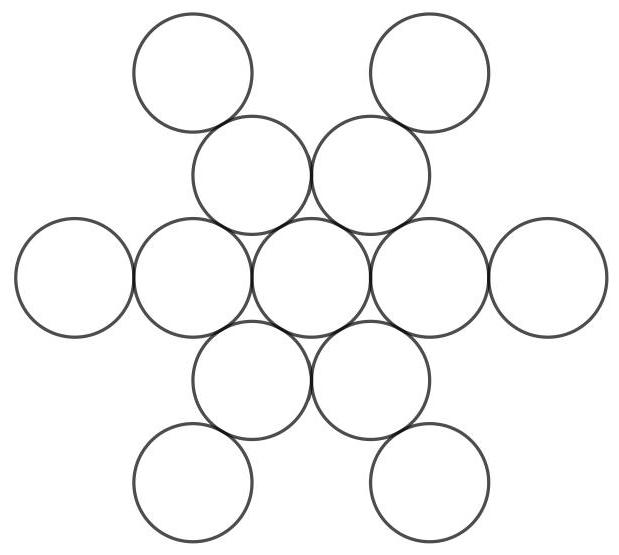
Each of the numbers from $1$ to $13$ is written in one of the circles of the snowflake in the figure below, so that the sums of the $5$ numbers on each line and the sum of the $7$ numbers in the centre of the figure are all equal. Find this sum, given that it is the smallest possible among those satisfying these conditions.
Initially, the number $1$ and two positive numbers $x$ and $y$ are written on a blackboard. In each move, a player may choose two numbers on the board, not necessarily distinct, and write their sum or their difference on the board. We may also choose a nonzero number on the board and write its reciprocal. After a finite number of moves, describe how we can obtain the following numbers:
A rectangular box (cuboid) is to be built by stacking small cubes with edge $1~\mathrm{cm}$; its length consists of $n$ small cubes, its width of $p$ small cubes and its height of $q$ small cubes.
a) What is the volume of the box?
b) If the faces of the box are painted red, how many small cubes will have exactly one of their faces painted red?
c) Take a box as in the statement with $n=p=q$. If we increase each of its dimensions by $a$, where $a$ is a natural number, the new cube has 98 small cubes more than the initial cube. What are the values of $n$ and $a$?
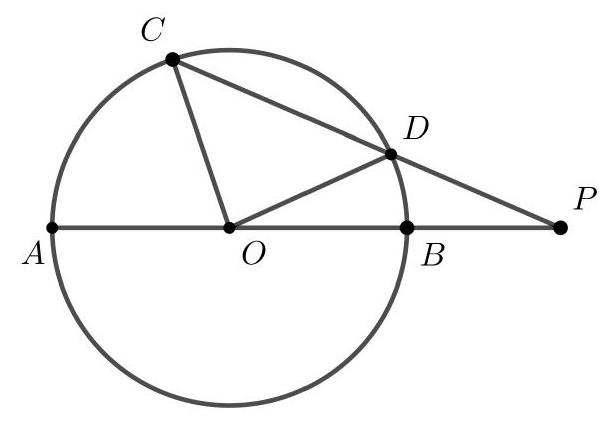
The segment $AB$ of length $16~\mathrm{cm}$ is a diameter of a circle with centre $O$. A secant line cuts the circle at $C$ and $D$ and the line $AB$ at $P$, as shown in the figure below. If $OD = DP$ and $\angle APC = 18^\circ$, what is the measure of the angle $\angle AOC$?
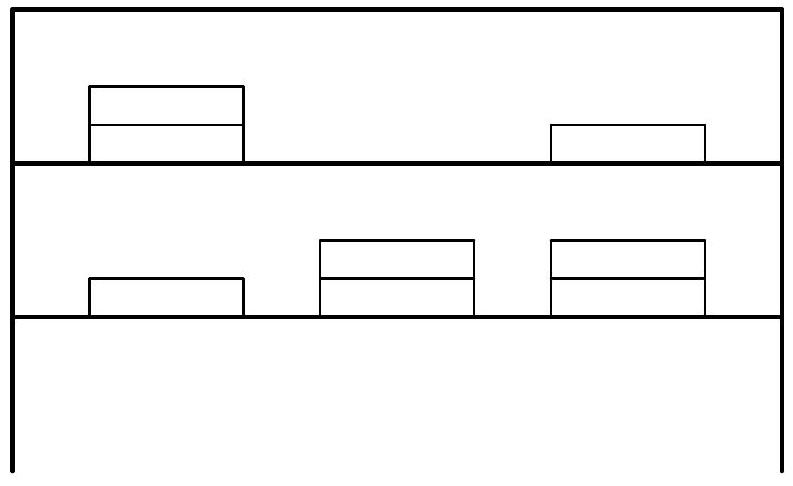
The figure below represents a bookcase with two shelves holding five piles of books, three of them with two books and two of them with only one book. Alice and Luiz invented a game in which each of them, alternately, removes one or two books from one of the piles of books. Whoever takes the last book wins. Alice starts the challenge. Which of them has a winning strategy, whatever the opponent's moves?
A more efficient lawn mower is being developed. For this, at a vertex of a square of grass with side $m$, one end of a metal rod of length $p$ is fixed, and at the other end of the rod an equilateral triangle with side $l$ is attached by one of its vertices, where $p+l\lt m$. The triangle spins very fast around its joint with the rod, and the rod rotates very slowly around its joint at the vertex of the square; that is, all the grass under the triangle is cut, forming part of a circular annulus. What is the area that is cut?
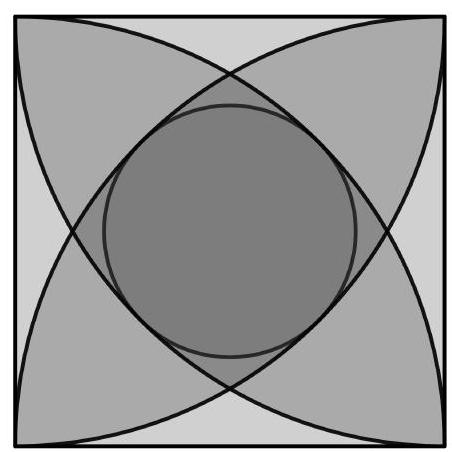
The bottle of a perfume has a cylindrical shape, and a flower-shaped package is to be built to hold it. To make this package, a square sheet of side $n$ will be used, together with four circular arcs centred at the vertices of the square with radius $n$, and a circle tangent to these arcs.
a) What is the radius of the circle?
b) What is the area of the lightest region of the figure?
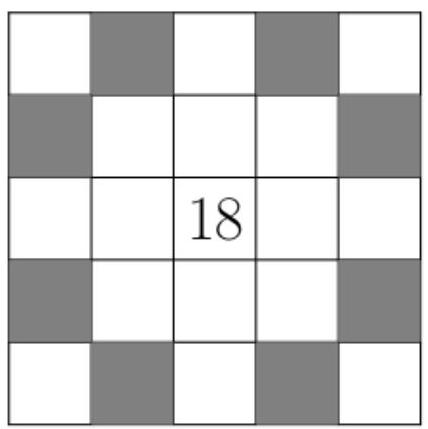
In the magic square below, every integer from $1$ to $25$ can be placed in the small squares so that the sums in every row and column, as well as on the diagonals, are the same. Given that the number in the centre of the square is $18$, what is the sum of the numbers written in the shaded squares?
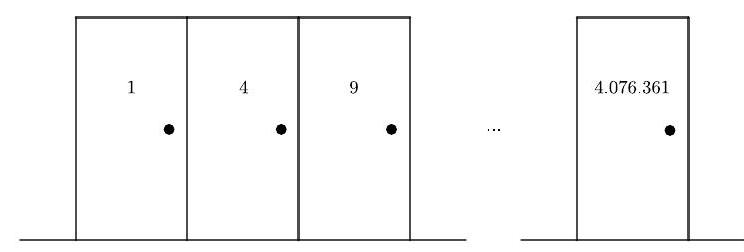
The $2019$ lockers of the $2019$ students of a school are numbered with the squares of the first $2019$ positive integers, that is, the first locker has number $1^{2}=1$, the second locker has number $2^{2}=4$, the third locker has number $3^{2}=9$, and so on up to the last locker, which has number $2019^{2}=4076361$.
a) How many digits were used to paint the first hundred lockers?
b) Adding all the locker numbers, what is the units digit of this result?