Consider all sequences of numbers with distinct terms which follow a geometric progression such that the first, second and fourth terms of the sequence are three consecutive terms of an arithmetic progression. Find the sum of squares of all the possible common ratios of these sequences.
Suppose that a given sequence $\{x_n\}$ satisfies the conditions that $x_1=1$ and, for $n\ge1$, $$x_{n+1}=\frac1{16}\left(1+4x_n+\sqrt{1+24x_n}\right).$$ Determine $\displaystyle\lim_{n\to\infty}3x_n$.
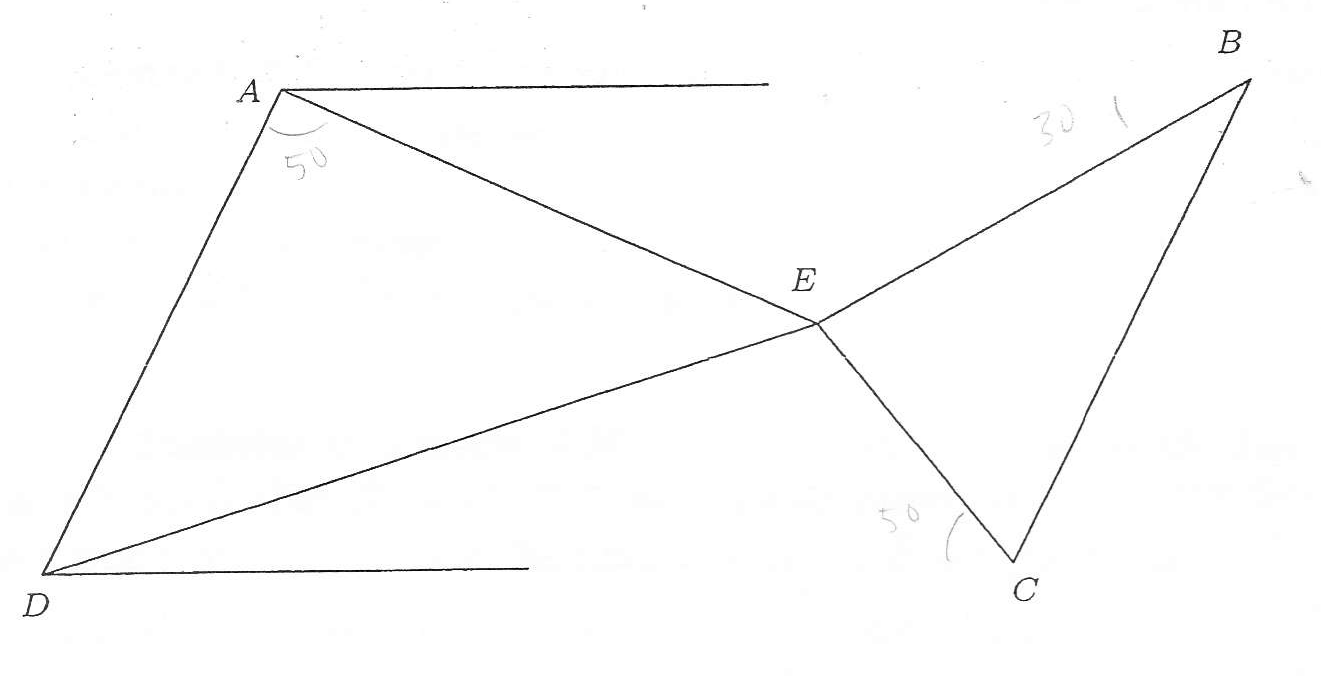
In the figure below, $E$ is a point inside the parallelogram $ABCD$ such that $\angle DAE=\angle DCE=50^\circ$ and $\angle ABE=30^\circ$. Find $\angle ADE$ in degrees.
In this paper, let $\lfloor x\rfloor$ denote the greatest integer not exceeding $x$. For examples, $\lfloor5\rfloor=5$, $\lfloor2.8\rfloor=2$, and $\lfloor-2.3\rfloor=-3$.
It is given that $S=\dfrac1{1\times2}+\dfrac1{2\times3}+\dfrac1{3\times4}+\cdots+\dfrac1{2014\times2015}$. Find the value of $\lfloor4030\times S\rfloor$.
Let $ABCD$ be a trapezium with $AB$ parallel to $DC$, and that $AB=20$ cm, $CD=30$ cm, $BD=40$ cm and $AC=30$ cm. Let $E$ be the intersection of $AC$ and $BD$. Find the area of triangle $DEC$ in cm$^2$.
In this paper, let $\lfloor x\rfloor$ denote the greatest integer not exceeding $x$. For examples, $\lfloor5\rfloor=5$, $\lfloor2.8\rfloor=2$, and $\lfloor-2.3\rfloor=-3$.
How many distinct integers are there in the following sequence: $$\left\lfloor\frac{1^2}{2015}\right\rfloor,\left\lfloor\frac{2^2}{2015}\right\rfloor,\left\lfloor\frac{3^2}{2015}\right\rfloor,\ldots,\left\lfloor\frac{2015^2}{2015}\right\rfloor?$$
In this paper, let $\lfloor x\rfloor$ denote the greatest integer not exceeding $x$. For examples, $\lfloor5\rfloor=5$, $\lfloor2.8\rfloor=2$, and $\lfloor-2.3\rfloor=-3$.
Let $S$ be the sum of all the positive solutions of the equation $$\sqrt{\frac{4-x^2}{3}}+\sqrt{\frac{x^2-1}{3}}=1.$$ Find $\lfloor S\rfloor$.
Let $a_n$ be the $n$th term of a geometric progression, where $a_1=1$ and $a_3=3$. Find $$\left(\sum_{i=0}^{10}\binom{10}{i}a_{i+1}\right)\cdot\left(\sum_{j=0}^{10}(-1)^j\binom{10}{j}a_{j+1}\right).$$
Fifty numbers from the set $\{1,2,\ldots,100\}$ are chosen and another fifty numbers from the set $\{101,102,\ldots,200\}$ are chosen. It is known that no two chosen numbers differ by 0 or 100. Determine the sum of all the 100 chosen numbers.
In this paper, let $\lfloor x\rfloor$ denote the greatest integer not exceeding $x$. For examples, $\lfloor5\rfloor=5$, $\lfloor2.8\rfloor=2$, and $\lfloor-2.3\rfloor=-3$.
Let $H=(x^3-x^2+x)^9$, where $x=\dfrac2{\sqrt5-1}$. Determine $\lfloor H\rfloor$.
In this paper, let $\lfloor x\rfloor$ denote the greatest integer not exceeding $x$. For examples, $\lfloor5\rfloor=5$, $\lfloor2.8\rfloor=2$, and $\lfloor-2.3\rfloor=-3$.
Assume that $x\ge y\ge z\ge\dfrac\pi{12}$ and $x+y+z=\dfrac\pi2$. Let $M$ and $m$ be the largest possible value and the smallest possible value of $\cos x\sin y\cos z$ respectively. Determine the value of $\left\lfloor\dfrac Mm\right\rfloor$.
Let $f:\mathbb R\to\mathbb R$ be a function such that, for any $x,y\in\mathbb R$, $$(x-y)f(x+y)-(x+y)f(x-y)=(6x^2y+2y^3)(x^2-y^2).$$ Suppose $f(1)=-999$. Determine the value of $f(10)$.
Let $b,c,d$ and $e$ be real numbers such that the following equation $$x^5-20x^4+bx^3+cx^2+dx+e=0$$ has real roots only. Find the largest possible value of $b$.
Let $x_1,x_2,x_3,x_4$ and $x_5$ be positive integers such that $$x_1+x_2+x_3+x_4+x_5=x_1\cdot x_2\cdot x_3\cdot x_4\cdot x_5.$$ Find the largest possible value of $x_5$.
Ah Meng is going to pick up 2015 peanuts on the ground in several steps according to the following rules. In the first step, he picks up 1 peanut. For each next step, he picks up either the same number of peanuts or twice the number of peanuts of the previous step. What is the minimum number of steps that he can complete the task?