In the table below each of the three rows is a correct calculation (the symbol $\div$ denotes division). Also each of the three columns (read from top to bottom) is a correct calculation. However, the digits in the table have been replaced by letters. Different letters represent different digits and no digits are $0$.
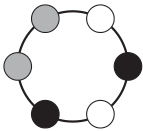
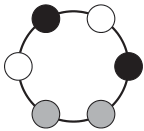
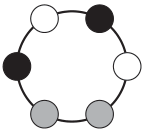
Lieneke is making bracelets with beads. Each bracelet has six beads: two white, two grey, and two black beads. Some bracelets look different on first sight, but are actually not different: by turning or flipping the first one over, it looks the same as the other one. For example, the following three bracelets are the same.
How many really different bracelets can Lieneke make?
A) 10
B) 11
C) 12
D) 14
E) 15
Find all lists $\left(x_{1}, x_{2}, \ldots, x_{2020}\right)$ of non-negative real numbers such that the following three conditions are all satisfied:
(i) $x_{1} \leq x_{2} \leq \ldots \leq x_{2020}$;
(ii) $x_{2020} \leq x_{1}+1$;
(iii) there is a permutation $\left(y_{1}, y_{2}, \ldots, y_{2020}\right)$ of $\left(x_{1}, x_{2}, \ldots, x_{2020}\right)$ such that
$$
\sum_{i=1}^{2020}\left(\left(x_{i}+1\right)\left(y_{i}+1\right)\right)^{2}=8 \sum_{i=1}^{2020} x_{i}^{3}
$$
A permutation of a list is a list of the same length, with the same entries, but the entries are allowed to be in any order. For example, $(2,1,2)$ is a permutation of $(1,2,2)$, and they are both permutations of $(2,2,1)$. Note that any list is a permutation of itself.
Let $A B C D E F$ be a convex hexagon such that $\angle A=\angle C=\angle E$ and $\angle B=\angle D=\angle F$ and the (interior) angle bisectors of $\angle A, \angle C$, and $\angle E$ are concurrent.
Prove that the (interior) angle bisectors of $\angle B, \angle D$, and $\angle F$ must also be concurrent.
Note that $\angle A=\angle F A B$. The other interior angles of the hexagon are similarly described.
A permutation of the integers $1,2, \ldots, m$ is called fresh if there exists no positive integer $k \lt m$ such that the first $k$ numbers in the permutation are $1,2, \ldots, k$ in some order. Let $f_{m}$ be the number of fresh permutations of the integers $1,2, \ldots, m$.
Prove that $f_{n} \geq n \cdot f_{n-1}$ for all $n \geq 3$.
For example, if $m=4$, then the permutation $(3,1,4,2)$ is fresh, whereas the permutation $(2,3,1,4)$ is not.
Consider the triangle $ABC$ with $\angle BCA \gt 90^{\circ}$. The circumcircle $\Gamma$ of $ABC$ has radius $R$. There is a point $P$ in the interior of the line segment $AB$ such that $PB = PC$ and the length of $PA$ is $R$. The perpendicular bisector of $PB$ intersects $\Gamma$ at the points $D$ and $E$.
Let $m \gt 1$ be an integer. A sequence $a_{1}, a_{2}, a_{3}, \ldots$ is defined by $a_{1} = a_{2} = 1$, $a_{3} = 4$, and for all $n \geq 4$,
$$
a_{n} = m\left(a_{n-1} + a_{n-2}\right) - a_{n-3}.
$$
Determine all integers $m$ such that every term of the sequence is a square.
There are the same number of boys and girls in a class. It is known that $60\%$ of pupils do sports and $\frac{5}{9}$ of pupils doing sports are boys. It is also known that $\frac{1}{3}$ of pupils doing sports go to math club and $\frac{2}{15}$ of girls neither do sports nor go to math club. On the other hand, $\frac{2}{15}$ of boys both do sports and go to math club. What percentage of girls go to math club?
Does there exist an integer $n \ge 3$ such that some 3 diagonals of a regular $n$-gon meet in one point that is neither a vertex nor the center of the $n$-gon? If yes then find the least such $n$.
Prove or disprove: For every integer $n \gt 0$, there is a polynomial $a_n x^n + a_{n-1} x^{n-1} + \dots + a_1 x + a_0$ satisfying the following conditions:
(1) All coefficients $a_n, a_{n-1}, \dots, a_1, a_0$ are positive real numbers;
(2) At least one of the coefficients is $\frac{1}{n}$;
(3) The value of the polynomial is integer for every integer $x$.
Find all positive integers $n$ such that one can choose $n-3$ non-intersecting diagonals of a regular $n$-gon that divide the $n$-gon into triangles in such a way that every chosen diagonal is a side of minimal length in some triangle.
Four boxes with masks and means of disinfection are transported to participants of a carnival. Weighing the boxes pairwise results in six quantities, four largest of which are $125$ kg, $120$ kg, $110$ kg and $101$ kg. Find all possibilities of what can be the weights of the four boxes.
Let $p_1, p_2, p_3, \dots$ be all prime numbers in increasing order. Prove that $p_2 + p_4 + \dots + p_{2n} \gt 3n^2 - 2n + 1$ for every positive integer $n$.
The polynomial $x^3 + px + q$, where $p$ and $q$ are real numbers and at least one of them is non-zero, has a real root $a$ that satisfies
$$
a^2 \le -\frac{4}{3}p.
$$
Prove that this polynomial has a real root different from $a$.
A quadrilateral $ABCD$ has incenter $I$. Diagonals $AC$ and $BD$ intersect at point $P$. Given that $I$ lies inside the triangle $PAB$ (not on its side), prove that the area of the triangle $PAB$ is greater than the area of any of triangles $PBC$, $PCD$ and $PDA$.
Some knights are on a playground. Each knight has three properties: speed, smartness and sightliness. For every knight, each property takes a certain integral value $x$ such that $1 \le x \le n$. A knight $A$ can win a knight $B$ if the speed, smartness and sightliness of $A$ are all greater than those of $B$. It is known that none among the knights on the playground can win any of the other knights and every two knights differ by at least one property. Find the largest possible number of knights on the playground.
Find all functions $f: \mathbb{R} \to \mathbb{R}$ such that, for every real number $a$, the function $g(x) = f(x + a)$ is either an even or odd function.