Let $ABC$ be a triangle inscribed in a circle $(O)$. A diameter $KL$ passes through the midpoint $M$ of $AB$, with $L$ and $C$ on opposite sides of $AB$. A circle through $M$ and $K$ intersects $LC$ at $P$ and $Q$, where $P$ lies between $Q$ and $C$. The line $KQ$ meets the circle $(LMQ)$ again at $R$. Prove that $ARBP$ is cyclic and that $AB$ is the $A$-symmedian of triangle $APR$.
Let $ABC$ be a triangle with circumcenter $O$, incenter $I$, and $A$-excenter $J$. Let $D$ be the point where $l_a(I)$ touches $BC$. The bisector of $\angle A$ meets $BC$ and $(O)$ at $E$ and $F$, respectively. The circle $(DEF)$ meets $(O)$ again at $T$. Prove that $AT$ passes through an intersection of $(J)$ and $(DEF)$.
Editorial clarification: the source writes the undefined notation $l_a(I)$. It is read here as the incircle $(I)$, since $I$ is the incenter and $D$ is its contact point with $BC$; $(J)$ denotes the $A$-excircle.
Let $ABCD$ be a quadrilateral with $\angle A=\angle B=90^\circ$ and $AB=AD$. Let $E$ be the midpoint of $AD$. Suppose that $CD=BC+AD$ and $AD\gt BC$. Prove that $\angle ADC=2\angle ABE$.
Let $ABC$ be a triangle inscribed in a fixed circle $(O)$, with $BC$ fixed and $A$ varying on $(O)$. Let $H$ be the orthocenter of $ABC$. Choose $D$ on $AB$ and $E$ on $AC$ so that $H$ is the midpoint of $DE$. Prove that, as $A$ moves on $(O)$, the center of $(ADE)$ lies on a fixed circle.
Let $ABC$ be an acute, non-isosceles triangle with circumcenter $O$ and incenter $I$. The incircle $(I)$ touches $BC$, $CA$, and $AB$ at $D$, $E$, and $F$, respectively. Suppose that $EF$ meets $(O)$ at $P$ and $Q$. Prove that the circle $(PQD)$ passes through the midpoint of $BC$.
Let $ABC$ be an acute, non-isosceles triangle with circumcenter $O$. The tangents to $(O)$ at $B$ and $C$ meet at $T$. A line through $T$ meets segment $AB$ at $D$ and ray $CA$ at $E$. Let $M$ be the midpoint of $DE$, and suppose that $MA$ meets $(O)$ again at $K$. Prove that $(MKT)$ is tangent to $(O)$.
Find all positive integer $n \ge 3$ such that it is possible to mark the vertices of a regular $n$-gon with the numbers from $1$ to $n$ so that for any three vertices $A$, $B$ and $C$ with $AB = AC$, the number in $A$ is greater or smaller than both numbers in $B$, $C$.
Prove that it is impossible to fill the cells of an $8 \times 8$ table with the numbers from $1$ to $64$ (each number must be used once) so that for each $2 \times 2$ square, the difference between products of the numbers on its diagonals will be equal to $1$.
For a positive integer $k$, denote by $f(k)$ the number of positive integers $m$ such that the remainder of $k m$ modulo $2019^3$ is greater than $m$. Find the amount of different numbers among $f(1), f(2), \ldots, f(2019^3)$.
Let $n$ be a positive integer. What is the smallest value of $m$ with $m \gt n$ such that the set $M = \{n, n+1, ..., m\}$ can be partitioned into subsets so that in each subset, there is a number which equals to the sum of all other numbers of this subset?
Let $N$ be a positive integer. Consider the sequence $a_1, a_2, ..., a_N$ of positive integers, none of which is a multiple of $2^{N+1}$. For $n \ge N+1$, the number $a_n$ is defined as follows: choose $k$ to be the number among $1, 2, ..., n-1$ for which the remainder obtained when $a_k$ is divided by $2^n$ is the smallest, and define $a_n = 2a_k$ (if there are more than one such $k$, choose the largest such $k$). Prove that there exist $M$ for which $a_n = a_M$ holds for every $n \ge M$.
Call a positive integer $x$ to be remote from squares and cubes if each integer $k$ satisfies both $|x - k^2| \gt 10^6$ and $|x - k^3| \gt 10^6$. Prove that there exist infinitely many positive integers $n$ such that $2^n$ is remote from squares and cubes.
Let coefficients of the polynomial $P(x) = a_d x^d + \ldots + a_2 x^2 + a_0$ where $d \ge 2$, are positive integers. The sequence $(b_n)$ is defined by $b_1 = a_0$ and $b_{n+1} = P(b_n)$ for $n \ge 1$. Prove that for any $n \ge 2$, there exists a prime number $p$ such that $p \mid b_n$ but it does not divide $b_1, b_2, \ldots, b_{n-1}$.
A finite set $S$ of positive integers has the property that, for each $s \in S$, and each positive integer divisor $d$ of $s$, there exists a unique element $t \in S$ satisfying $\gcd(s, t) = d$. (The elements $s$ and $t$ could be equal.)
Given this information, find all possible values for the number of elements of $S$.
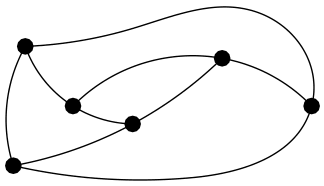
The Planar National Park is a subset of the Euclidean plane consisting of several trails which meet at junctions. Every trail has its two endpoints at two different junctions, whereas each junction is the endpoint of exactly three trails. Trails only intersect at junctions (in particular, trails only meet at endpoints). Finally, no trails begin and end at the same two junctions. (An example of one possible layout of the park is shown to the left below, in which there are six junctions and nine trails.)
A visitor walks through the park as follows: she begins at a junction and starts walking along a trail. At the end of that first trail, she enters a junction and turns left. On the next junction she turns right, and so on, alternating left and right turns at each junction. She does this until she gets back to the junction where she started. What is the largest possible number of times she could have entered any junction during her walk, over all possible layouts of the park?
Let $n \ge 2$ be an integer. An $n \times n$ board is initially empty. Each minute, you may perform one of three moves:
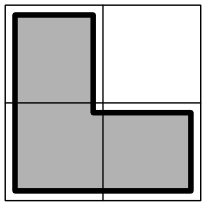
* If there is an L-shaped tromino region of three cells without stones on the board (see figure; rotations not allowed), you may place a stone in each of those cells.
* If all cells in a column have a stone, you may remove all stones from that column.
* If all cells in a row have a stone, you may remove all stones from that row.
For which $n$ is it possible that, after some non-zero number of moves, the board has no stones?
A finite set $S$ of positive integers has the property that, for each $s \in S$, and each positive integer divisor $d$ of $s$, there exists a unique element $t \in S$ satisfying $\gcd(s, t) = d$. (The elements $s$ and $t$ could be equal.)
Given this information, find all possible values for the number of elements of $S$.
Given $n \geq 2$ distinct positive integers $a_1, a_2, \ldots, a_n$ none of which is a perfect cube. Find the maximal possible number of perfect cubes among their pairwise products.