There are 44 distinct holes along a straight groove and 2017 ants. Each ant emerges from one hole, crawls at constant velocity to a different hole, and disappears into it. Let $T$ be the set of all emergence and disappearance times. The ants' velocities are pairwise different, and $|T|\le45$. Prove that at least two ants never meet. Two ants meet if, at some instant, both occupy the same position in the groove, including their emergence and disappearance instants.
For each positive integer $n$, let $x_n=\binom{2n}{n}$.
(a) Prove that if $2017^k/2\lt n\lt 2017^k$ for some positive integer $k$, then $2017\mid x_n$.
(b) Find every integer $h>1$ for which there exist positive integers $N,T$ such that $x_{n+T}\equiv x_n\pmod h$ for all $n>N$.
Triangle $ABC$ has incircle $(I)$ tangent to $BC,CA,AB$ at $D,E,F$, respectively. Let $I_b,I_c$ be its $B$- and $C$-excenters. Let $P,Q$ be the midpoints of $I_bE,I_cF$. The circles $(PAC),(QAB)$ meet $AB,AC$ again at $R,S$, respectively.
(a) Prove that $PR,QS,AI$ are concurrent.
(b) Put $K=DE\cap I_bI_c$, $J=DF\cap I_bI_c$, and $M=EJ\cap FK$. The lines $PE,QF$ meet $(PAC),(QAB)$ again at $X,Y$, respectively. Prove that $BY,CX,AM$ are concurrent.
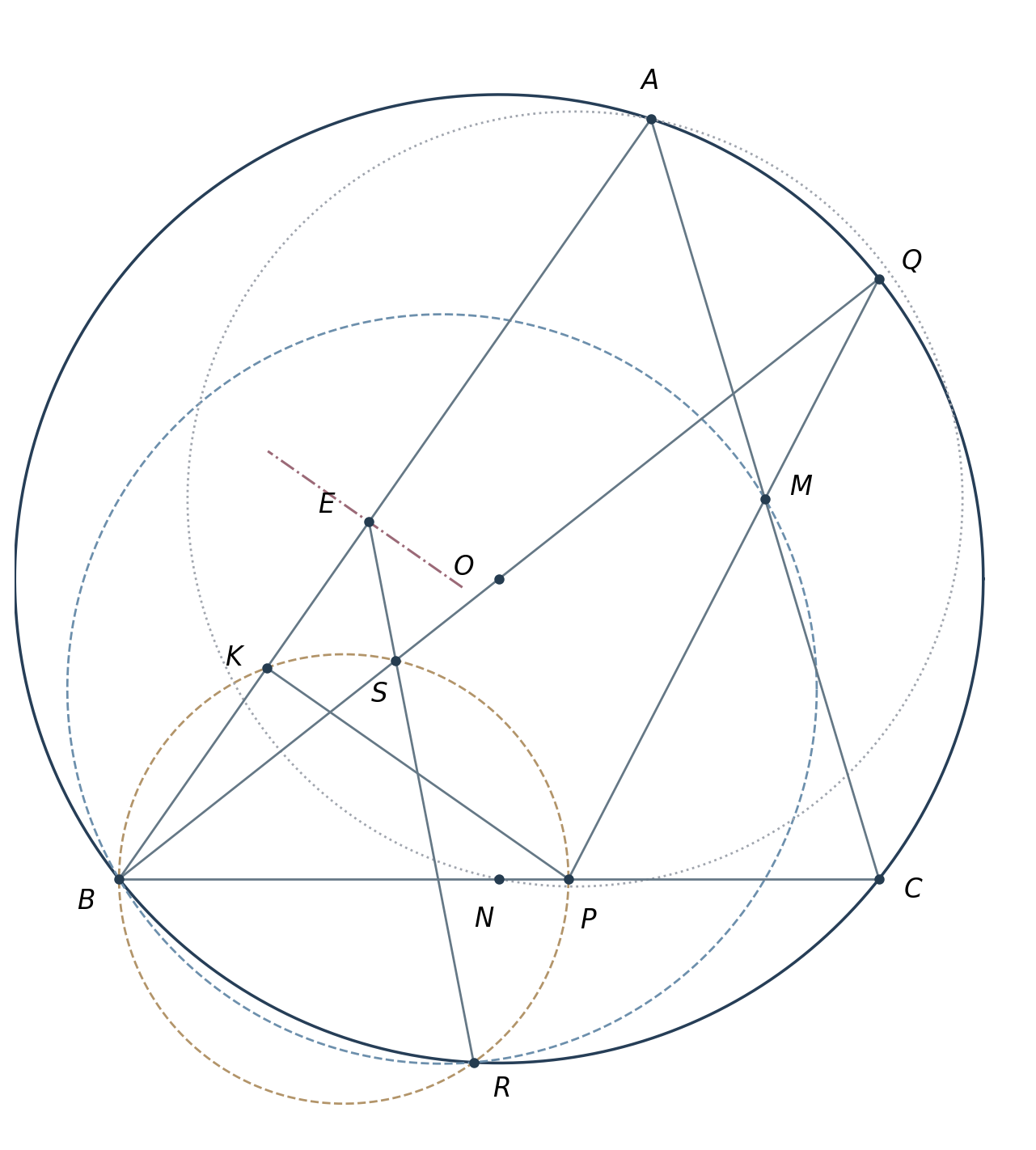
Triangle $ABC$ is inscribed in a fixed circle $(O)$, with $B,C$ fixed and $A$ moving on $(O)$ so that $AB>BC$. Let $M$ be the midpoint of $AC$. The circle with diameter $BM$ meets $(O)$ again at $R$. The line $RM$ meets $(O)$ again at $Q$ and meets $BC$ at $P$. The circle with diameter $BP$ meets $AB$ and $BO$ again at $K$ and $S$, respectively.
(a) Prove that $SR$ passes through the midpoint of $KP$.
(b) Let $N$ be the midpoint of $BC$. The radical axis of the circles with diameters $AN$ and $BM$ meets $SR$ at $E$. Prove that $ME$ always passes through a fixed point.
Given 2017 positive real numbers $a_1,a_2,\ldots,a_{2017}$, define, for every $n>2017$,
$$a_n=\max\{a_{i_1}a_{i_2}a_{i_3}:i_1+i_2+i_3=n,\ 1\le i_1\le i_2\le i_3\le n-1\}.$$
Prove that there exist positive integers $m\le2017$ and $N>4m$ such that $a_na_{n-4m}=a_{n-2m}^2$ for all $n>N$.
For each positive integer $n$, consider a permutation $a_1,a_2,\ldots,a_{2n}$ of the first $2n$ positive integers. Call it beautiful if opposite entries satisfy $a_i+a_{n+i}=2n+1$ for $1\le i\le n$, and the $2n$ differences $a_i-a_{i+1}$ are pairwise incongruent modulo $2n+1$, with $a_{2n+1}=a_1$.
(a) Give a beautiful permutation for $n=6$.
(b) Prove that a beautiful permutation exists for every positive integer $n$.
Let $a$ be real and define
$$u_1=a,\qquad u_{n+1}=\frac12+\sqrt{\frac{2n+3}{n+1}u_n+\frac14}\quad(n\ge1).$$
a) For $a=5$, prove that the sequence has a finite limit and find it.
b) Find all $a$ for which the sequence is defined over the reals and has a finite limit.
Let $ABC$ be an acute scalene triangle inscribed in $(O)$, with orthocenter $H$. Let $E,F$ be the feet of the altitudes from $B,C$, respectively, and let $AH$ meet $(O)$ again at $D\ne A$.
a) Let $I$ be the midpoint of $AH$, and set $M=EI\cap BD$, $N=FI\cap CD$. Prove $MN\perp OH$.
b) Lines $DE,DF$ meet $(O)$ again at $P,Q\ne D$, respectively. The circumcircle of $AEF$ meets $(O)$ and $AO$ again at $R,S\ne A$, respectively. Prove that $BP,CQ,RS$ are concurrent.
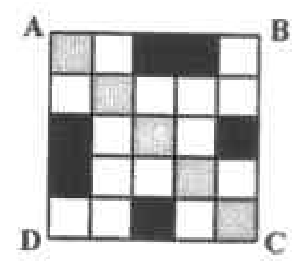
Let $n\gt 1$ be an integer. An $n\times n$ board $ABCD$ consists of unit squares colored black, white or gray. A coloring is symmetric if the squares whose centers lie on diagonal $AC$ are gray, and each pair reflected across $AC$ is either both black or both white. Put 0 in each gray square, a positive integer in each white square and a negative integer in each black square. For a positive integer $k$, a filling is called k-balanced if:
i) Each reflected pair has the same integer, belonging to $[-k,k]$.
ii) If a row and column intersect in a black square, their sets of positive entries are disjoint; if they intersect in a white square, their sets of negative entries are disjoint.
a) For $n=5$, find the least $k$ permitting a k-balanced filling of the pictured coloring.
b) For $n=2017$, find the least $k$ that works for every symmetric coloring.
Prove that
a) $\displaystyle\sum_{k=1}^{1008}k\binom{2017}{k}\equiv0\pmod{2017^2}$;
b) $\displaystyle\sum_{k=1}^{504}(-1)^k\binom{2017}{k}\equiv3(2^{2016}-1)\pmod{2017^2}$.
Let an acute triangle $ABC$ be inscribed in $(O)$. Let $G$ lie on the arc $BC$ not containing $O$ of the circumcircle $(I)$ of triangle $OBC$. The circumcircle of $ABG$ meets $AC$ again at $E\ne A$; the circumcircle of $ACG$ meets $AB$ again at $F\ne A$.
a) Put $K=BE\cap CF$. Prove that $AK,BC,OG$ are concurrent.
b) Fix a point $D$ on the arc $BOC$ containing $O$ of $(I)$. Put $M=GB\cap CD$ and $N=GC\cap BD$. Suppose $MN$ meets $(O)$ at two points $P,Q$. Prove that, as $G$ varies on the arc $BC$ not containing $O$, the circumcircle of $GPQ$ always passes through two fixed points.